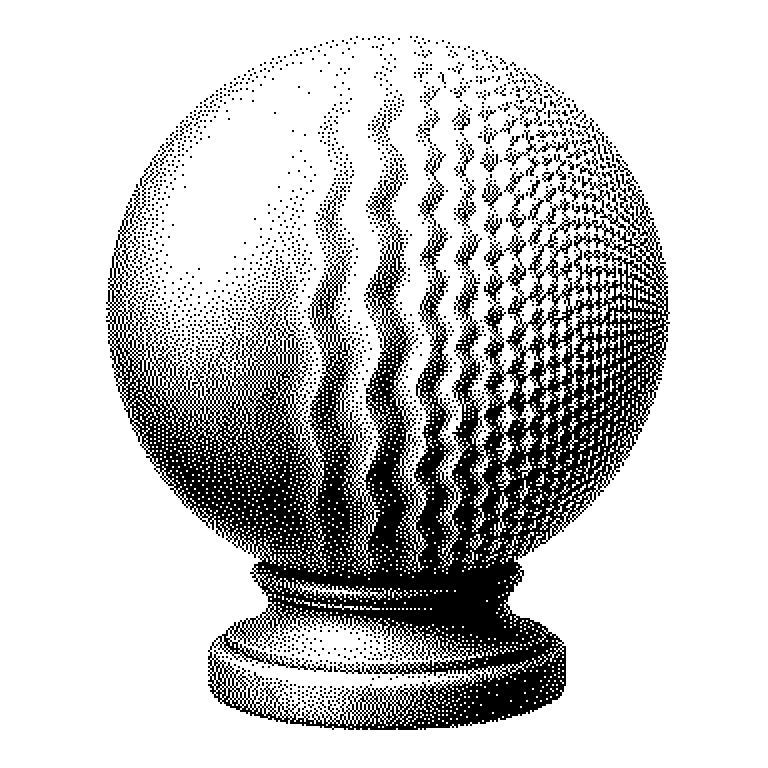
Spatial Frequency
Spatial frequency describes how quickly brightness or color values change from point to point in an image. The higher the spatial frequency, the finer the structures or patterns the image contains.
When looking at an image, you sometimes see coarse areas and sometimes fine details. This distinction can be measured. Spatial frequency indicates how often a pattern — for example, a shift from light to dark — repeats over a given distance. Coarse structures, such as a uniform sky, have low spatial frequency. Fine structures, such as hair or the texture of fabric, have high spatial frequency. The term originally comes from optics and signal processing, but today it plays a central role in image processing through artificial intelligence.
Spatial Frequency as a Key to Image Analysis
Images contain information on very different levels simultaneously. A photo of a city shows both the coarse silhouette of the skyline and the fine grid of a window. Both levels are important — but for different tasks. An AI model that recognizes faces must process coarse proportions just as much as fine edges.
By deliberately separating spatial frequencies, an image can be broken down into its components. This is comparable to hearing bass and melody separately in a piece of music. In image processing, this is called filtering: a low-pass filter lets only low spatial frequencies through and produces a blurred image. A high-pass filter retains only high spatial frequencies — showing only edges and contours.
How Spatial Frequency Operates in Neural Networks
Neural networks for image recognition — so-called Convolutional Neural Networks, or CNNs for short — process spatial frequencies automatically, without being explicitly taught to do so. In early layers of the network, individual units respond strongly to specific patterns: some to slow brightness gradients, others to sharp edges. This corresponds exactly to the distinction between low and high spatial frequencies.
Researchers have found that AI models sometimes rely too heavily on high spatial frequencies — that is, on fine textures — in their decisions, while humans tend to focus more on coarse shapes. As a result, a network can misclassify an image if the fine textures are slightly altered, even though the shape of the object remains unchanged. This phenomenon underlies many so-called adversarial attacks: minimal changes in high spatial frequencies, invisible to the eye, cause an AI model to completely misinterpret an image.
Generative Adversarial Networks — GANs for short, i.e. AI systems that generate new images — also have a characteristic weakness related to spatial frequencies. They often produce images that look real at first glance but, upon closer analysis, show typical artifacts in high spatial frequencies. Software for detecting AI-generated images exploits exactly this.
Spatial Frequency in Products and Current Research
Image compression formats like JPEG work directly with spatial frequencies. JPEG breaks an image into small blocks and stores, for each block, which spatial frequencies are present and to what degree — deliberately discarding high spatial frequencies, because the human eye misses them the least. This is why heavily compressed JPEG images appear blurry or blotchy at edges.
In medical imaging, such as MRI scans, the term is indispensable. Raw data from an MRI machine initially exists in the so-called frequency space and must first be converted before a doctor can view it. AI models that analyze MRI images benefit from using this frequency information directly rather than only looking at the finished image.
Spatial frequency also comes up regularly in discussions about deepfakes. Detectors developed by companies such as Microsoft or Adobe search high spatial frequencies for patterns that distinguish AI-generated faces from real photos. Spatial frequency is thus no longer a purely academic term — it is embedded in every smartphone, every video streaming service, and every tool for detecting fake media.