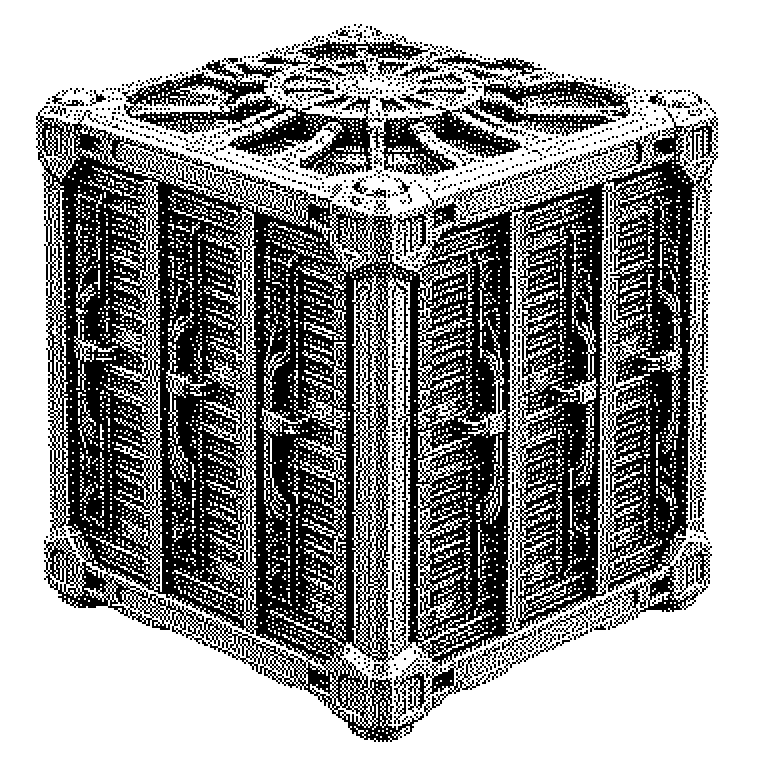
SuperPOD
A SuperPOD is a ready-assembled large-scale system made up of many interconnected specialized computers, sold by chipmaker Nvidia as a complete package. It is used to train very large AI models in weeks instead of years.
A SuperPOD is a very large computer that is made up of many individual computers. These individual computers stand side by side in cabinets and are connected via extremely fast cables. To the outside, they behave largely like a single machine. The whole thing is sold by the company Nvidia as a finished package: computers, cabling, cooling concept, and software are all matched to one another. A buyer therefore does not have to figure out for themselves which parts fit together. Such a system is intended for tasks that a normal computer would take decades to compute.
Why companies buy a complete package instead of building it themselves
Modern AI systems learn from enormous amounts of text. This learning is called training, and it consists of trillions of individual computational steps. A single computer cannot manage this in a reasonable amount of time. That is why the work is distributed across thousands of chips simultaneously. A SuperPOD is the prefabricated form of this distribution.
The actual value lies less in the chips than in the time saved during setup. Designing a self-planned data center of this size often takes over a year. With the ready-made package, network, power supply, and cooling have already been thoroughly tested. For companies in the race for better AI models, months saved are worth a great deal. This is precisely why such systems are in demand despite prices in the tens to hundreds of millions.
Economically, this is one reason for Nvidia’s enormous significance on the stock market. The company no longer sells only individual components, but entire installations. When news reports say that a country or corporation is building up AI infrastructure, it is often about such systems. Power consumption and site-location questions are also directly tied to this.
What’s inside the cabinets
The basic unit is a server with several graphics processors, or GPUs for short. A GPU is a chip that carries out many simple calculations in parallel instead of a few complicated ones in sequence. This is exactly the type of calculation AI needs. Several such servers form a rack, i.e., a cabinet. Many racks together make up the SuperPOD, typically with a few hundred to several thousand GPUs.
The decisive part is the network in between. All chips work on the same model and must constantly exchange their intermediate results. If this connection is too slow, expensive chips sit idle. That is why special connection technologies are used that are significantly faster than a typical office network. One can imagine it like a rowing boat: the rowers are strong, but without an exact rhythm the boat makes no progress.
In addition, there is software that automatically distributes a computing task across all chips. It also ensures that a failure does not ruin everything. With thousands of components, something breaks down regularly — that is normal. The current computation state is therefore saved at intervals. A SuperPOD should not be confused with a classic supercomputer for weather models or physics: the setup is similar, but the SuperPOD is specifically tailored to AI computations.
SuperPODs in headlines and behind chatbots
One practically never sees such a system directly. One encounters it indirectly as soon as one uses an AI chatbot or an image generator. The model behind it was trained on installations of this scale. Automakers, pharmaceutical companies, and research institutes are now also operating their own systems.
In business news, the term appears in reports about investments. Reports about new data centers frequently cite the number of GPUs as a benchmark. A common misconception is that a SuperPOD is the AI itself. It is only the machine on which an AI is created and runs. Equally wrong is the assumption that every chatbot needs such an installation for a single answer: answering is far cheaper than training.