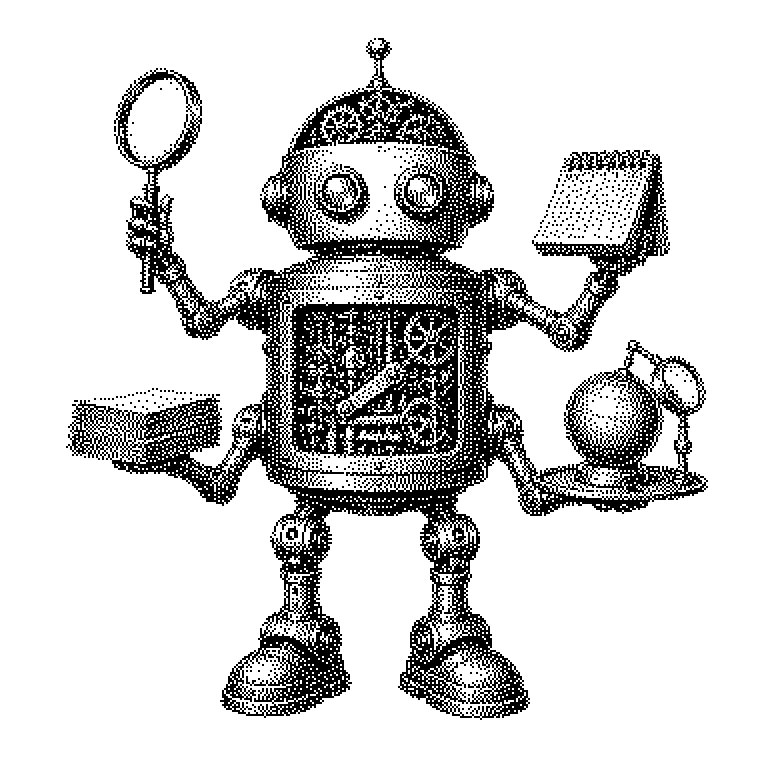
Bot (AI Agent)
A bot is a program that performs a task independently and repeatedly, without a human triggering every step. Modern bots powered by AI in the background are often called AI agents: they plan intermediate steps themselves and, in doing so, use other programs such as search engines or calendars.
A bot is a computer program that performs a task independently and over and over again. The name comes from “robot,” even though a bot usually has no physical body. It simply runs on a computer and does its work there. A human starts it once and defines what it should do. After that, the bot keeps working without constant instructions, often around the clock. Simple bots follow rigid rules, such as: check every minute whether a new message has arrived. Newer bots use artificial intelligence and thereby appear more flexible. For these, the term AI agent has become established.
From script to independent action
Bots do work that would be too monotonous or too extensive for humans. Search engines, for example, could not exist without bots. Their so-called crawlers scour billions of web pages and read out their content. No team in the world could accomplish that by hand.
The leap to the AI agent is economically even more significant. A classic bot can only do what someone has previously described in precise detail. An AI agent, by contrast, is given a goal and finds its own way there. You might tell it: “Find the three cheapest flights to Rome in May.” It then decides on its own which sites to visit and in what order.
That’s precisely why many companies have been calling 2024 onward the “year of the agent.” The hope is that such programs will take over entire workflows, not just individual tasks. At the same time, there is a downside: a substantial share of worldwide internet traffic comes from bots, and some of it is malicious. This includes programs that try out passwords or spread masses of fake posts on social networks.
What happens inside an agent’s loop
A simple bot consists of three parts. A trigger tells it when to start, for example a specific time. Then follows a list of rules that gets worked through. At the end there is an action, for example a message being sent. This is rigid, but very reliable.
An AI agent, by contrast, operates in a loop. At its center is a language model, i.e. an AI system that can understand and write text. It first considers which step makes sense to take next. Then it carries out that step by using a tool. Tools are other programs: a search engine, a calculator, a calendar, or a database. The agent reads the result, evaluates it, and plans the next step. This loop continues until the goal is reached.
You can think of it like a new intern. They receive an assignment, not a step-by-step instruction manual. They try something, look at the result, and correct themselves. But this is exactly where the biggest problem arises. Because the agent chooses its own steps, it can go off track, run in circles, or incur costs. That’s why developers build in limits: a maximum number of steps, or a check-back with a human before anything final happens.
Bots in everyday life and in the headlines
Bots are most commonly encountered in customer service. The small chat window on a shop’s website is almost always such a program. Bots are also widespread in messaging services and in games, where they control opponents or teammates. In sneaker or concert ticket sales, bots buy up entire batches within seconds. That’s why many websites rely on checks designed to distinguish humans from programs.
In business news, the discussion is mostly about AI agents within companies. They are meant to check invoices, presort emails, or test software independently. This also includes programming tools that find and fix a problem on their own. This is relevant for investors, because a new market is emerging here: companies are no longer just selling programs, but completed work.
An important distinction is often blurred. Not every bot is an AI agent, and not every chatbot acts independently. A chatbot only responds, an agent carries out actions. Anyone reading a report that a company is deploying “agents” should therefore check what the program is actually allowed to do. The difference between suggesting and executing determines both benefit and risk.