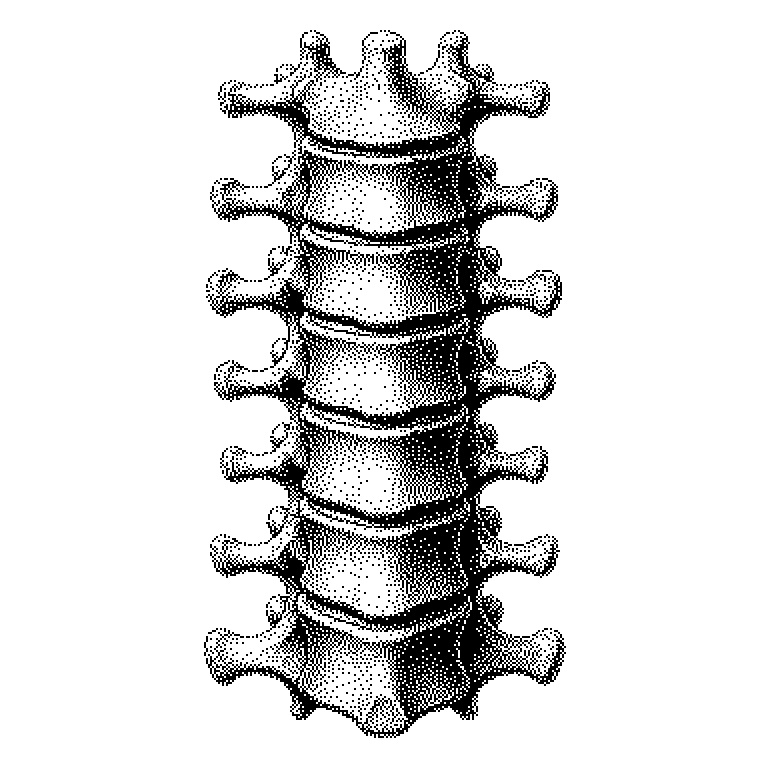
Backbone
A backbone is the central core part of a neural network that transforms raw input data – such as an image or text – into a structured, machine-readable form that other parts of the system can continue working with. Anyone trying to understand how AI models are built internally will almost always encounter this term first.
A neural network – that is, a computing system roughly modeled on the human brain that learns from inputs – usually consists of several parts with different tasks. The backbone is the part that does the main work of processing. It takes in raw data, for example the pixel values of a photo or the words of a sentence, and computes from them a compact, structured representation. This representation is also called a feature representation – it summarizes what the model has recognized in the data. Only after that comes a smaller, specialized part of the network that turns this representation into a concrete answer: a label, a probability, a translated line.
Why the backbone is the heart of a model
The quality of an AI system depends largely on how well its backbone understands the input data. A weak backbone produces a poor representation – and even the smartest downstream part can no longer rescue good results from it. This can be compared to the foundation of a house: everything built on top of it stands or falls with its stability.
That’s why backbones are often pretrained on huge amounts of data before being deployed for a specific task. This step is called pretraining. During it, the model learns general patterns – such as edges and shapes in images or grammatical structures in texts. For a new task, one then only needs to adapt the smaller output part, not the entire backbone. This saves considerable time and computing power.
How a backbone processes data
A backbone consists of many layers connected one after another. Each layer refines the representation a bit further. At the beginning, the network recognizes simple patterns, for example light and dark edges in an image. Further into the network, more abstract concepts emerge, such as 'this looks like an ear' or 'this beginning of a sentence sounds like a question.' At the end of the backbone there is no answer, but a long vector of numbers – a kind of encoded fingerprint of the input.
For images, so-called Convolutional Neural Networks or newer architectures like Vision Transformers are often used as backbones. For text, the Transformer is the dominant model. Here, the backbone and the output part are clearly separate components – one can reuse the same backbone for many different tasks by attaching a different output part each time. A backbone pretrained on images can thus be used both for object detection and for image captioning.
A common misconception is to equate the backbone with the entire model. That is not correct. The backbone is deliberately kept task-neutral. It doesn’t yet 'know' whether it’s about to name an object or classify an image. That decision is only made in the downstream part, the so-called head.
Backbone in products and tech news
Anyone reading tech news usually encounters the term when new AI models are introduced. When a company announces that it has developed a new backbone, this generally means: the core part has been improved or replaced, while the task remains the same. Meta's image recognition system and Google's language models, for example, are regularly equipped with new backbones without the entire system needing to be rebuilt.
The concept is also found in everyday products, even if it isn’t called that there. Face recognition used to unlock a smartphone uses a backbone that translates facial contours into numerical values. Automatic captioning in video conferences is based on a speech backbone that first converts spoken syllables into an abstract representation before text is generated from it. The word backbone rarely appears in these contexts – but the concept behind it always does.
In research, the backbone is often the most expensive and difficult part of a project. A powerful, publicly available backbone – such as BERT for text or ResNet for images – can be used by other research teams as a starting point. This approach, called transfer learning, has massively accelerated AI development in recent years, because no one has to start from scratch anymore.