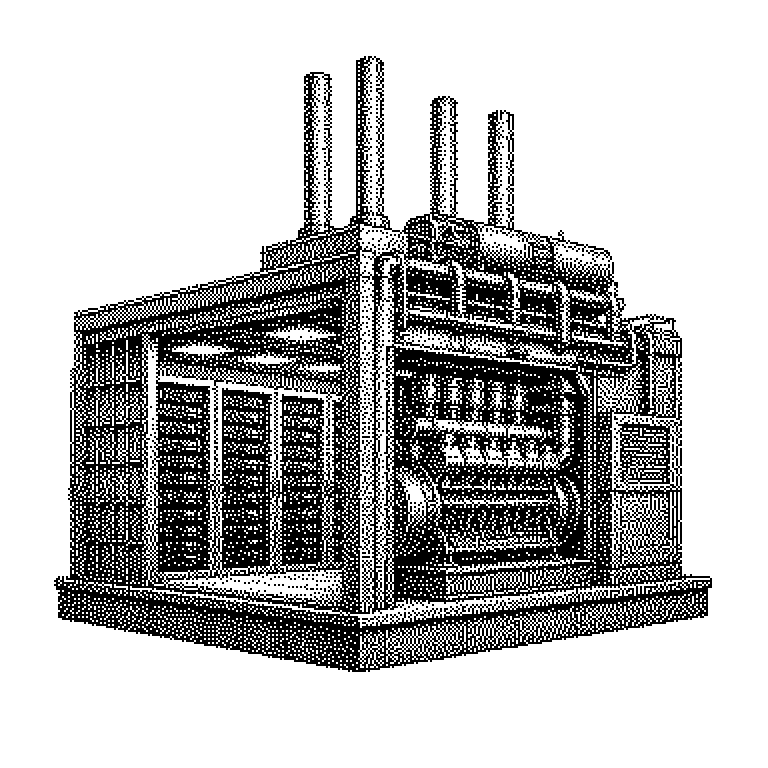
Behind-the-Meter
Behind-the-Meter refers to power generation located directly at the consumer's site, with electricity that does not pass through the public grid's meter. Data centers use this principle to place power plants directly next to their server halls, bypassing the long detour through the electrical grid.
Every house and every factory has an electricity meter. It measures how much power is drawn from the public grid, and the bill is based on that. Behind-the-meter literally means “behind the meter”. What is meant is a private power source located on the consumer’s own premises that supplies it directly. This electricity never passes the meter, because it never comes from the grid in the first place. The best-known small example is a solar array on your own roof. The biggest current example is gas or nuclear power plants connected directly to a data center.
Why data centers no longer want to wait for the grid
Data centers for artificial intelligence need enormous amounts of electricity. A single large site can consume as much as a small city. The public power grid is not built for such jumps. Anyone applying for a new grid connection of this scale in the US often waits five years or longer.
This waiting time is the real problem for operators. The expensive graphics chips used for AI training become obsolete within a few years. Letting them sit unused for years costs billions. A dedicated power plant right at the site significantly shortens the time until operations can start.
Then there’s the price. Anyone drawing electricity from the grid pays not only for generation but also grid fees and levies. These surcharges often make up half the bill. Behind-the-meter avoids them entirely or in part. This is exactly what sparks political criticism, however.
The path of electricity bypassing the meter
Technically, the matter is simple. Between power plant and consumer lies a direct line, often just a few hundred meters long. There is no high-voltage line, no substations over long distances, and no measuring point from the grid operator in between. A grid connection often still exists, but only serves as a backup.
Many things can serve as a power source. Small gas turbines can be set up quickly and run around the clock. Solar farms with battery storage are cleaner but don’t deliver power consistently. Sites next to existing nuclear power plants are particularly sought after, because power is available there without interruption.
A common misconception is that behind-the-meter is the same as a green power contract. That is not true. With such a contract, the electricity still flows through the public grid; it is only allocated on paper. Behind-the-meter, by contrast, is a physical connection. The technical term for the tight variant is co-location: generator and consumer are located on the same site.
Where the term shows up in the news
The approach became best known through Amazon. In 2024, the company bought a data center next to the Susquehanna nuclear power plant in Pennsylvania. Microsoft, Google, and Meta are also negotiating direct connections to power plants. Such announcements regularly move the stock prices of energy providers.
At the same time, regulators are scrutinizing these contracts critically. The accusation is: if large consumers don’t pay grid fees, ordinary households bear the cost of the grid alone. In the US, the responsible federal agency has already halted one such contract. Similar debates are underway in Europe, where grid fees are also rising sharply.
On a small scale, the principle is encountered every day. A photovoltaic system with home battery storage is nothing other than behind-the-meter in the private household. The self-generated electricity flows directly into the refrigerator, without passing through the meter. The difference from data centers lies only in scale, not in principle.