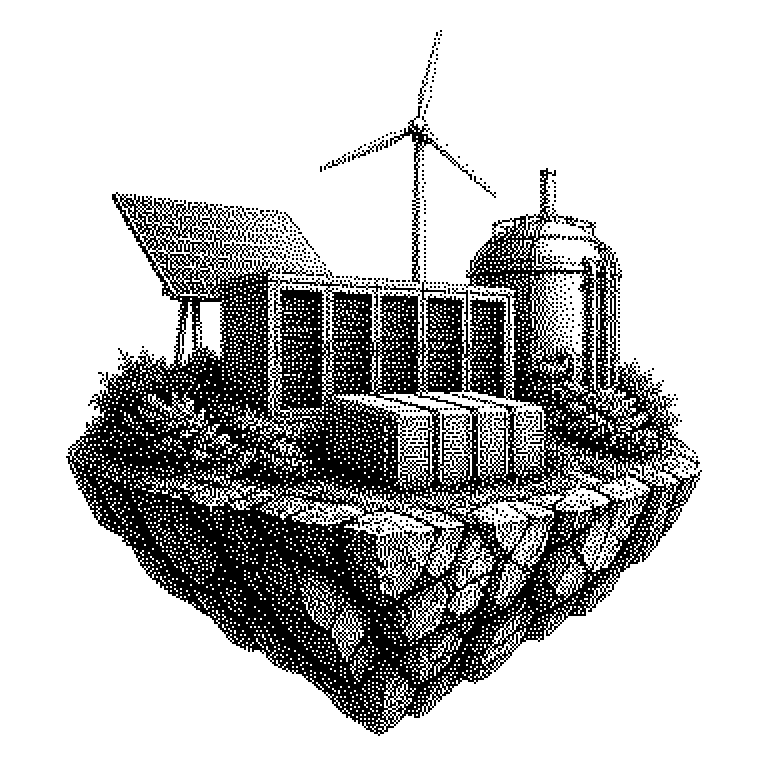
Off-Grid
Off-grid refers to operation without a connection to the public power grid: electricity is generated and stored on-site. In the tech industry, the term has become important because large data centers are increasingly building their own power plants instead of waiting for grid connections.
Almost every building is connected to a large power line network, through which electricity flows from power plants to consumers. Anyone who operates off-grid does without this connection. The electricity is then generated directly on-site, for example with solar panels, a wind turbine, or a generator that burns gas or diesel. Because sun and wind are not always available, batteries are almost always part of the setup. The term originates from the energy world, but it appears increasingly often in news about technology companies. The counterpart is called on-grid: connected to the public grid.
Why data centers are suddenly building their own power plants
Large data centers for artificial intelligence need enormous amounts of electricity. A single site can consume as much as a small city. The public grid cannot deliver such quantities everywhere immediately. In many regions of the US and Europe there are waiting lists for new grid connections. Anyone applying for a connection there sometimes waits five to seven years.
For a company in the AI race, such waiting periods are unacceptable. That’s why operators build their own gas power plants or solar farms right next to the building. Some sign contracts with nuclear power plants and settle directly next door. This makes the site wholly or partially independent of the grid.
This also has a political dimension. When a corporation generates its own electricity, it relieves the public grids and helps keep prices stable for households. Critics counter that gas power plants emit additional carbon dioxide. Off-grid is thus not automatically a green approach, but initially just a matter of independence.
Generation, storage, and the question of dark days
An off-grid system always consists of three parts. First, a source that generates electricity. Second, a storage unit, usually a battery system. Third, a controller that coordinates the two and serves consumption.
The difficult part is the sizing. On the grid, demand doesn’t matter, you simply draw more power. Off-grid, the system also has to survive the worst day of the year. This means: significantly larger solar arrays and batteries than average consumption would suggest. A common misconception is that you just need to divide annual consumption by 365.
That’s why most large systems rely on a mix. Solar panels provide the cheap baseline share, gas turbines step in when needed. Many operators also choose a middle path instead of true isolation: they generate their own electricity but keep a grid connection as a backup. Experts then speak of a microgrid, i.e. a small private network that can disconnect from the larger one when needed.
From the mountain hut to the quarterly figures
In everyday life, off-grid is mainly known from small-scale applications. Mountain huts, RVs, sailboats, and construction site traffic lights have worked this way for decades. Mobile phone towers in remote areas also often have their own solar panels and batteries. In countries with unreliable power supply, home solar systems are the only realistic option for many families.
In business news, the term appears in a completely different context. When Microsoft, Amazon, Google, or Meta announce new data centers, there is now almost always something about power supply. Buzzwords like behind the meter or power purchase agreements belong in this context. Investors pay attention because energy has become a major cost factor in the AI industry.
For you as a reader, a simple distinction is worthwhile. Off-grid means: no line to the outside, everything self-supplied. Everything else is an intermediate form. Anyone who knows the difference understands reports about AI and energy much better.