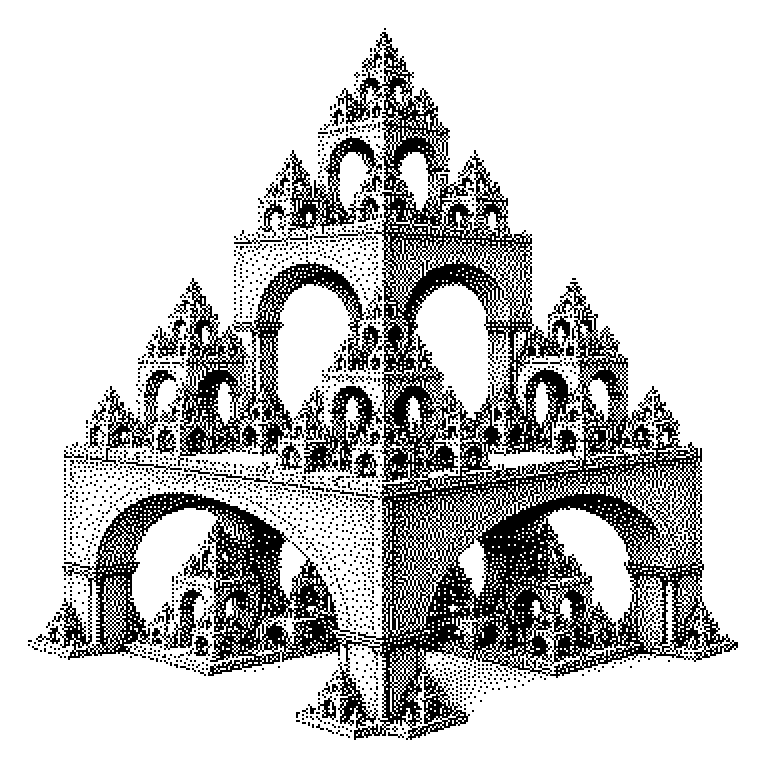
Scale-free architecture
A scale-free architecture is a system design that works on the same principle whether the quantity involved is very small or very large. So it doesn't need to be rebuilt when ten users become ten million.
When experts talk about an architecture, they mean the blueprint of a technical system. In other words, the question of what parts it consists of and how those parts work together. Some blueprints only work well at a certain size. A program runs smoothly with a hundred users and collapses at a million. A scale-free architecture is the opposite of that: its basic principle stays the same no matter how small or large the system becomes. You enlarge it by adding more of the same, not by inventing something new.
Why growth otherwise forces a rebuild
Most systems have a size beyond which they tip over. An online shop with a single database is a good example. As long as few people are ordering, one server is enough. If the number of orders rises sharply, that server becomes the bottleneck. Then the system has to be taken apart and rebuilt. That costs months of work, and it’s the time during which competitors pull ahead.
Scale-freeness is meant to avoid exactly this break. The blueprint provides from the outset that work is distributed across many identical units. When things get tight, you place additional units alongside them. For the company, that means predictable costs: double the load costs roughly double the hardware, not an entirely new product.
In AI, this point is especially important. The large language models of recent years are based on a blueprint that can be scaled up almost arbitrarily. You take more computing power, more text, and more adjustable numerical values in the model. The procedure itself stays the same. It is precisely this property that made the AI boom possible in the first place.
Identical building blocks instead of special cases
The technical core is usually simple: many identical building blocks and a distribution point in front of them. This distribution point sends every request to a free building block. Because all building blocks can do the same thing, it doesn’t matter which one answers. This is also called horizontal scaling, as opposed to upgrading a single large machine.
For this to work, no building block may be the sole holder of indispensable knowledge. As soon as a single part becomes irreplaceable, a bottleneck arises again. That’s why data in such systems is stored distributed and redundantly. If one machine fails, the others take over without users noticing.
A common misconception: scale-free doesn’t mean limitless. At some point the connection between the building blocks becomes the brake, or the distribution point itself becomes the bottleneck. Limits show up in AI models too, for instance when high-quality training texts run out. Scale-free only means: within the range that is practically relevant, the underlying principle doesn’t have to change.
From cloud services to model families
The principle is most clearly visible with cloud providers, i.e. companies that rent out computing power over the internet. When a video service has an especially large audience in the evening, additional servers automatically join in. At night they disappear again. The blueprint stays unchanged; only the number of units changes.
In news about AI, you’ll often encounter this idea as a model family. A provider releases the same model in a small, a medium, and a very large variant. The small one runs on a laptop, the large one in a data center. The fact that this is possible is due to the scale-free design behind it.
Pay attention to how the word is used. In marketing texts, scale-free sometimes sounds like just a promise without evidence. The useful question is what exactly scales along with growth and where the first bottleneck lies. Whoever can answer that question means the principle seriously.
