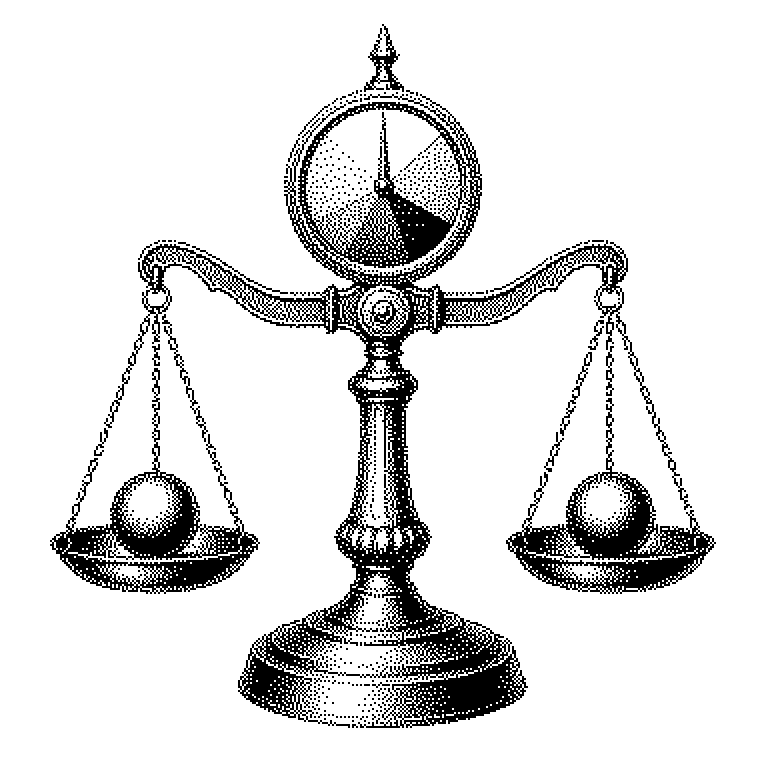
Strictly Proper Scoring Rule
A strictly proper scoring rule is a calculation method that grades probabilistic forecasts. It is designed so that, on average, you only get the best score if you honestly state what you truly believe.
Some predictions aren’t clear yes-or-no statements, but probabilities. A weather app doesn’t say “it will rain”, but “70 percent chance of rain”. Such statements must be graded differently than a simple right or wrong. This is what scoring rules are for: calculation methods that turn the stated probability and the actual outcome into a score. A scoring rule is called strictly proper if you maximize your expected score only by stating the honest probability. Any embellishing, exaggerating, or hedging leads, on average, to a worse score.
Why honesty has to pay off
Without this property, a grading scheme rewards the wrong behavior. An example: you only evaluate whether the more likely side occurred. Then it doesn’t matter whether someone says 51 percent or 99 percent. A forecaster can therefore appear much more confident than they really are, without any downside. This is exactly what is called a perverse incentive.
Conversely, there are rules that reward caution. Whoever always says 50 percent never falls flat on their face. This too is bad, because such predictions are worthless. A strictly proper rule rules out both escape routes. It harshly penalizes exaggerated certainty as well as cowardly middle-of-the-road values.
For AI, this is more than a statistical fine point. Language models are trained to assign probabilities to the next word. The loss function commonly used for this is a strictly proper rule. This means the model has no advantage during training in hiding its uncertainty. Whether it still ends up sounding overconfident is a different question — more on that later.
The Brier score and the log score
The best-known rule is the Brier score. You take the stated probability and the outcome, which counts as 1 if it occurred and 0 if it did not. Then you form the difference and square it. If someone says 0.7 and it rains, the error is 0.3 squared, i.e. 0.09. If it doesn’t rain, it’s 0.7 squared, i.e. 0.49. Smaller is better.
That this rule induces honesty can be verified by calculation. Whoever truly believes 70 percent fares best in expectation by stating 0.7. Any other number worsens the result. The squaring is the crucial trick. It ensures that large deviations become disproportionately costly.
The second important rule is the log score. It penalizes according to the logarithm of the probability assigned to the outcome that actually occurred. Whoever assigns 1 percent to an event and it happens incurs a very high penalty. At 0 percent, the penalty would even be infinite. The log score is thus considerably stricter against overconfidence than the Brier score. Both are strictly proper, but they set different priorities.
From prediction markets to model evaluation
Such rules are most visible on prediction platforms. There, people state probabilities for election outcomes or economic data and collect points. Weather forecasts, too, have been measured using the Brier score for decades. In medicine, it is used to evaluate risk calculators, for instance for the probability of a heart attack.
In the AI world, the term mainly comes up in the context of calibration. A model is calibrated if, of all statements where it states 80 percent confidence, about 80 percent are actually correct. Strictly proper rules are the tool used to measure this. They capture two things at once: how well someone discriminates, and how honest their confidence statements are.
A common misconception: a proper rule guarantees honest models. That’s not true. It only guarantees that honesty would be the best strategy. If a model is subsequently further trained with human feedback, new incentives can arise. Confident-sounding answers often please people more. That’s why chatbots, despite proper training objectives, can sound convincing and still be wrong.