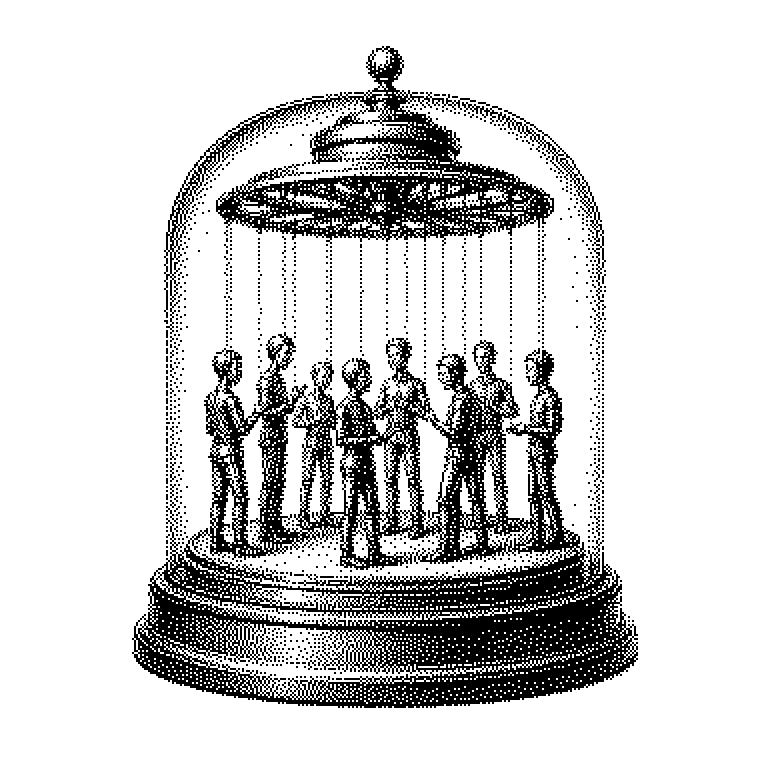
Social Simulacra
Social Simulacra are artificially generated user groups that write and react in a still-empty online community the way real people would. Developers use them to test a new forum or a new app before anyone has even signed up.
Anyone building a new online forum or social network has a problem at the start: the platform is empty. Without users, nobody knows how the thing will behave once it’s running. Social Simulacra are an attempt to fill that gap. A text program generates hundreds of invented members complete with posts, replies, and arguments. The result looks like a lively forum, even though not a single human was involved. The term comes from a 2022 research paper by Stanford University.
The problem of the empty platform
Social rules only reveal their weaknesses once people actually use them. A discussion rule sounds sensible at the drawing board and fails in everyday practice. Operators often only notice this after launch, when thousands of people are already signed up. By then, a change is expensive and annoys the community.
With artificial members, you can try out beforehand what might happen. The developer describes in a few sentences what the forum should be about and which rules apply. Then they watch how the invented users behave. Perhaps a harmless question tips into an insult after three replies. Perhaps an important section gets completely ignored.
So the benefit doesn’t lie in perfect predictions. It lies in seeing cases at all that one hadn’t thought of oneself. Experts refer to this as design tools: aids that make ideas and problems visible during the design process.
How the invented members come to be
The basis is a language model. That is a program that has learned from enormous amounts of text which words typically follow one another. Because the training material contains countless real forum posts, it can imitate the tone of such discussions. It doesn’t know what an argument is, but it knows the pattern.
First, the system generates a list of people. Each one gets a name, an interest, and an attitude. The model then writes posts for each of these people. If a second person replies, the model receives the history so far as a template. In this way, entire discussion threads grow step by step.
An important addition is the ability to rewind the history. The developer can change a rule at a certain point and let the discussion run again. Two versions of the same situation are then compared. This is similar to a wind tunnel: the model car isn’t real, but the airflow still reveals where the shape causes problems.
Limits and typical confusions
Social Simulacra are no substitute for real user testing. The model produces the expected, not the surprising. Very small groups, rare opinions, or people with unusual language use often get short shrift. Anyone who tests only with invented users is thus building a platform for an average that doesn’t actually exist.
The term is often confused with social bots. Social bots are accounts meant to deceive real people on real platforms. Social Simulacra, by contrast, run in a closed test environment and are clearly recognizable as artificial to the developers. The distinction matters, because one is a tool and the other is usually manipulation.
In the news today, the idea mostly appears under the keyword agent simulations. Companies use it to test moderation rules, market researchers have artificial target audiences rate advertising, researchers simulate opinion formation. Similar methods also show up in games, when supporting characters are meant to talk among themselves. The core criticism remains the same everywhere: a simulation shows what the model considers plausible, not what people actually do.