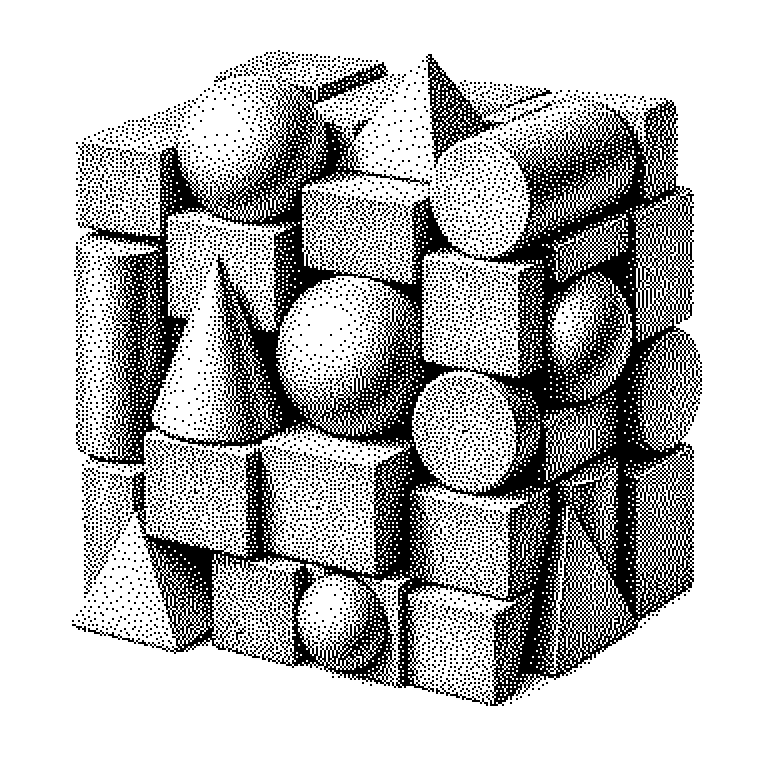
Spatial Primitives
Spatial primitives are simple basic shapes such as point, line, triangle, cube, or sphere, from which computers assemble complicated three-dimensional objects. They are the smallest building blocks that graphics programs, game engines, and AI models use to describe space.
A computer cannot simply look at a shape and understand it. It needs a description made of numbers. That’s why every spatial object is broken down into very simple basic shapes. Such basic shapes are called spatial primitives: a point, a line, a triangle, a cube, a sphere, a cylinder. From many of these building blocks, a car, a face, or an entire city can then emerge. The principle resembles Lego bricks: few kinds of bricks, but practically unlimited numbers of constructions.
Why graphics cards love triangles
The most important reason for primitives is speed. Calculating an arbitrary curved surface is mathematically expensive. A triangle, on the other hand, is always flat and fully described by three points. Graphics cards are specialized in drawing millions of such triangles per second. Everything else is translated into triangles beforehand.
The second reason is memory efficiency. A sphere as a primitive only needs a center point and a radius, so four numbers. The same sphere as a mesh of triangles can cost thousands of numbers. Where precision and small file sizes matter, such as in mechanical engineering design programs, people therefore prefer to work with exact basic shapes.
For AI systems, there is a third reason. A robot or a self-driving car must know instantly whether it is bumping into something anywhere. Checking this against a complicated shape takes too long. Checking it against a rough envelope made of a few primitives happens in fractions of a second.
From building block to finished image
Every primitive is described by its vertices. A vertex is a triple of numbers: how far right, how far up, how far back. Connecting three such points creates a triangle. Putting many triangles together produces a mesh that forms the surface of an object. Experts call this mesh a mesh.
When displaying it, this happens in fixed steps. First, all vertices are rotated and shifted, depending on where the virtual camera is positioned. Then each triangle is projected onto the screen. Finally, it is calculated which pixels it covers and what color they get. This last step is called rasterization.
A common misconception is that more triangles automatically look better. Beyond a certain density, the eye no longer notices a difference, but the computational load keeps increasing. Games therefore use several versions of the same object: a detailed one for close-up views, a rough one for distant views. Primitives must also be distinguished from voxels. Voxels are small cubes on a fixed grid, similar to pixels, only three-dimensional. Primitives, on the other hand, can be located anywhere in space and be of any size.
From Minecraft to the robotic hand
Primitives are most visible in computer games. Every game character, every wall, and every tree consists of triangle meshes. Modern games render several million triangles per frame onto the screen, and that sixty times per second. The 3D filters in video chats and the effects in phone apps work the same way, too.
In industry, primitives appear wherever something is being built. Design programs assemble parts from boxes, cylinders, and holes. A 3D printer almost always ends up receiving a file with a pure triangle mesh. Architecture firms model buildings from simple solids before details are added.
In AI news, you mostly encounter the term in robotics and autonomous driving. There, objects are surrounded by a bounding box, i.e., a simple box as an envelope. AI systems that generate 3D models from text descriptions also usually deliver the result as a triangle mesh. Anyone who understands what primitives are can categorize such news much better.