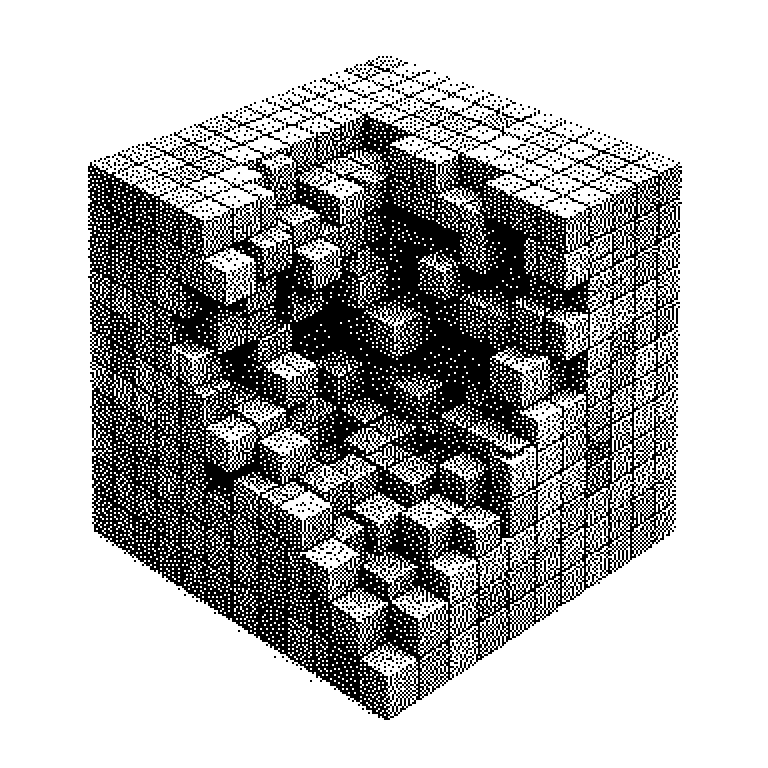
Voxel
A voxel is the three-dimensional counterpart to the pixel: it describes a tiny cube in space and stores a value for that point, for example density, color, or brightness. Voxels are used wherever volumes rather than surfaces need to be represented or processed – from medical technology to game graphics.
A pixel is a small square in a flat image. If you transfer this idea into the third dimension, you get a voxel — a tiny cube in space. The word is made up of “volumetric” (referring to volume) and “pixel”. Just as a photo consists of millions of small squares, a three-dimensional object can be built from millions of small cubes. Each of these cubes stores exactly one value: for example a color value, a material density, or the information whether there is anything at all at that location. Voxels thus describe not only surfaces but the interior of a body.
Voxels as the key to the third dimension
In a normal image, there is no information about what lies behind the surface. In a photo of a hand, you see skin — what lies beneath it is not present in the image. A voxel dataset solves this problem. It describes, layer by layer, the entire space within an object.
This is especially crucial in medicine. A computed tomography scanner — CT for short — scans the body from many angles and in doing so produces a voxel dataset. Each voxel contains a density value: bone is dense, air is not. The result is a complete, three-dimensional image of the inside of the body. Doctors can make arbitrary cross-sections in it without actually cutting the patient open.
Voxels also play a growing role in AI research. Neural networks, i.e. learning programs built after the model of the brain, can process three-dimensional voxel data directly. This enables, for example, the automatic detection of tumors in CT scans — a task that used to be handled exclusively by radiologists.
How a voxel dataset is structured
You can picture a voxel dataset as a stack of layers. Each layer is a normal raster image. If you stack many such images on top of each other — like pages in a book — a three-dimensional grid of cubes emerges. The resolution describes how small each individual cube is. In medical CT scans, a voxel is typically less than one millimeter in size.
The smaller the voxels, the finer the representation — and the larger the amount of data. A high-resolution voxel dataset of the human brain can quickly amount to several gigabytes. This is where the most important difference from the triangle mesh lies, another widespread method for 3D objects: a mesh describes only the outer shell of an object as a collection of triangles, saving storage space, but containing no information about the interior. Voxels, on the other hand, store everything — surface and core.
Another advantage of voxels is their regularity. The grid is uniform, every cube has the same size and sits at a known location. This makes mathematical operations easier. Computer programs can, for example, directly overlay two datasets and compare them point by point — for instance, to track the growth of a tumor over months.
Where voxels are encountered in everyday life
The best-known example from medicine is the CT scan, but MRI machines — magnetic resonance imaging devices that examine the body using magnetic fields instead of X-rays — also deliver voxel data. Both procedures have become indispensable in modern hospitals.
In the gaming industry, the term became especially popular through the game Minecraft. Its entire world consists of equally sized cubes — a vivid, if coarsely resolved, example of what a voxel structure looks like. Professional graphics programs, on the other hand, use voxels for realistic effects such as smoke, fire, or clouds, because these phenomena are better described as a volume rather than a surface.
Voxels also appear in robotics and autonomous driving. Sensors such as lidar — devices that scan the surroundings using pulses of light — generate point clouds. These are frequently converted into a voxel grid so that an AI system can analyze the environment in a structured way. The term is thus no longer limited to medicine, but a fundamental building block wherever computers need to understand three-dimensional space.