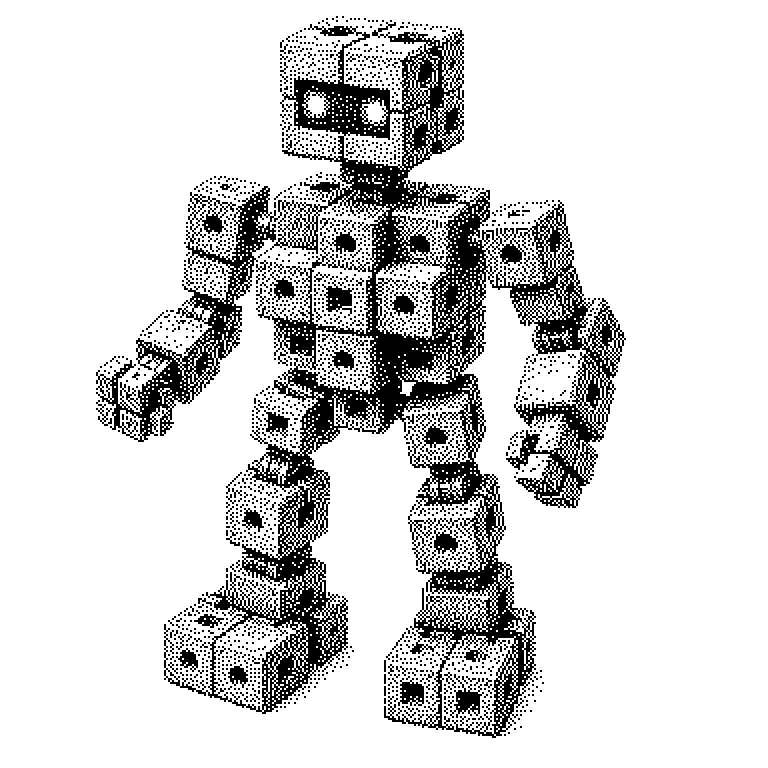
Voxel Robot
A voxel robot consists of many uniform, cube-like modules that can connect and disconnect to change their shape. Because the robot's structure is not fixed, it can adapt to new tasks without being physically rebuilt.
A voxel is the spatial counterpart to a pixel: just as a pixel is a small square on a screen, a voxel is a small cube in three-dimensional space. A voxel robot consists of many such cube-shaped units that can connect with one another and separate again. Each unit carries its own motors and electronics. The shape of the overall robot arises from how the units happen to be assembled at any given moment. Because this arrangement can change, the robot is not locked into a fixed form.
Why a changeable shape makes a difference
A conventional robot is built for a specific task. A welding robot in a factory can weld — and nothing else. If the task changes, one often has to buy a new robot or rebuild the old one at great effort. A voxel robot fundamentally sidesteps this problem.
It can reshape itself because its modules can independently release and re-form their connections. The same device can move through narrow gaps as a flat crawling robot and then rise up into a grasping arm. This is especially valuable in fields such as disaster relief or space exploration: environments there are unpredictable, and replacement devices are hard to bring in.
Another advantage is fault tolerance. If a single module is damaged, the robot can in theory remove it from the assembly and keep working regardless. This property is called redundancy — the system has more parts than it needs for minimal operation.
Self-organization of the modules
For a voxel robot to reshape itself in a meaningful way, each module must know where it is located within the overall assembly and where it needs to go next. This is solved either centrally — an overarching computer plans the entire reconfiguration — or in a distributed manner, with each module deciding according to simple local rules. The distributed approach is harder to program, but it still works even if the connection to the central computer is lost.
This is where artificial intelligence comes into play. Researchers train models that teach the modules how to jointly reach a target shape — similar to teaching a student a strategy rather than dictating every single move. So-called reinforcement learning, in which a system is rewarded through trial and error as it gets closer to the target shape, has proven especially useful here.
In practice, the mechanical side is still a major hurdle. The connections between modules must be strong enough to transmit forces while also being quickly releasable. In addition, each module needs its own power supply or a reliable way to route energy through the assembly.
Voxel robots in research and product development
MIT and Harvard University have presented several working prototypes in recent years. A well-known example is MIT’s so-called M-Blocks: magnetically connected cubes that can jump and roll using internal rotating masses, without any external legs or wheels. Each cube is roughly the size of a small apple.
In industry, the concept is of particular interest to the aerospace sector. NASA is researching whether voxel-based structures could be used to automatically assemble or reconfigure parts of a space station in orbit. The principle is also being tested for rescue robots — for instance after earthquakes — because a robot that can change its shape can traverse rubble in ways that are impossible for rigid machines.
In tech news, the term frequently appears alongside modular robotics or self-reconfiguring systems. Anyone reading reports about robots that rebuild themselves will almost always encounter voxel architectures in the background — even if the term itself is not always mentioned.