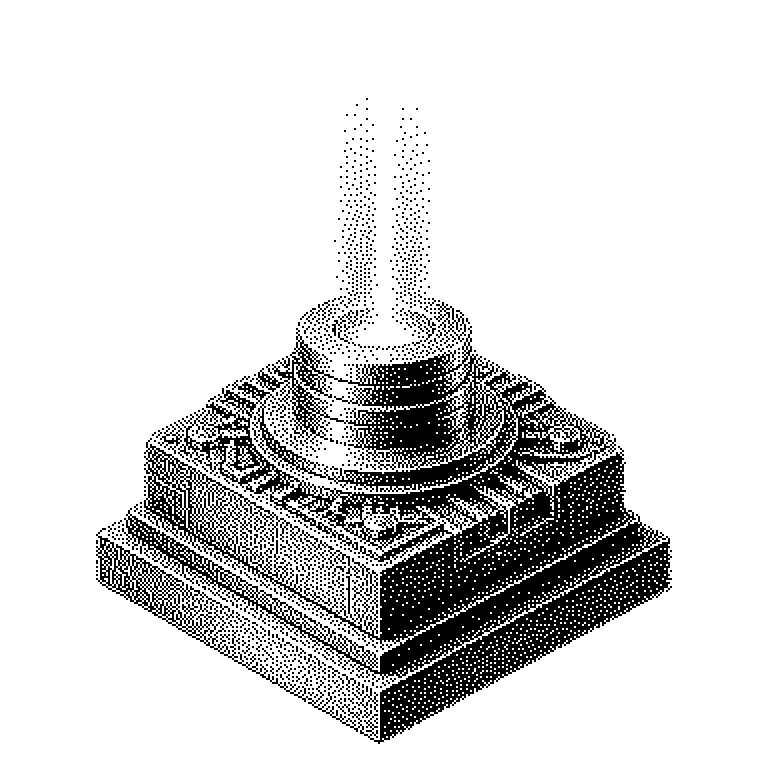
VCSEL
A VCSEL (Vertical-Cavity Surface-Emitting Laser) is a tiny semiconductor laser that emits light perpendicular to the chip surface rather than sideways. It's found in iPhones, data centers, and industrial sensors – anywhere precise, fast, and energy-efficient laser light is needed.
A VCSEL is a very small laser that sits on a semiconductor chip and emits light straight upward. The acronym stands for “Vertical-Cavity Surface-Emitting Laser” – in other words, a laser with a vertical cavity that emits light from its surface. Most other semiconductor lasers emit their light sideways, which makes manufacturing and installation more complex. A VCSEL, by contrast, is so compact that thousands of them can be manufactured simultaneously on a single wafer – a thin semiconductor disc – and tested directly on the wafer. This makes it unusually inexpensive and reliable.
Why VCSELs are crucial for AI hardware and data centers
Modern AI models run on massive server farms where thousands of chips must communicate with one another. Copper cables quickly reach their limits here: beyond a certain length and data rate, the signal becomes too weak and heat generation too high. Fiber-optic connections using laser light solve this problem – and VCSELs are the preferred light source for it.
A single VCSEL can transmit data at over 50 gigabits per second. In a data center, dozens of such lasers sit side by side within a single connector. Because VCSELs consume very little power and generate hardly any waste heat, they noticeably lower operating costs. For companies like Google, Microsoft, or Amazon, which operate millions of servers, this difference amounts to billions.
How a VCSEL generates light
The core of a VCSEL is an extremely thin layer of semiconductor material called the active region. When electrical current flows through it, electrons release energy in the form of light particles – this is the basic principle behind every light-emitting diode. The difference from a simple LED lies in what happens next: several dozen ultra-thin mirror layers sit above and below the active region. These mirrors reflect the light back and forth so many times that it amplifies and eventually exits, bundled, straight upward.
Because the cavity – the space between the mirrors – is extremely short (often just a few micrometers, i.e., thousandths of a millimeter), the light oscillates at a very precise wavelength. This is important so that optical fibers can carry the signal with minimal loss. A laser that emits sideways would require a more complex design to achieve the same effect. The VCSEL achieves this in a chip barely larger than a speck of dust.
A common misconception: VCSELs and ordinary LEDs sound similar but are fundamentally different. An LED scatters light in all directions and does not amplify it. A VCSEL bundles and amplifies it – that’s the decisive step that makes it a laser.
VCSELs in everyday life: facial recognition, mice, and factories
The best-known consumer product featuring a VCSEL is the iPhone. Apple's Face ID system uses a VCSEL array – a grid of many tiny laser points – to project more than 30,000 invisible infrared dots onto the face. A camera measures how these dots are distorted and uses this to calculate a three-dimensional depth image. This works reliably in the dark and is harder to fool than a simple front-facing camera.
Optical computer mice also frequently use VCSELs instead of LEDs, because the coherent, focused light allows for more precise surface tracking. In industry, VCSELs are used for distance measurement, material inspection, and heating tiny surface areas. Autonomous vehicles use them in LiDAR systems, which scan the surroundings three-dimensionally using laser pulses – similar to Face ID, but for the road.
In the tech press, the term mainly comes up in the context of AI infrastructure expansion. Manufacturers like II-VI (now Coherent) or Lumentum supply the major cloud providers with VCSEL modules. When a data center doubles its capacity for AI training, demand for VCSELs typically rises as well – which is why investors increasingly watch the term as an early indicator of the AI infrastructure boom.