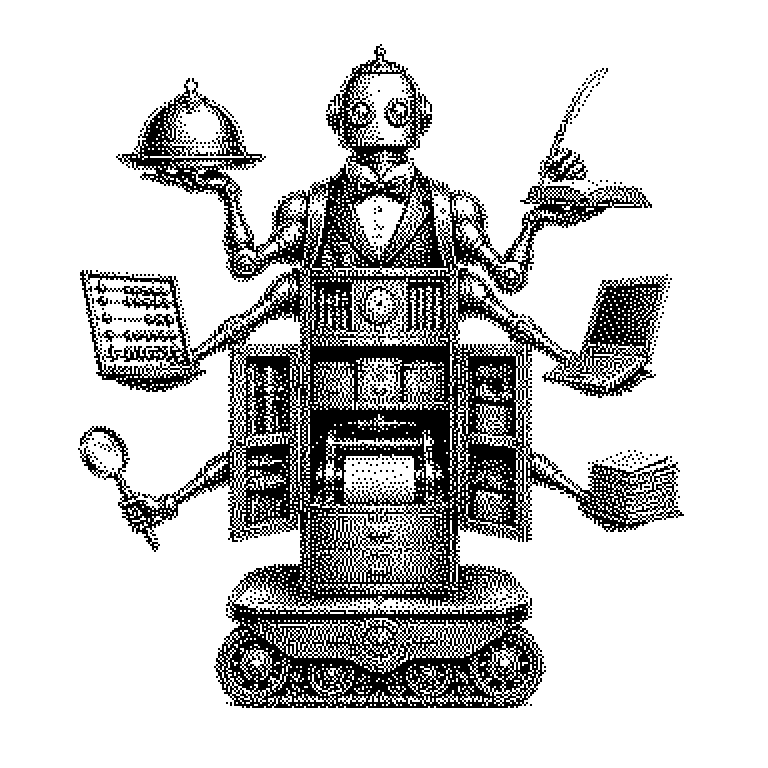
Super-Agent
A super-agent is an AI system that doesn't just answer but independently completes entire tasks: planning, operating programs, checking intermediate results. The term is more a marketing promise than a fixed technical definition.
Most AI programs people know answer a question and are then done. A super-agent is supposed to do more. It receives a goal instead of a single question, for example: “Plan my class trip to Rome.” It then breaks the goal down into steps itself, searches for information, fills out forms, and only reports back with the result. The term thus refers to an AI that acts rather than merely talks. Important to know: “super-agent” is not a protected technical term but a marketing word that companies use for their particularly capable systems.
From the information desk to the caseworker
The difference between answering and getting things done is economically enormous. A program that explains to you how a tax return works saves you ten minutes of reading. A program that actually fills out the tax return replaces a work process. That’s exactly why tech companies talk so much about agents: that’s where the money is, not in better chat answers.
For investors and observers, the term should still be approached with caution. There is no test a system must pass to be allowed to call itself a super-agent. Some products with this label can genuinely operate multiple programs. Others are a regular language model with a few extra buttons attached. Anyone reading the news should therefore always ask which task the system completes from start to finish without further prompting.
On top of that comes a question of trust. A system that independently places orders or sends emails needs access to accounts and data. A mistake then is no longer just a wrong answer but a wrong transaction. For this reason, many agents today only run with a confirmation step: a human clicks “Yes” once more before every important action.
Planning, using tools, revising
At its core, almost every super-agent contains a language model. That is a program that has learned from huge amounts of text to write sensible continuations. What’s new is the loop built around it. The model first writes a plan, i.e. a list of sub-steps. Then it works through the steps one after another and checks after each step whether the result looks usable.
For this to work, the model is given tools. Here, tools are simply programs it is allowed to call: a search engine, a calculator, a calendar, a browser. The model doesn’t write text to the user but a command to the tool. The result comes back and feeds into the next step. You can picture it like an intern who is allowed to use the phone, a search engine, and the filing system.
The hardest part is memory across long tasks. After thirty steps, the system still needs to know what the original goal was. That’s why agents make notes and read them back in later. Even so, it frequently happens that they get lost and repeat the same action multiple times. Small errors add up: if you’re off by five percent per step, after twenty steps you barely have a usable result left.
What already works today
Agents are furthest along in programming. Tools like GitHub Copilot or Claude Code receive a bug description, search through the code, change files, and run tests. This works well because the computer immediately reports back whether it succeeded. This fast feedback is missing for many other tasks.
In everyday life you encounter early stages of this: research features that independently read twenty web pages and write a report, or customer service systems that actually trigger a return. In corporate announcements, the term also appears as a sales pitch, often alongside words like “autonomous” or “end-to-end.” A useful benchmark is to ask about the chain: how many steps can the system manage without human intervention? With honest figures, it’s usually a few dozen today, not hundreds.