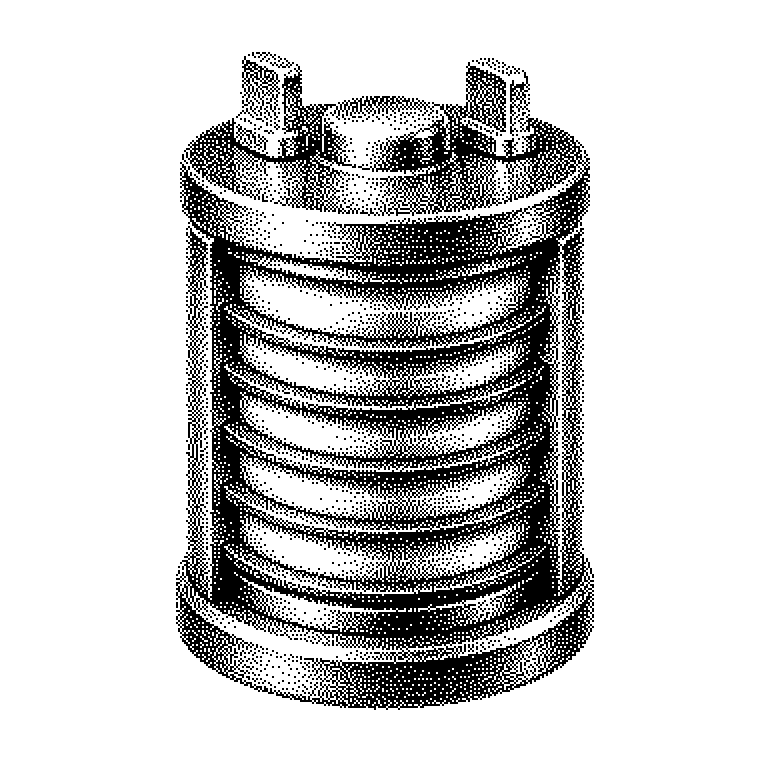
SHPMIM Capacitor
SHPMIM capacitors are tiny components inside computer chips that store electrical charge and thereby keep the chip's power supply stable. They are a particularly high-performance variant of the so-called MIM capacitors and are used above all in chips for artificial intelligence.
A capacitor is a component that can briefly store electrical charge and release it again quickly. You can picture it as a tiny bucket for electricity that fills and empties in fractions of a second. In modern computer chips, millions of such buckets are built directly into the layers of the chip so that the power supply doesn’t collapse when a lot of computing power is suddenly needed. SHPMIM stands for “Super High Performance Metal-Insulator-Metal,” i.e. a particularly high-performance structure made of two metal layers with a non-conductive layer in between. This design stores considerably more charge in the same area than older variants. Chipmakers such as TSMC offer it in their most advanced manufacturing processes, because AI chips would simply run unstably without this buffering.
Why AI chips need a charge buffer right next to the compute unit
A large AI chip today consumes several hundred watts, some more than a thousand. This consumption is not constant but fluctuates extremely. When tens of thousands of compute units start working in the same clock cycle, power demand spikes within nanoseconds. The external voltage supply is far too sluggish to keep up that quickly.
If the voltage briefly dips during this, the chip computes incorrectly or crashes. That’s why a reserve of charge has to sit directly next to the compute unit. This is exactly what SHPMIM capacitors do: they sit in the metal layers above the transistors, just a few micrometers away from the point where the current is needed. The shorter the path, the faster the compensation.
For the chip industry, this has tangible economic consequences. A more stable supply allows higher clock rates without having to raise the voltage as a safety margin. Less voltage means less waste heat and lower electricity costs in the data center. Area that a capacitor doesn’t need can also be used for compute logic. That’s why improved capacitor technology is often explicitly mentioned in announcements about new manufacturing processes.
Two plates, one insulating layer — and the trick with the dielectric
The basic structure is simple: two thin metal plates lie on top of each other, with an insulating layer in between. When voltage is applied, negative charges collect on one plate and positive charges on the other. The insulating layer prevents them from equalizing directly. Hence the name Metal-Insulator-Metal.
How much charge such a component can hold depends on three things. The area of the plates should be large, the distance small, and the insulating material should withstand electric fields well. This material is called the dielectric. In SHPMIM, instead of simple silicon compounds, so-called high-k materials are used, such as compounds containing hafnium or zirconium. The “k” is a material coefficient: the higher it is, the more charge fits into the same area.
A second lever is the design. Instead of just one pair of plates, several layers are stacked on top of each other or the structure is folded to increase the effective area. Together, both measures bring a multiple times higher capacitance per square millimeter compared to older MIM capacitors. The price for this is additional, very precise manufacturing steps. If the insulating layer is too thin at one point, a short circuit occurs and the entire chip becomes scrap.
Where the term appears in chip news
In everyday life, you never see SHPMIM capacitors, since they are hidden invisibly within the layers of a chip. You’ll encounter the term mainly in trade reports on semiconductor manufacturing. TSMC, for example, mentions SHPMIM as part of its process generations in the range of a few nanometers, i.e. the currently most advanced manufacturing.
Affected above all are graphics and AI accelerators, such as those sold by Nvidia or AMD, as well as high-performance processors for servers. In smartphone chips, the technology also plays a role, because there every saved milliwatt extends battery life. Anyone reading quarterly reports or technology roadmaps will often find such detailed information listed alongside keywords like transistor density or energy efficiency.
It’s worth avoiding a common confusion. SHPMIM capacitors have nothing to do with the storage cells of DRAM memory, even though capacitors are found there too. There, they store data; here, they merely stabilize the voltage. And they are not the same as the black components you can see on a circuit board. Those sit outside the chip and react much more slowly.