SDR
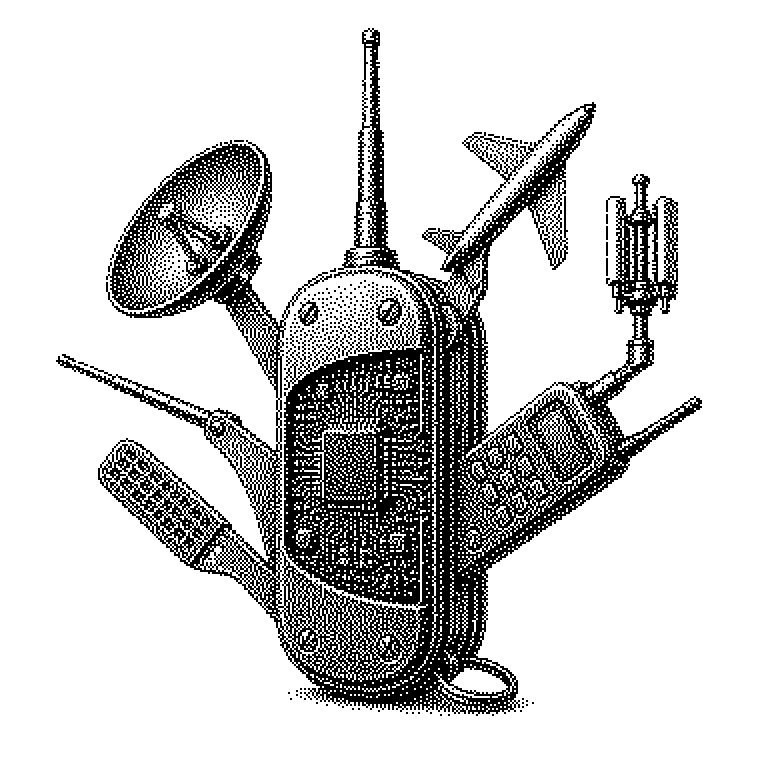
SDR stands for Software Defined Radio: a radio device in which a program takes over the tasks that used to be handled by fixed, hard-wired components. The same device can thus receive radio broadcasts, listen in on aircraft signals, or act as a mobile network base station – depending on which software is running.
Radio devices work with invisible waves that carry information through the air. In the past, every device contained a fixed circuit made of coils, filters, and amplifiers, built for exactly one task. An FM radio could therefore only receive FM, and no one could change that. A Software Defined Radio, or SDR for short, turns this around: it only has a few simple components left for the antenna, and everything else is handled by a program on a computer chip. So it is no longer the physical design but the code that decides what kind of radio signal the device can understand. The English term “Software Defined Radio” is often translated into German as “softwaredefiniertes Funkgerät.”
One device instead of a shelf full of radios
The obvious advantage is versatility. A single USB stick with SDR technology costs around 30 euros and can use it to receive radio stations, weather data from satellites, and position reports from aircraft. For the same tasks, you would previously have needed three separate specialized devices. Upgrading also becomes easier: when a new radio standard comes along, an update is often enough.
Economically, this is the reason the term shows up in tech news. Mobile network operators are increasingly building their networks with standard servers and software instead of specialized hardware from individual manufacturers. This approach lowers costs and makes operators less dependent on individual suppliers. The military makes a similar argument, aiming to cover many radio procedures with a single type of device.
The price for this is computing power. What used to be handled by a small coil with almost no power now has to be calculated by a processor millions of times per second. At very high frequencies or with very large amounts of data, classical hardware therefore remains more efficient and faster.
From the antenna to a stream of numbers
The core of an SDR is the analog-to-digital converter. This component measures the voltage at the antenna extremely often, frequently several million times per second, and records each measurement as a number. In this way, the radio wave becomes a pure stream of numbers. Everything that happens afterward is computation: a program searches through these numbers for the desired signal, filters out interference, and translates the result into sound or data packets.
A comparison helps: a classical radio is like a template that fits exactly one shape. An SDR, by contrast, photographs the entire range and cuts out the interesting section afterward on the computer. This is why a single SDR can track several transmitters at once, as long as there is enough computing power.
When transmitting, the process runs in reverse. The software generates the appropriate sequence of numbers, a digital-to-analog converter turns it into a voltage, and an amplifier sends it to the antenna. A common misconception is that an SDR consists solely of software. The antenna, amplifier, and converter remain hardware, and their quality ultimately determines how good the reception is.
From the hobbyist stick to the 5G antenna
The best-known examples are the cheap DVB-T sticks that were actually intended for television. Hobbyists discovered that their chip could be reprogrammed into a broadband receiver. Tens of thousands of people now use this to track flight movements and feed the data into portals like Flightradar24. Radio amateurs and security researchers also use such sticks, for example to examine poorly secured radio keys or sensors.
In the professional field, SDR technology is found in mobile network towers, in satellites, and in measuring instruments. The term Open RAN describes mobile networks whose base stations largely consist of software running on standard servers. For network operators and equipment manufacturers, this is a multi-billion-dollar market, which is why the term regularly appears in business news.
Artificial intelligence is increasingly coming into play. Because the radio signal exists as a series of numbers, learning algorithms can be applied to it. They recognize unknown types of signals, filter out interference, or allocate frequencies dynamically. Without the software-based design, this would not be possible at all, since a fixed circuit cannot be trained.