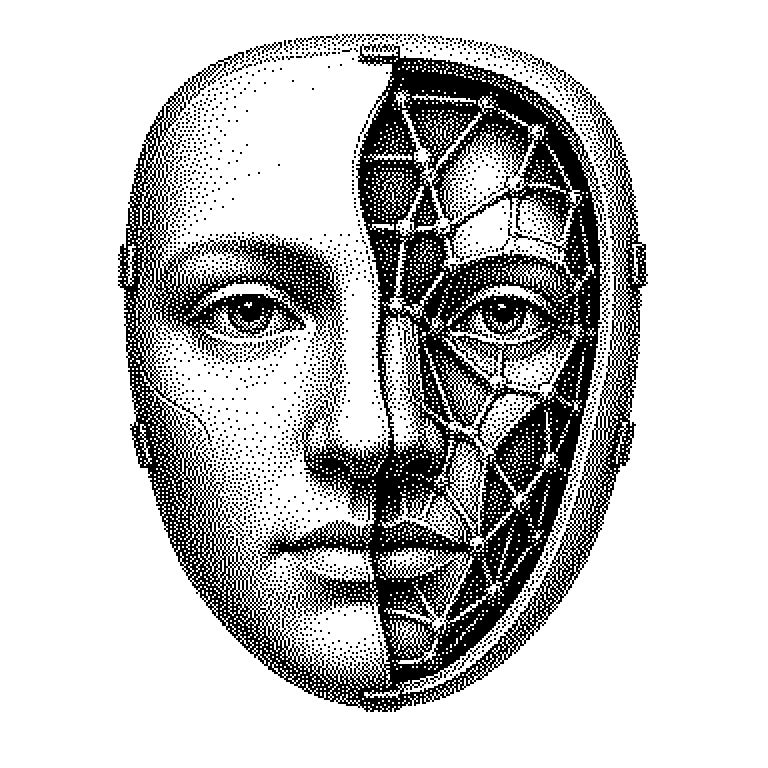
Deepfake
A deepfake is a fake photo, video, or audio recording created by a computer program that looks or sounds real. It usually shows people saying or doing things that never actually happened.
A deepfake is a forgery of an image, video, or audio recording created by a computer program. A typical example is a video in which a well-known person says sentences they never actually said. Pure audio forgeries are also possible: a voice sounds on the phone like that of a friend or boss. The word is made up of two parts. “Fake” means forgery, and “deep” refers to the technology behind it, so-called deep learning. This refers to programs that learn patterns themselves from a great many examples, rather than being given every rule in advance. A deepfake is therefore not laborious manual image editing, but the result of a system that has learned how a particular face or voice works.
What happens when you can no longer trust videos
Moving images were long considered strong proof. A photo could be retouched, but a video seemed harder to manipulate. That certainty is gone. If any video could be fake, even genuine recordings lose their persuasive power. Experts call this the liar’s dividend: anyone caught in a genuine recording can simply claim it’s a deepfake.
Concretely, the damage being done today occurs mainly in three areas. First, fraud: criminals call employees and imitate the voice of management to trigger money transfers. In a well-known case in Hong Kong, a company lost around 25 million US dollars in 2024 after an employee sat in a video conference with faked colleagues. Second, politics: shortly before elections, fake voice messages from candidates appear.
Third, and by far the largest in number, are pornographic forgeries made without the consent of the person depicted. According to studies, this category makes up the vast majority of all deepfakes circulating online. Those affected are not only celebrities but also private individuals and schoolgirls. In Germany, this can be prosecuted as, among other things, a violation of personal rights and as defamation.
How a face is created from examples
It always starts with material. The program is shown and made to listen to many images or audio recordings of the target person. From this, it learns how this face behaves at different angles and under different lighting conditions. With voices, it learns tone, speaking speed, and emphasis. In the past, this required hours of material; today, good systems need only a few minutes.
There are two common approaches to the actual forging process. In the older one, two programs work against each other: one generates forgeries, the other tries to expose them. Both improve in the process, until the forgeries are barely noticeable anymore. This principle is called a GAN, short for generative adversarial network. Newer systems instead use diffusion models: they start with pure image noise and gradually convert it into a clear image.
A forgery can be recognized by small details, but this is becoming increasingly difficult. Telltale signs are often transitions at the hairline, odd teeth, hands with the wrong number of fingers, or earrings that jump between two images. With voices, breathing is often missing. More reliable are technical proofs of origin: cameras and programs can write a tamper-proof signature into the file that documents where it came from. The industry is working on the C2PA standard for this purpose.
From film studios to the grandchild scam
The same technology also has legal applications, and these are part of everyday life. Film studios use it to make actors look younger or to dub lip movements into other languages. Commercials are broadcast in thirty markets using a rented digital voice. People who are losing their voice due to illness have it digitally recreated beforehand. The difference from a deepfake in the bad sense lies not in the technology but in consent and labeling.
In the news, you usually encounter the term in three contexts: election campaigns, investment fraud using fake celebrity endorsements, and regulation. The European Union’s AI Act requires that artificially generated content be labeled as such. Major platforms like YouTube and TikTok require uploaders to provide corresponding disclosures.
In practice, a simple rule helps you more than any look at image quality: check the source, not the image. If no reputable news outlet is reporting on what is supposedly shown, suspicion is warranted. And if a familiar voice on the phone demands money or passwords, hang up and call back using the saved number.