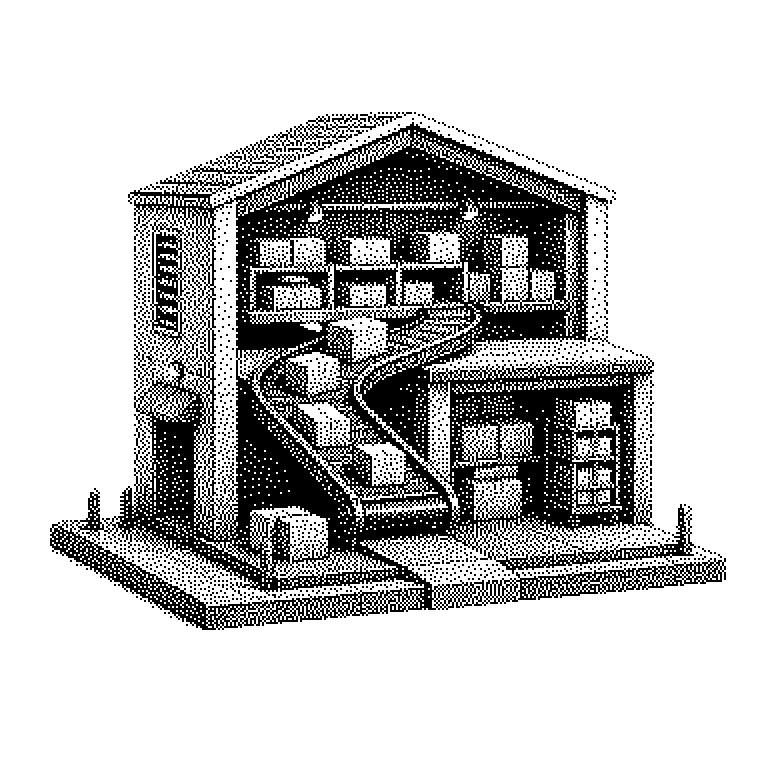
Delivery Station
A delivery station is a small warehouse on the outskirts of a city where packages are sorted for the final leg of their journey to the customer. It is the last stop between the large fulfillment center and the front door, and today it is heavily controlled by software and algorithms.
A delivery station is a building where packages are prepared for the last stretch of their journey. It is usually located on the outskirts of a city or in an industrial area. At night, trucks arrive there from the large warehouses. The packages are unloaded, sorted by street and neighborhood, and distributed onto delivery vans. In the morning, the vehicles head out, and the building remains almost empty until the next night. The English name has become established mainly because Amazon spread this model across Europe; in German, one would speak of a 'Zustellstation.'
The last mile determines the costs
In logistics, the stretch from the last warehouse to the front door is called the last mile. This short segment is by far the most expensive part of the entire transport chain. Estimates suggest that it accounts for roughly half of all shipping costs. The reason is simple: a truck can carry a thousand packages at once along the highway, but at the end, someone has to carry each individual package to a different address.
That is why retailers and parcel services are building more and more of these stations, as close to customers as possible. Short distances mean more stops per route and less time stuck in traffic. This is exactly what makes next-day or even same-day delivery possible in the first place. Without this dense network of stations, the promise of fast delivery could not be kept.
For investors and business journalists, delivery stations are therefore a signal. When a company announces dozens of new locations, it is planning growth in a region. Conversely, closures are seen as a sign that demand is being assessed as weaker. Strikes and debates about working conditions also frequently revolve around exactly these buildings.
From truck to route: the process during one night
Operations follow fixed steps. First, the packages are tipped from the truck onto a conveyor belt. Scanners read the codes on the labels and register each package with the central system. The shipments then move into containers or bags, each assigned to a specific route. One bag roughly corresponds to a handful of streets.
The division of addresses is not handled by a person, but by software. A route-planning program calculates which addresses are grouped together into a route and in what order they are visited. It takes into account distances, expected traffic, time windows, and how full a vehicle is allowed to get. Such calculations are mathematically difficult, because the number of possible sequences becomes astronomically large once there are a hundred stops. That is why these systems do not look for a perfect solution, but for a very good one within a few seconds.
On top of that come forecasts based on past data. The system estimates how many packages will arrive tomorrow and plans staff and vehicles in advance. Some stations also use cameras and image recognition to detect damaged or misplaced packages. The building itself looks simple, but the control system behind it is not.
What the customer actually notices
Most people encounter the delivery station without ever seeing it. When an app reports in the morning that the package is 'out for delivery,' it has just left the station. The live map showing 'five stops away from you' also comes from this station’s route planning. If a delivery is delayed due to snow or a traffic jam, the rerouting happens there.
It is important to distinguish this from the large warehouse, the fulfillment center. There, millions of items sit on shelves, and orders are picked, packed, and labeled. In the delivery station, by contrast, nothing sits in storage for longer than a few hours. It is a flow-through facility, not a shelf. A common misconception is that goods are kept there in stock and can be picked up.
In the news, delivery stations mainly come up in three contexts: investment plans by major retailers, debates about subcontractors and drivers' working hours, and disputes in cities over delivery traffic and emissions. Anyone who knows the term understands these reports much more quickly.