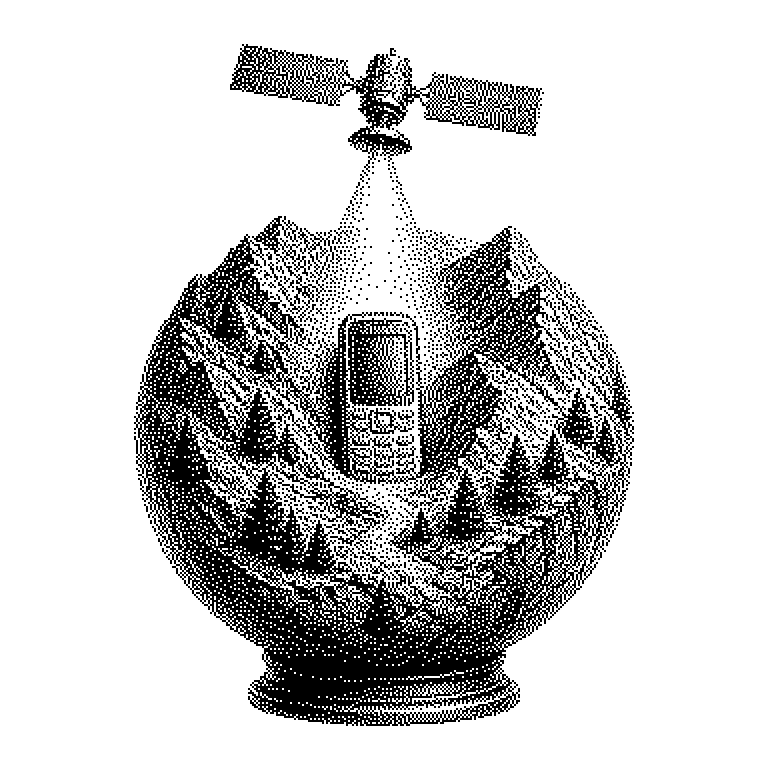
Direct-to-Device
Direct-to-Device refers to mobile communication in which a regular phone connects directly to a satellite without any additional device. The goal is to eliminate dead zones where no cell tower is within range.
A phone normally communicates via a nearby cell tower. If no tower is within range, the display shows no signal. Direct-to-Device means: in this case, the phone instead connects directly to a satellite in space. The satellite thus takes over the role of the tower. Crucially, no special device and no external antenna are needed for this. An off-the-shelf smartphone is enough, often just a software update from the provider suffices.
What the end of dead zones would mean
Cell towers are built where many people live. In mountains, at sea, in deserts, and in large forested areas, building them isn’t worthwhile. Estimates suggest that around 80 percent of the Earth’s surface has no mobile network. A satellite suddenly sees a huge area and makes these gaps usable.
The most important use so far is safety. Anyone who falls while hiking or gets stranded with their car on a remote road can call for help. Cell towers also fail after earthquakes or floods, whereas satellites do not. Aid organizations and authorities are therefore very interested in the technology.
For the economy, a lot of money is at stake. Satellite operators like SpaceX or AST SpaceMobile want to sell the technology to mobile network providers. These providers, in turn, can gain customers without having to build expensive towers in unprofitable regions. Conversely, some providers fear that satellite companies will make them obsolete in the long run.
Why the satellite has to do what a tower normally does
A phone transmits with less than one watt of power, roughly as much as a small LED lamp. A cell tower is a few kilometers away, whereas a satellite is several hundred kilometers away. The signal therefore arrives extremely weak up there. That’s why satellites carry very large antenna surfaces, sometimes over a hundred square meters, in order to still pick up the weak signal.
So that the phone doesn’t have to relearn anything, the satellite behaves like an ordinary cell tower. It uses the same radio frequencies that the mobile provider also uses on the ground. To the phone, it looks as if a tower were standing on the horizon. That is exactly the core of the idea: the technology is in the satellite, not in the phone.
The satellites fly in low orbit, racing across the sky at around 27,000 kilometers per hour. Each one is only visible for a few minutes, after which the next one takes over. This requires hundreds of satellites for seamless coverage. The data rate remains low, because all users in a huge area share the capacity of one satellite. That’s enough for text messages, but not for video streaming.
Emergency SMS in the mountains and mobile providers' advertising
The term is most commonly encountered in connection with smartphone emergency features. Apple has offered satellite emergency calls since the iPhone 14, and Google offers something similar on Pixel devices. In the US, T-Mobile is working with Starlink and sends short messages via satellite. Tests are underway in Europe, but here the allocation of frequencies has not yet been clarified everywhere.
In business news, Direct-to-Device often appears alongside stock prices and billion-dollar contracts. Companies like AST SpaceMobile are highly valued on the stock market, even though they have only a few satellites in space so far. Such reports should be read with caution: years lie between a test call and a stable service for millions of customers.
A common misconception is confusing this with satellite phones, which expeditions have used for decades. These require their own bulky device with a fold-out antenna. The difference with Direct-to-Device lies precisely in the fact that an ordinary phone in your pocket is enough. Anyone expecting full internet access in a dead zone will nevertheless be disappointed.