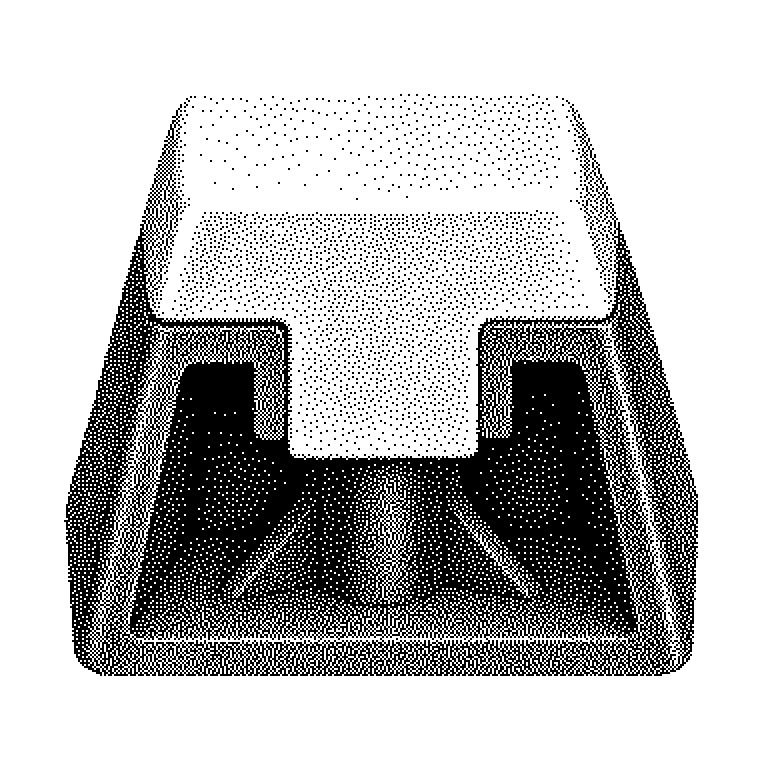
Doubleshot Process
In the doubleshot process, a plastic part is manufactured from two separately injected plastic portions that fuse firmly together. It is best known from keyboard keycaps, whose letters consist of a second plastic and therefore cannot wear off.
Many plastic parts are molded: liquid plastic is injected into a cavity and hardens there into the desired shape. In the doubleshot process, this happens twice in succession, with two different plastic portions. First, a base body is created that deliberately has gaps or recesses. Then a second portion of plastic, usually in a different color, is injected into these gaps. Both parts merge together to form a single piece. The name comes from English and literally means “two shots,” because the plastic is injected in two passes.
Why the lettering doesn’t wear off
The process is best known from computer keyboards. The letters on cheap keycaps are usually printed on or laser-etched. This layer is thin and sits on top. After a few months of intensive typing, it disappears on the frequently used keys. Anyone who types a lot knows keyboards with bare spots on A, S, D, and E.
On a doubleshot keycap, the letter is not a print, but a block of material. It extends from the surface deep into the key. If the top surface wears down, the same letter reappears underneath. So the lettering cannot be wiped away, because it is part of the component. That’s why the process is considered a quality feature in the keyboard scene.
Economically, this is a trade-off. Doubleshot parts require two molds and a more elaborate machine. This significantly increases the manufacturing cost per unit. This is paid for through a higher sales price or through the longer service life of the product.
Two shots into one mold
In the first step, a steel mold closes around a cavity. Molten plastic is pressed in under high pressure and cools down. The resulting base body remains in the machine and is not removed. It only moves into a second mold half, which is somewhat larger and leaves new cavities open.
Now follows the second shot with the other plastic. Because the first part is still warm, the surfaces of the two portions fuse together. This does not create a glued joint, but a true material bond. For this to succeed, the two plastics must be chemically compatible with each other. Otherwise they won’t adhere and the part will later fall apart.
The process is easily confused with so-called dye-sublimation printing, in which color penetrates the surface of a finished part. The difference is fundamental: there, coloring takes place, here a second material is built in. The boundary with simple two-color printing is also clear. Printing sits on the component, the second shot sits inside it.
From keycap cellars to toothbrushes
The term is most often encountered in reviews of mechanical keyboards. Manufacturers advertise “Doubleshot PBT” there, with PBT being the abbreviation for a particularly hard plastic. Such keycap sets often cost more than an entire office keyboard. Hobbyists buy them individually and swap them out themselves.
Outside the keyboard world, the same principle is found in many everyday items. Toothbrushes have a hard handle with soft rubber zones, tool grips and car switches are built the same way. There, one usually speaks of two-component injection molding or 2K injection molding for short. Illuminated car buttons also use the process: the symbol consists of transparent plastic, while the rest is black and blocks the light.
For investors, the term is above all an indication of manufacturing depth. Companies that produce such parts cleanly in large quantities need expensive machines and experience. This protects them to some extent from cheaper competition.