Dark Fiber
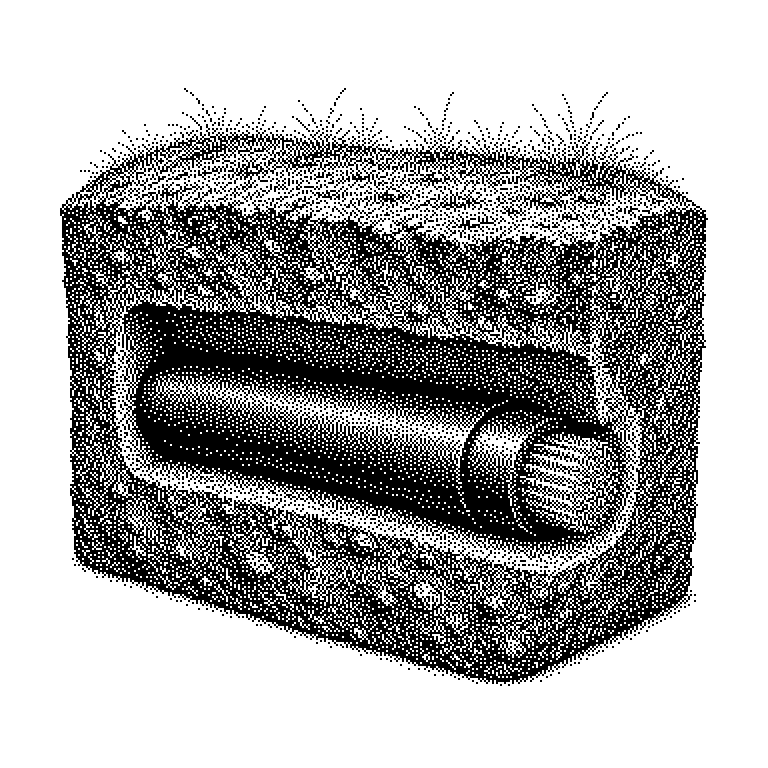
Dark fiber refers to laid fiber-optic cables through which no light has yet been sent and which therefore lie unused in the ground. Companies lease such fibers and operate them with their own equipment instead of buying data lines from a network operator.
Data usually travels over long distances through fiber-optic cables. These are hair-thin strands of glass in which information is transmitted as light signals. Without light, such a strand is simply glass, and it is then called dark. That’s exactly what dark fiber means: fibers already laid, through which no data yet flows. They exist because construction work is the most expensive part of laying cable. Once someone digs a trench, they lay far more fiber into it than they immediately need.
Why unused fibers are worth billions
Digging a trench often costs several hundred euros per meter, depending on the ground. The actual cable is cheap by comparison. That’s why overcapacity pays off: reserves are laid today that won’t be used for another ten years. These reserves later become an asset without anyone having to dig again.
For lessees, dark fiber is above all a question of control. Whoever buys a finished data line gets fixed bandwidth and has to reorder at a higher price if demand grows. Whoever leases the fiber itself connects their own equipment to both ends. If they swap out this equipment, capacity on the same glass increases manyfold, without a new contract.
A second reason is data protection and security. Banks, government agencies, and corporations want to know whose technology is handling their data. On a fiber of one’s own, only one’s own traffic runs, and encryption stays in one’s own hands. A common misconception, incidentally, is that dark fiber is especially fast. The fiber itself is neutral: speed only arises from the equipment at the ends.
What happens when the light is switched on
A fiber-optic cable often contains dozens to hundreds of individual fibers. Usually a fiber pair is leased: one fiber for each direction. The lessor supplies only the glass and guarantees that the route is continuous and mechanically sound. Everything else is up to the lessee.
The lessee installs transmitting and receiving devices at both ends, so-called transponders. Modern technology splits the light into many colors, similar to how a prism disperses sunlight. Each color carries its own data stream. This way, dozens of channels run in parallel on a single fiber without any problem, and total capacity reaches many terabits per second.
Over long distances, the signal weakens and must be amplified along the way. That’s why equipment rooms with power supply are placed along the route. When leasing, the actual cable length also matters, not the straight-line distance. A detour around a river costs money and increases latency, because light has to travel a longer path.
Data centers, exchanges, and AI demand
Dark fiber appears most often in news related to data centers. Operators connect their locations to one another so that data is mirrored and a single outage doesn’t bring everything down. Universities, municipal utilities, and hospital networks also use such routes within a region. They are often laid and leased by power grid operators or railway companies, since these already own their own rights-of-way.
In the financial sector, dark fiber plays a special role. In high-frequency trading, millionths of a second decide profits, and a shorter dedicated fiber to the exchange can provide that edge. Such routes are traded at correspondingly high prices.
Since the AI boom, demand has risen sharply. Training large models is spread across multiple data centers that exchange huge amounts of data. Companies like Meta, Microsoft, or Google are therefore securing long-term fiber rights, often for 20 years or more. Such agreements are called IRUs, a right of use that is economically almost equivalent to a purchase. When stock market news mentions fiber deals without new construction work, it’s almost always about dark fiber.