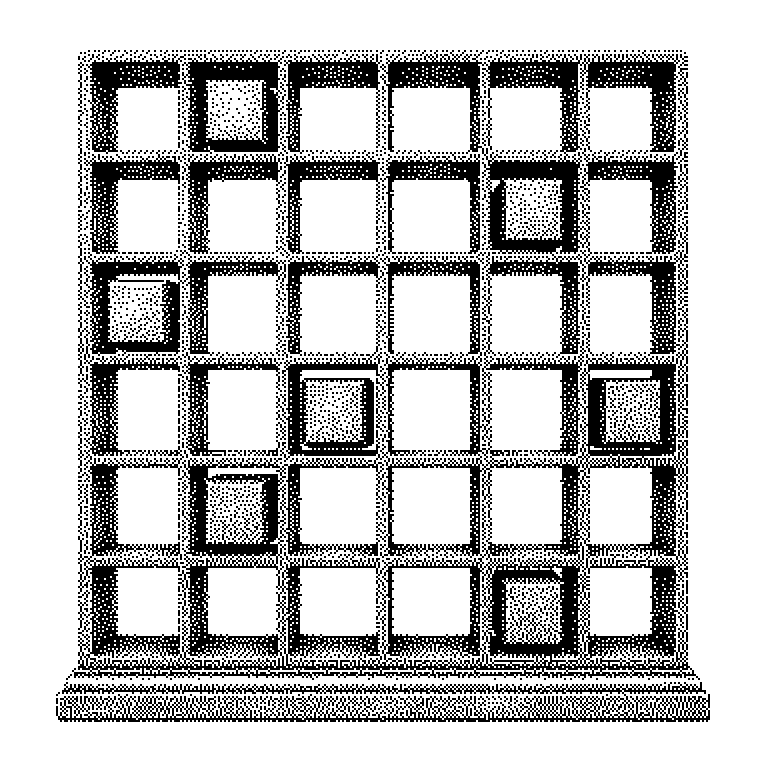
Sparse Matrix
A sparse matrix is a table of numbers in which the vast majority of entries are zero. AI systems exploit this structure to save memory and computing time by storing only the few non-zero values.
A matrix is a rectangular table of numbers — much like a spreadsheet in Excel. Mathematicians and computer scientists constantly work with such tables, for example to represent relationships between things. A sparse matrix is one such table in which almost all fields contain the value zero. Only a small fraction of the entries are non-zero. At first this sounds like a special case, but in practice it’s the normal case: most large data tables in computer science are sparse.
Why zeros become expensive
A naive computer stores every number in a table individually — regardless of whether it is zero or not. For a matrix with a million rows and a million columns, that adds up to a trillion entries. Even if 99.9 percent of these are zero, the table takes up enormous amounts of memory and requires enormous amounts of time for every computation.
This is not an academic problem. Recommendation systems — the algorithms that suggest what to watch or listen to next on Netflix or Spotify — work with tables in which users form the rows and movies or songs form the columns. Most users have rated only a tiny fraction of all movies. The table is therefore more than 99 percent empty. Anyone who still stores these zeros is wasting resources.
How to store only what matters
The trick with a sparse matrix is not to store the zeros in the first place. Instead, you create a compact list: for each non-zero value, you note only three things — the row, the column, and the actual value. A table with a billion fields but only ten thousand non-zero entries then only takes up space for ten thousand records.
There are various technical formats for this compact representation, for example the “Compressed Sparse Row” format (CSR). Here, the non-zero values are sorted by their row, and additionally it is stored where each new row begins in the list. This sounds elaborate, but it enables extremely fast computations, because the computer can process contiguous data in memory especially efficiently.
What matters here is: the mathematical results are identical to those of a full matrix. This is not an approximation or simplification. The same numbers are stored and computed — just more cleverly.
Sparse matrices in AI models and products
In AI, you encounter sparse matrices in many places. Language models like ChatGPT work internally with a representation of words as rows of numbers — so-called vectors. These vectors are often sparse. The connections in a neural network, i.e. the computational web that forms the AI model, can also be deliberately reduced to just a few active connections. This technique is called “pruning” and deliberately creates a sparse structure to make the model faster and more resource-efficient.
Search engines like Google also contain a classic sparse matrix: the so-called term-document matrix, in which each row represents a word and each column a document on the internet. Since no document contains all words, almost all fields are zero. Without sparse storage, an index of the entire internet simply would not fit into a data center.
Specialized libraries such as SciPy in Python, or dedicated hardware units in modern AI chips, specifically accelerate computations with sparse matrices. The distinction between a full (“dense”) and a sparse matrix is therefore among the first decisions developers make when optimizing an AI system for production use.