Matrix Multiplication Exponent
The matrix multiplication exponent, usually called "ω", describes how quickly matrices can be computationally multiplied with one another. The smaller ω is, the more efficiently the operation can be performed — and the faster many AI computations become.
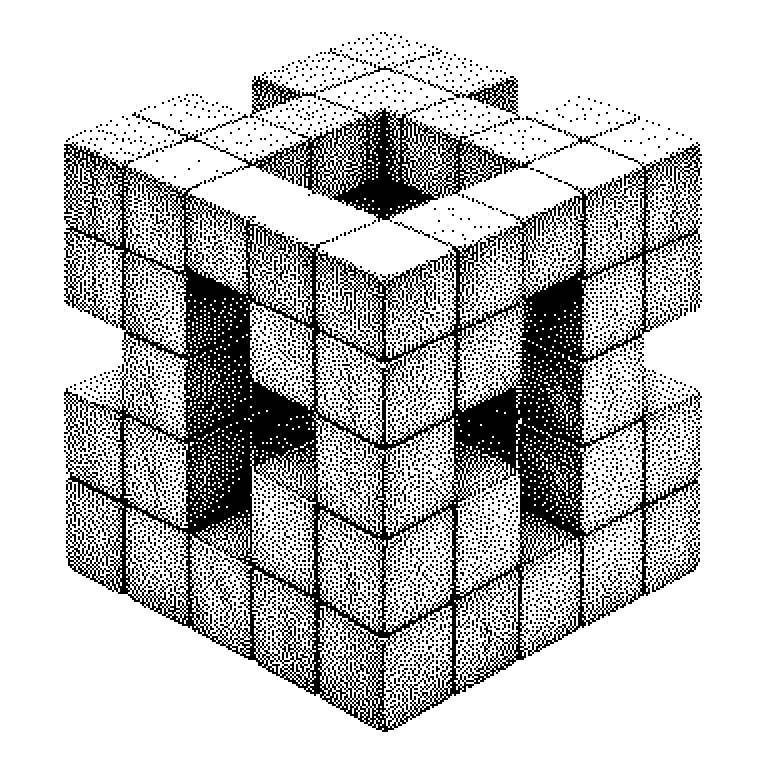
Matrices are rectangular tables of numbers, and multiplying two such tables together is one of the most common computational operations in computer science. But how many individual calculations are needed for this, at minimum? This question lies behind the term “matrix multiplication exponent,” abbreviated ω (lowercase omega). It is a number that indicates how strongly the computational effort grows as the tables get larger. Multiplying an n×n matrix with another costs roughly n^ω computational steps. The naive method, which everyone learns in math class, requires n³ steps — so the naive exponent would be 3. Researchers have been searching for decades for clever algorithms that get by with a smaller ω. The smallest possible value ω can reach is 2 — this would theoretically be optimal, since one must fill at least n² fields in the result table anyway.
Why ω determines the speed of entire AI systems
Neural networks — that is, the models behind voice assistants, image generators, and translation programs — consist at their core of endless numbers of matrix multiplications. Every time a model processes a request, dozens of such operations run one after another. The computational effort for training a large model adds up to quadrillions of such individual steps.
A smaller ω therefore doesn’t affect a single computational step, but rather every matrix multiplication throughout the entire system. If ω drops from 3 to 2.5, matrices twice as large will need significantly less than twice as much time. The larger the models become, the more this factor weighs in. This is the reason why mathematicians and AI researchers consider the lowest possible value of ω to be one of the most important open questions in theoretical computer science.
How researchers are shrinking ω
The first breakthrough came from German mathematician Volker Strassen in 1969. He showed that two 2×2 matrices can be multiplied using just 7 multiplications instead of 8, if the computational steps are cleverly restructured. That sounds like little, but applied recursively — that is, repeatedly to subproblems — it yields an ω of about 2.81 instead of 3.
Since then, ω has been pushed down step by step. The current lowest known value stands at about 2.371 — a result that was slightly improved again in 2024. The latest approaches use sophisticated methods from combinatorics, in which groups of computational operations are arranged so that as many dependencies as possible are eliminated. However, these algorithms are so complex that they are rarely used directly in practice — the advantage only becomes apparent with extremely large matrices, such as those found in scientific computing.
A different logic applies to AI hardware: here, ω is not lowered through a clever algorithm, but through specialized chips that map matrix operations in a single step in hardware. Google's Tensor Processing Units (TPUs) or the Tensor Cores in Nvidia graphics processors are built for this purpose. They don’t mathematically reduce ω in practice, but they increase the number of computational steps that can be completed per second — with a similar effect.
ω in current news and products
In early 2024, a paper by mathematician Josh Alman and his co-author Virginia Vassilevska Williams made headlines because it once again narrowly undercut the known record value for ω. Tech media reported on it because a lower ω means, in the long run: cheaper AI training, faster models, and possibly architectures that are not yet possible today.
In products, ω appears indirectly when chip manufacturers advertise “TFLOPS” — that is, trillions of floating-point operations per second. This figure indicates how many matrix multiplications a chip can perform, and is therefore directly dependent on how efficiently ω can be exploited. Anyone who buys or evaluates a new AI accelerator is essentially buying hardware that is optimized to get step by step closer to the theoretical value ω = 2.
A common misconception: many people confuse ω with the question of how accurately an AI model computes. ω says nothing about the quality of the results — only about how quickly the computational operations can be completed. It is a matter of efficiency, not intelligence.