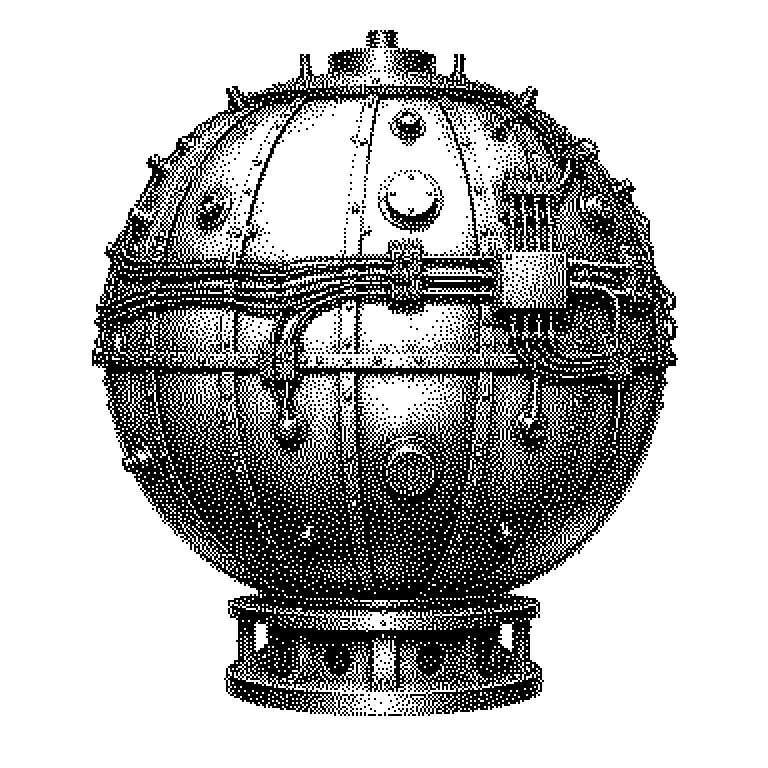
Manhattan Project
The Manhattan Project was the secret U.S. research program that built the first atomic bomb during World War II. In today's tech debates, the name serves as a buzzword for a massive, government-led crisis project – often in connection with artificial intelligence.
The Manhattan Project was a secret U.S. research and construction program running between 1942 and 1946. Its goal was to build the first atomic bomb before Germany could achieve the same. At the time, the state poured roughly two billion dollars into it, equivalent to about 30 billion dollars in today’s purchasing power. At several secret sites, more than 120,000 people worked at the peak, most of them without knowing what they were actually helping to build. In July 1945, the first bomb was tested in the New Mexico desert, and just a few weeks later the U.S. dropped two bombs on the Japanese cities of Hiroshima and Nagasaki. Today the name mostly appears as a comparison when talking about very large government technology programs.
Why the name keeps coming up in AI debates
Anyone who says “Manhattan Project” today rarely means a history lesson. The term has become shorthand for: the state takes a technology seriously as a national emergency and pours money and personnel into it. In the U.S. in 2024, a congressional commission proposed launching a “Manhattan Project for AI.” What was meant was a state-funded program meant to ensure American models are finished before Chinese ones.
The comparison is so popular because it conveys two things at once. First: it’s about enormous sums and a race against an opponent. Second: the technology could be dangerous. But it is precisely this double meaning that also makes it problematic. Critics point out that the original was a weapons program and that the comparison generates fear where a sober debate would be needed.
There is a second interesting point that plays a role in the financial world. The Manhattan Project was entirely government-controlled. With AI, however, the money, data centers, and experts lie with private companies. A state wanting to launch such a program today would first have to bring these companies on board. This is one of the reasons why the comparison is often considered technically off the mark.
How research turned into a bomb in three years
The scientific foundation had been discovered in Germany in 1938: nuclear fission. In this process, the nucleus of a heavy atom splits and releases energy. Splitting nuclei trigger further nuclei, creating a chain reaction. Whether a weapon could be built from this was initially completely uncertain. The project therefore had to conduct research and carry out industrial production at the same time.
The hardest part was not the physics but the raw material. Only certain variants of uranium and plutonium are suitable, and they hardly occur in pure form in nature. That’s why a gigantic facility solely for enriching uranium was built in Oak Ridge, Tennessee. In Hanford, in the state of Washington, reactors were built that produced plutonium. These factories at times consumed more electricity than entire major cities.
The third site was Los Alamos in New Mexico, led by the physicist J. Robert Oppenheimer. There, a team of theorists and engineers designed the actual bomb. The sites barely knew about one another; each only knew its own part. This principle of strict isolation is called compartmentalization, and it is still considered a model for secret large-scale projects today.
Where you encounter the Manhattan Project today
Most recently, the subject was most visible on the big screen. Christopher Nolan’s 2023 film “Oppenheimer” tells the story of the project and won seven Oscars. As a result, many people know the basic outlines without ever having opened a history book on the topic. This also explains why the comparison ignites so quickly in discussions.
In business and tech news, you usually encounter the term in a specific phrasing: “a Manhattan Project for X.” It has already been used for cancer research, for battery technology, for climate protection, and, of course, for AI. It always refers to the same pattern: a clearly defined goal, a tight timeline, and a lot of public money. Whether the pattern fits the respective problem is the actual point of contention.
A common misconception, by the way, is that the project was located in New York. The name only came from the Army’s administrative district, which was initially based in Manhattan. The actual work took place in remote areas, precisely in order to hide it. So if you see the term in a headline, it is almost never about a place – but about a scale.