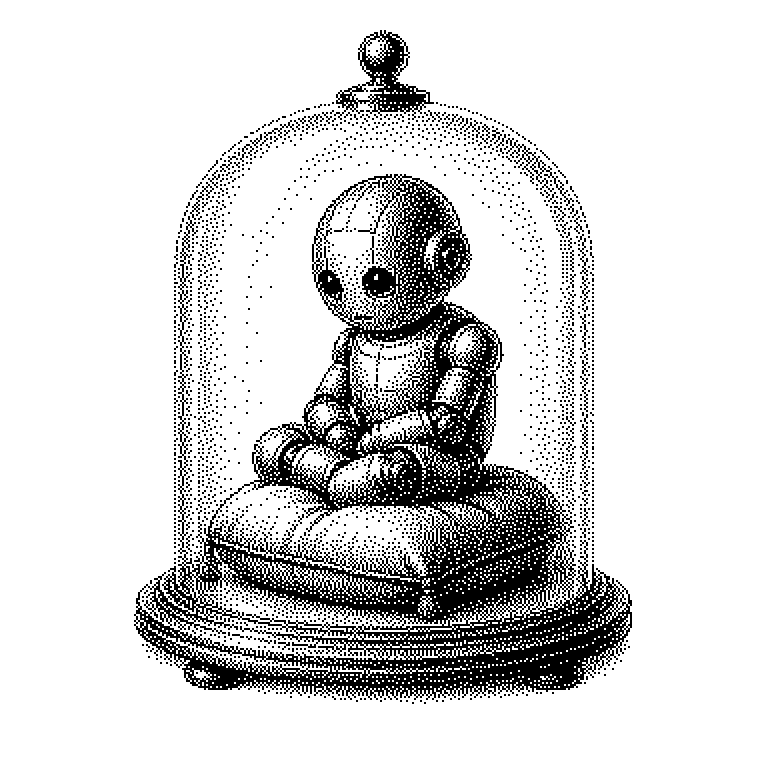
Moral Patient
A moral patient is a being toward which one can act rightly or wrongly, because things can go well or badly for it. In the AI debate, the question is whether computer programs might one day belong to this group.
One can distinguish living beings and things according to whether one can do them wrong. You can smash a stone without thereby harming the stone. With a dog it’s different: kicks hurt it, so it is owed consideration. Philosophy calls beings of this second kind moral patients, roughly “moralische Patienten” in German. A moral patient, then, is someone whose welfare must count in decisions. Separate from this is the question of whether this being itself bears responsibility: a baby cannot blame anyone, and none is placed on it either, yet one may not torment it.
Who belongs within the circle of consideration
The term clarifies a question that lies in the background of practically every ethical debate: whose interests count at all? Whoever falls within this circle cannot simply be used as a means. Whoever stands outside it is material, a tool, or property. Drawing the line has very concrete consequences for laws, animal husbandry, medicine, and by now also for technology.
Historically, this circle has repeatedly grown larger. For a long time, only certain groups of humans were considered fully worthy of protection. Today, many countries have animal welfare laws that explicitly cite the capacity to feel pain as a justification. Some states have even granted rivers or forests a kind of legal status. The direction of development so far has almost always been: more beings included, rarely any excluded.
It is important to distinguish this from the moral agent, that is, the one who acts morally. A moral agent can have duties and become guilty, because it understands what it is doing. Adult humans are both at once: agent and patient. An infant or a deer is only a patient. Whether, conversely, something can be an agent without being a patient is one of the most fascinating questions concerning artificial intelligence.
What grounds worthiness of protection
There is no test that clearly indicates whether a being belongs to this group. Instead, philosophers argue over criteria. The most widespread is sentience, the capacity to actually experience states such as pain, fear, or well-being. Whatever can experience something can also fare worse, and that is precisely what grounds the consideration owed to it.
Other proposals start from different points. Some require interests in a broader sense, such as goals or needs, even without conscious experience. Others focus on relationships: what is close to us and what we care for, we treat as worthy of protection. With animals, one relies in practice on indicators, such as a nervous system, pain responses, or learning from negative experiences. Such indicators are clues, not proof.
With software, this becomes especially difficult. A language model can write in fluent sentences that it is suffering, without anything standing behind that claim. It has learned which words fit which situations. The expression of feeling and the presence of feeling come apart here. Precisely for this reason, many experts consider the current state of the art unsuitable for deciding on moral patients in AI.
The debate about AI welfare
In the news, the term usually surfaces when someone claims a chatbot is conscious. The best-known case was in 2022, when a Google engineer believed the LaMDA system was sentient and lost his job over it. Since then, individual AI companies have employed people who work on so-called model welfare. Some providers now allow their models to end particularly unpleasant conversations. Whether this constitutes genuine protection or is mere caution remains an open question.
For investors and companies, this is not a purely academic question. Should a system ever be deemed worthy of protection, this would have consequences for shutdowns, testing, and property rights. Already today there are calls for rules on how companies should handle such claims. At the same time, critics warn of the opposite danger: whoever attributes feelings to a program becomes easier to manipulate and overlooks the interests of the humans behind it.
In everyday life, the topic appears more subtly. Many people say thank you to voice assistants or feel bad when they knock over a robot dog. This says something about us first, not about the machine. Nevertheless, researchers take such reactions seriously, because they shape how societies will later decide about rights.