Minibinder
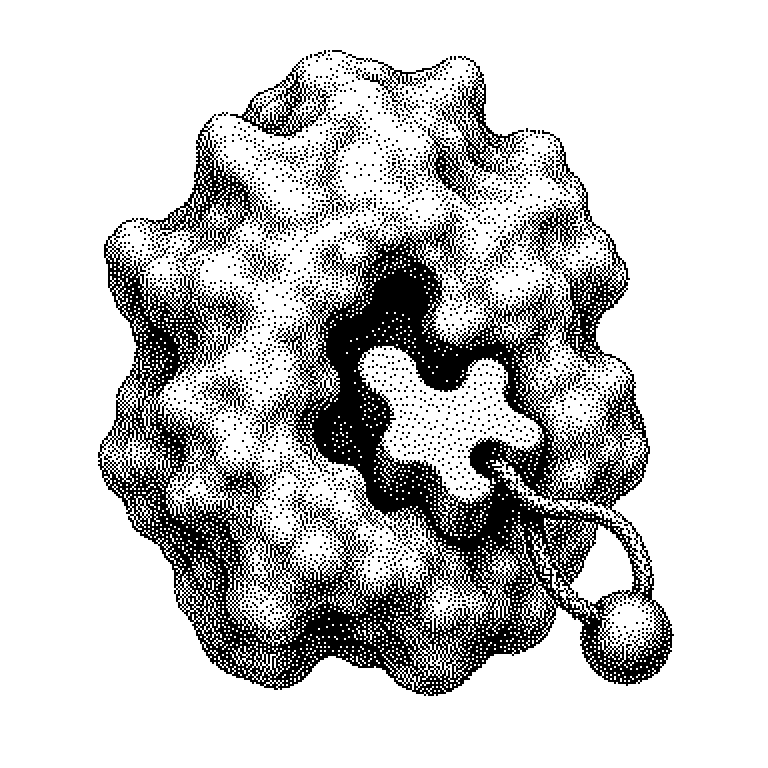
A minibinder is a very small, artificially designed protein that attaches precisely to a specific site on another protein. Such molecules are nowadays mostly designed by AI programs and are considered promising candidates for new drugs and rapid tests.
Proteins are tiny building blocks that living organisms are made of and that carry out almost all tasks within the body. Many of them work by attaching to another protein and thereby blocking or activating it. A minibinder is a particularly small protein that has been designed on a computer for exactly this purpose. It is meant to attach to a predetermined site on a target molecule, much like a key fits a specific lock. Unlike natural proteins, a minibinder does not occur in any living organism. It is invented entirely from scratch, nowadays almost always with the help of artificial intelligence programs.
Why tiny proteins are changing the search for drugs
Until now, medicine has relied mainly on antibodies when a particular molecule in the body needs to be stopped. Antibodies are natural defense proteins and work well, but they are large and sensitive. Producing them is expensive, and they usually have to be stored refrigerated and administered by injection. A minibinder is often twenty to fifty times smaller. This makes it more stable, cheaper, and easier to handle.
Such small proteins can be produced in large quantities by bacteria. Some even withstand weeks at room temperature without breaking down. For poorer regions without a continuous cold chain, this would be a major advantage. In addition, small molecules can penetrate tissue that an antibody can barely reach, such as deep inside a tumor.
The second reason for the great interest is speed. In the past, researchers spent years searching for a suitable active substance, often by trying out millions of variants. With AI-based design, usable candidates can now be produced within days. This shifts the bottleneck from the search itself to laboratory testing.
From target molecule to finished design
The starting point is the target structure: one needs to know what the protein to be attacked looks like. This three-dimensional shape is known from measurements or from predictions made by programs such as AlphaFold. Next, a specific site on the surface is chosen, the so-called binding site. Usually, this is exactly the spot where the target molecule carries out its harmful activity.
After that, an AI model designs a matching counter-shape. Programs like RFdiffusion work similarly to image generators: they start with a random cloud of points and gradually shape it, step by step, into a meaningful structure. A second program then calculates which sequence of amino acids could produce this shape. Amino acids are the chain links that every protein is built from. A typical minibinder consists of about 50 to 70 such links.
The final step is crucial: the laboratory. The AI often suggests thousands of candidates, most of which do not work. These are produced by bacteria and measured individually. Hit rates of just a few percent are already considered very good, since in the past they were close to zero.
Where minibinders are already appearing today
Minibinders are furthest along in their development against viruses. During the Covid pandemic, a team at the University of Washington designed small proteins that blocked the virus’s spike protein. In animal testing, they protected against infection when used as a nasal spray. Successful designs also now exist against influenza viruses and snake venom.
A second field of application is tests and sensors. Anyone wanting to reliably detect a molecule needs something that binds only to it and nothing else. This is exactly what a minibinder achieves, and it is more durable than an antibody in the process. Rapid tests that require no refrigeration are conceivable.
In business news, the term comes up in the context of biotech companies like Xaira or EvolutionaryScale, which are raising large sums of money for AI-driven protein design. David Baker received the 2024 Nobel Prize in Chemistry partly for this work. A common misconception is to confuse minibinders with classic pill-form drugs. These are much smaller still and chemically constructed in a completely different way. And so far, no minibinder has been approved as a drug.