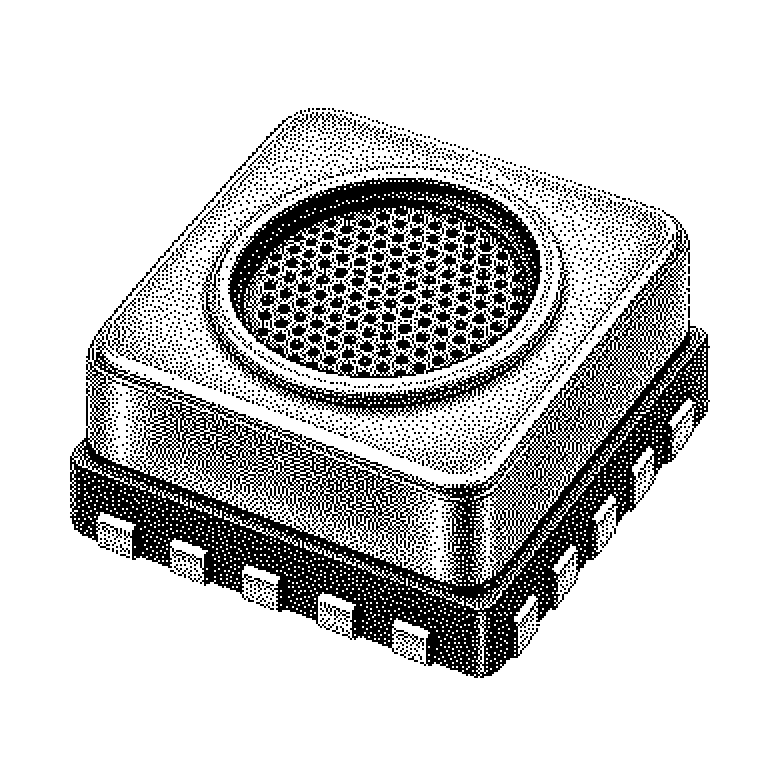
MEMS microphone
A MEMS microphone is a tiny microphone whose sound-sensitive part is etched directly onto a silicon chip. Almost every smartphone, laptop, and voice assistant uses this design because it is only a few millimeters in size and very cheap to manufacture.
A microphone converts sound into an electrical signal. To do this, it needs a thin membrane, that is, a wafer-thin skin that is set into vibration by air pressure. In a MEMS microphone, this membrane does not sit inside a metal housing, but is etched directly into a silicon wafer. Silicon is the same material that computer chips are made of. The abbreviation MEMS stands for micro-electromechanical systems: tiny movable components that are manufactured using chip-fabrication processes. This is how microphones smaller than a matchstick head are made, and yet they still hear reliably.
Why there are several of them in every phone
Classic microphones are assembled individually. MEMS microphones, on the other hand, are produced by the thousands simultaneously on a round silicon disc, a so-called wafer. Afterwards, the disc is sawn apart. This makes the individual component extremely cheap: it often costs less than one euro.
The second advantage is uniformity. Two microphones from the same production run sound almost identical. This is important when a device uses several microphones at the same time. A modern smartphone has three to four, a smart speaker sometimes seven or more.
With several microphones of the same kind, software can calculate which direction a sound is coming from. This is because the sound reaches the microphones with tiny time differences. From this, the speaker’s voice can be amplified and street noise can be calculated out. Without cheap, uniform MEMS manufacturing, this would not be affordable in a phone.
From vibrating membrane to a sequence of numbers
Inside, the silicon membrane sits a few micrometers above a fixed counter-plate. Together, both form a capacitor, that is, a component that stores electrical charge. When sound hits the membrane, the distance changes. This also changes the stored charge, and a tiny voltage fluctuation is produced.
This signal is so weak that it would be useless on its own. That is why a second small chip, the amplifier, sits in the same housing. In digital MEMS microphones, this chip also handles the conversion into numbers. It measures the voltage many thousands of times per second and outputs the readings as a data stream.
A common misconception: that MEMS microphones are worse than large studio microphones. When it comes to noise and maximum volume level, this is still often true. In uniformity and robustness, however, they are superior. They withstand the heat of soldering and barely react to vibrations. That is why they are also found in headphones, hearing aids, and cars.
The component behind voice assistants and wake words
Every time you say “Hey Siri” or “Alexa,” a MEMS microphone is listening. These fixed trigger words are called wake words. A very small AI program in the device continuously checks whether the word has been spoken. Only after that is the actual speech recognition started, often in a data center.
For this to run around the clock, the microphone has to be extremely economical. Some models need less than one milliwatt. For comparison: a phone display consumes several hundred milliwatts. This very economy is precisely the reason why continuous listening is practical at all.
In business news, MEMS microphones usually appear as a component business. A few manufacturers from Europe, the US, and Asia share the market, and billions of units are sold every year. As the number of voice-controlled devices grows, this market grows along with it. They are now also found in noise-cancelling earbuds and in sensors that listen to machines.