Microviridae
Microviridae are a family of very small viruses that infect bacteria and carry their genetic material as single-stranded DNA within a spherical shell. Their best-known member, phiX174, is one of the most important model organisms in genetics and today serves as a standard control in DNA sequencing devices.
Microviridae are a group of viruses that infect exclusively bacteria. Such bacterial viruses are called phages; they are harmless to humans. Their blueprint is stored in DNA, the molecule that carries genetic information in all living organisms. Unlike in us, however, this DNA is present here only as a single strand, not as a double strand. The viruses are also extremely small and simply built: a sphere made of protein, containing genetic material with only about a dozen sets of building instructions. The name comes from the Latin “micro” for small, and the ending “-viridae” denotes a virus family in biology.
phiX174 as the yardstick of genetics
The best-known member of this family is called phiX174. In 1977, it was the very first organism whose complete genetic material was ever decoded. Frederick Sanger and his team read off all 5,386 building blocks in sequence. This earned a Nobel Prize, and the method shaped genetics for decades.
The reason for this choice was size. Human genetic information comprises around three billion building blocks, phiX174 only about five thousand. Anyone wanting to test a new method sensibly starts with the simplest case. The same argument still holds today: phiX174 is so precisely measured that any deviation in reading immediately stands out as a device error.
That is why Microviridae are also technically relevant, not just biologically. They serve as a reference standard, similar to a certified weight used in scale calibration. Without such controls, one could hardly trust the results of modern sequencing devices.
A genome in which genes overlap
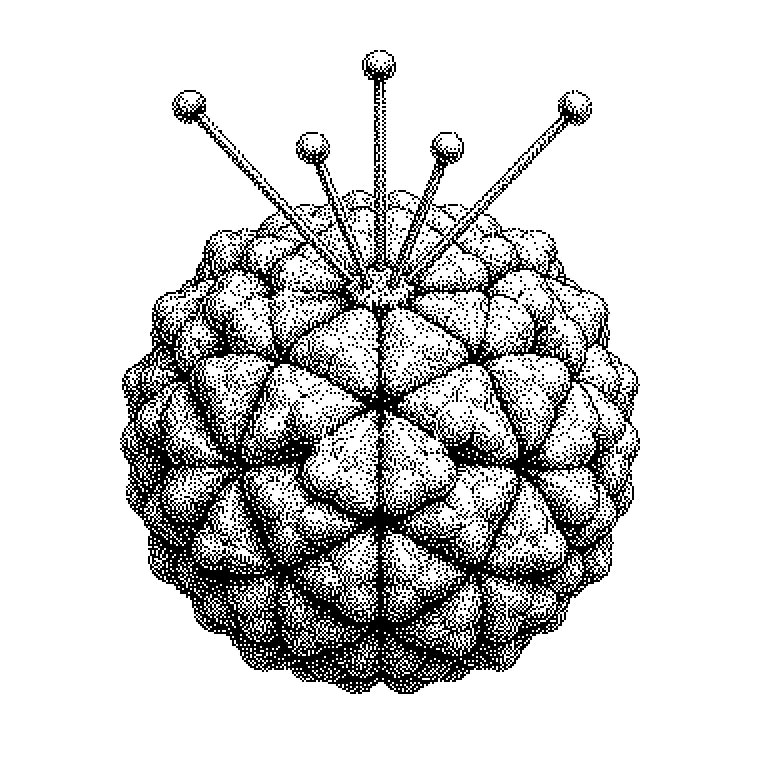
The viral sphere consists of twenty triangular faces, similar to a soccer ball made of protein building blocks. At the corners sit spikes, with which the virus attaches to the surface of a bacterium. It then pushes its DNA strand into the cell. The empty shell remains outside.
Inside the cell, the single strand is first completed into a double strand. Only this form can be read by the bacterium, since its machinery is set up for double strands. The virus then takes over the cell as a factory: it produces new shells and new genetic strands. In the end, the bacterium bursts and releases hundreds of new viruses.
Particularly notable is the economy of the genome. Some genes overlap, meaning the same DNA segment is used for two different proteins. It is read with a shift of one building block, yielding a completely different set of instructions. This allows more information to fit into a small space than would seem possible.
From the gut microbiome to the sequencing lab
Microviridae occur wherever bacteria live. Large quantities are found in the human gut, in seawater, and in soil. Studies of the microbiome, that is, the totality of microorganisms in the body, regularly encounter them. What exact role they play there has not yet been conclusively determined.
In the news, the term usually appears in two contexts. First, in genome research, where phiX174 is mentioned as a control sample. Second, in synthetic biology: in 2003, a team artificially assembled the complete phiX174 genome in the laboratory. This was an important step toward self-designed organisms.
A common misconception is confusing them with viruses that make humans sick. Microviridae cannot infect human cells, as they lack the matching docking site. They are also often confused with the better-known T4 phages, which have a head with a tail. Microviridae have no tail and are considerably smaller.