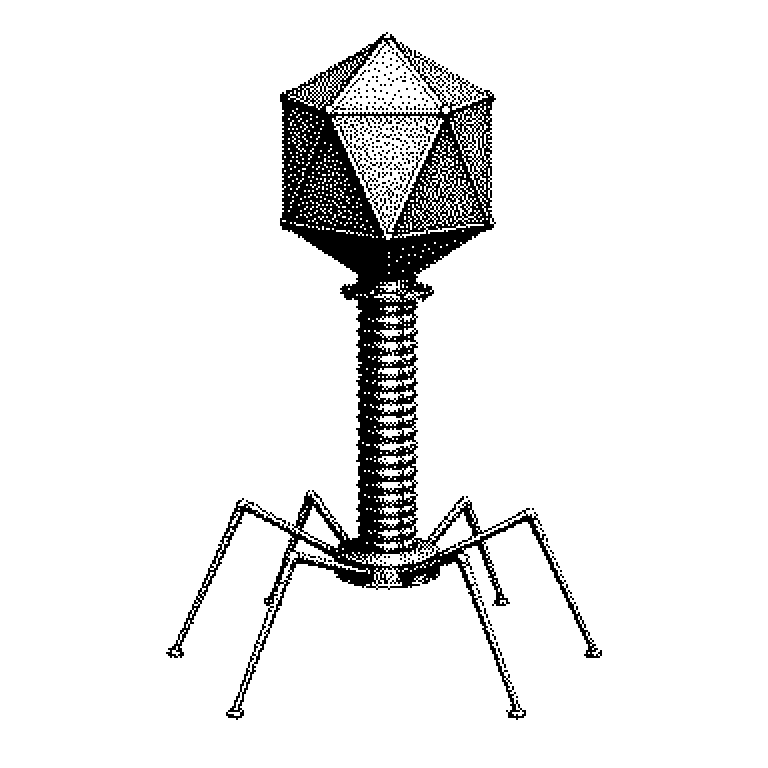
Phi X-174
Phi X-174 is a tiny virus that infects bacteria, its genetic material only about 5,400 building blocks long. In 1977 it became the first living thing whose genome was fully decoded, and today it serves as a standard test object in genetic research and in AI models for biology.
Phi X-174 is a virus that infects only bacteria, not humans. Viruses of this kind are called bacteriophages, literally “bacteria eaters.” Phi X-174 is especially small: its blueprint consists of roughly 5,400 chemical building blocks and describes only eleven components. By comparison, the human blueprint comprises about three billion such building blocks. Because Phi X-174 is so manageable, it became one of the most important test objects in biology. In 1977, a group led by the Briton Frederick Sanger succeeded in writing down its complete blueprint building block by building block — a world first that earned Sanger a Nobel Prize.
The first fully read organism
The genetic material of living things is stored in a molecule called DNA. This DNA consists of a long chain of four different building blocks, abbreviated A, C, G, and T. The order of these letters is the actual information. Until the 1970s, no one could read out this order for an entire genome. Phi X-174 was small enough to attempt it first.
The success of 1977 showed that genetic material is fundamentally readable. Everything that came afterward followed the same principle on a larger scale. The Human Genome Project, which decoded human DNA starting in 1990, used further-developed versions of Sanger’s method. Phi X-174 was thus the proof of concept that guided everything that followed.
In 2003, a second milestone was added. A team led by Craig Venter assembled the genome of Phi X-174 in the lab entirely from individual building blocks — and the artificial virus worked. This made Phi X-174 not only the first genome ever read, but also one of the first synthetically written genomes.
A genome that overlaps itself
Phi X-174 uses its scarce space with a trick that surprised researchers. Some sections of its genome are used twice: the same sequence of letters yields two different blueprints depending on the starting point. You can picture it like a strip of text where, depending on where you start reading, you get a different word. This way, the virus fits eleven components into a space that would actually be enough for fewer.
The course of an infection is simple. The virus docks onto an intestinal bacterium and pushes its DNA inside. The bacterium’s machinery reads this foreign blueprint and builds new viruses from it. After about 20 minutes, the cell bursts and releases hundreds of new viruses. The virus itself thus brings along almost nothing but the information.
An important distinction: Phi X-174 has single-stranded DNA, meaning its genome is just a single strand rather than the usual double helix of two intertwined strands. Only inside the bacterium does it temporarily become a double strand. This peculiarity made it additionally interesting for basic research.
From lab standard to AI dataset
Today, Phi X-174 is mostly encountered as a control sample. Modern sequencing devices that read out genetic material routinely mix a small amount of PhiX DNA into every measurement. Because the correct answer has been known since 1977, it’s possible to immediately check whether the device is working correctly. In practice, labs simply call this addition a “PhiX spike-in.”
The name resurfaced in AI coverage in 2024 and 2025. Companies such as Microsoft, Arc Institute, or Google DeepMind train large models not on text, but on DNA sequences. Such models are meant to predict which genetic change has which effect. Phi X-174 serves as a touchstone here: can a model design a functioning viral genome that actually infects bacteria in the lab? Exactly this was demonstrated in 2025 with AI-generated PhiX variants.
This puts Phi X-174 at the center of a safety debate as well. It is considered harmless to humans and is therefore an acceptable practice object. Critics point out, however, that the same methods could be transferred to more dangerous viruses. Anyone reading news about “AI-designed viruses” should therefore look closely: what is usually meant is this tiny bacteria eater, not a pathogen for humans.