Punch Card
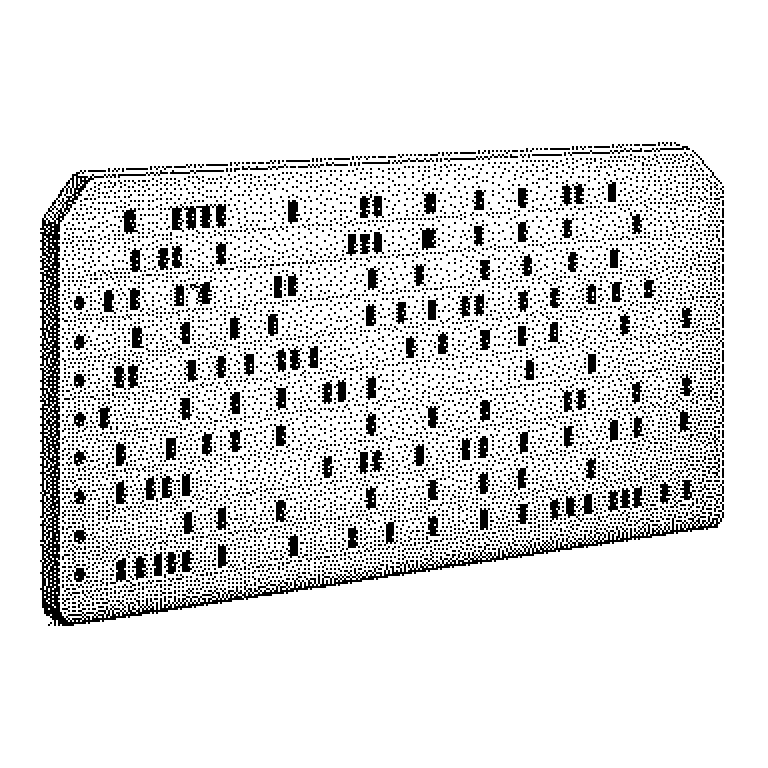
A punch card is a piece of stiff cardboard into which holes are punched at specific positions. The position of the holes represents numbers, letters, or commands — punch cards were the most important storage medium of data processing for decades.
A punch card is a rectangular piece of stiff cardboard, roughly the size of a banknote. Small holes are punched into this cardboard at precisely defined positions. A machine scans the card and detects where there is a hole and where there isn’t. From this pattern, it reads out a number, a letter, or an instruction. Before there were hard drives, USB sticks, or memory cards, this was for decades the common way to store data and feed it into a computing machine. A single card held roughly 80 characters, about one line of text.
The beginning of machine-based data processing
The punch card is the point at which computing first became industrial. It became famous through the 1890 US census. Evaluating the 1880 census had taken almost ten years, all done by hand. With Herman Hollerith’s punch card machines, the evaluation was completed much faster. Hollerith’s company later became the IBM corporation.
Until the 1970s, wages, insurance, timetables, and inventory were all handled via punch cards. Programs, too, were entered this way: each line of program code was a card, and a program was an entire stack of cards. Anyone who dropped the stack had a real problem, since the order was the program logic. For this reason, a diagonal line was often printed on the edge of the cards, so that misplaced cards could be spotted immediately.
Today the term mostly appears as a benchmark for comparison. When talk turns to the rapid development of computing power, the punch card serves as the starting point. A modern chip processes more data in one second than was ever punched onto punch cards. The principle of storing information as yes-no states has also survived — it’s just called a bit today.
Holes as code
The most common card had 80 columns and 12 rows. Each column represented exactly one character. Which character was meant depended on which rows in that column had holes. A digit needed one hole, a letter needed two, and some special characters needed three. This pattern was a fixed code that both machine and human could look up alike.
Punching was done on a card punch, a device with a typewriter-style keyboard. You typed a line, and the device punched the corresponding holes. To read the cards, a card reader pulled them through one by one. Early models used metal pins that made an electrical contact through the holes. Later devices worked with light: where there was a hole, light passed through and hit a sensor.
It’s important to distinguish between storage and computation. The card itself did not compute anything; it merely recorded information. The computing was done by the machine into which the stack was fed. The card thus corresponds more to a modern hard drive than to a processor. A common misconception is also equating punch cards with punched tape — punched tape consists of long paper strips and cannot be individually resorted.
Where punch cards still show up today
As a storage medium, the punch card has disappeared. Nevertheless, one encounters it in surprising places. In the disputed 2000 US presidential election in Florida, ballots were counted using the punch card principle. Because some holes had not been cleanly punched through, paper fragments got stuck and the machines miscounted. The incident is still considered the standard example of the risks of poorly chosen technology.
The punch card also lives on linguistically. The term “batch,” meaning processing an entire stack at once, comes directly from this era. In AI development, one now speaks of batch size when a model processes many examples together. The underlying idea is the same as back then: not one at a time, but as a batch.
In tech news, the term usually serves as an image for something outdated. When someone writes that a method dates “from the punch card era,” that’s not a factual statement but criticism. In museums and computer science courses, on the other hand, the card remains a useful teaching object: it makes visible what remains invisible inside a chip — that in the end, all digital data consists of just two states.