PCM
PCM is the standard method for turning sound into numbers: sound pressure is measured many thousands of times per second, and each measurement is stored as a number. Almost every digital audio recording – from CDs to voice messages – exists in this form at some point.
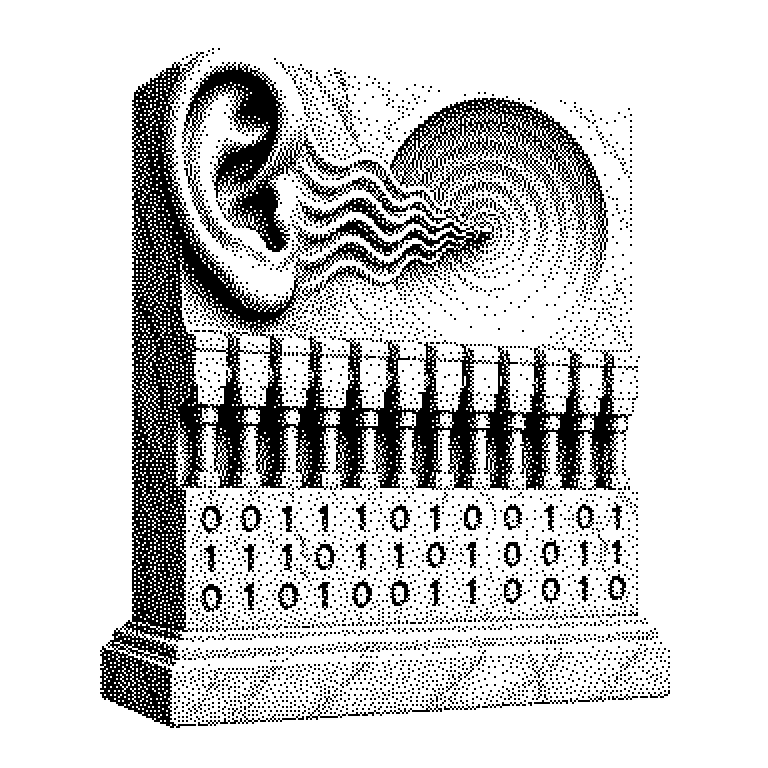
Sounds are fluctuations in air pressure. A microphone converts these fluctuations into a fluctuating electrical voltage. But a computer can’t do anything with such stepless fluctuations, it only understands numbers. PCM is the method that closes this gap: it measures the voltage many thousands of times per second and writes down each measurement as a number. A continuous wave thus becomes a long list of numbers. The abbreviation stands for Pulse Code Modulation, a name originating from 1930s telephone technology.
The format everyone agreed on
PCM is the common language of digital audio technology. An audio CD stores PCM, as do WAV files on a computer and the audio track of a Blu-ray. Even when you listen to music as MP3, it is converted back into PCM shortly before playback. This is because the chip that ultimately drives the speaker understands nothing else.
It is also important that PCM is uncompressed. Unlike MP3, it doesn’t discard any information to save space. That’s why sound studios and music producers work with PCM files: every edit starts from the complete recording. The price for this is file size. One minute of CD quality takes up about ten megabytes, whereas as MP3 it’s about a tenth of that.
This is also relevant for AI systems. Speech recognition, voice cloning, and music generators almost always expect their input as a PCM number sequence. Before a language model understands a word, the sentence exists as a list of measurements. What the model does with that is a second step.
Sample rate and bit depth
Two numbers determine how accurately PCM captures sound. The first is the sample rate: how often per second a measurement is taken. A CD measures 44,100 times per second, written as 44.1 kHz. The reason for this is a rule from signal theory: you must sample at least twice as often as the highest frequency you want to capture. Humans hear up to about 20,000 hertz, so a good 40,000 measurements are enough.
The second number is the bit depth: how finely each individual measurement is resolved. At 16 bits, 65,536 possible levels are available. Each measured value is rounded to the nearest level. This rounding is called quantization and is the actual loss inherent in PCM. When audible, it sounds like faint background noise. Studios therefore often record at 24 bits, where there are over 16 million levels.
A vivid image is a fever thermometer read once a minute. The sample rate corresponds to the rhythm of the readings, the bit depth to the number of decimal places. If you read too rarely, brief fever spikes are missed. If you round too coarsely, small differences disappear. Together, both determine how close the number sequence stays to the original.
PCM in devices and headlines
In everyday life, you usually encounter PCM in a settings menu. In the audio options of a TV or a game console, there’s often a choice between “PCM” and “Bitstream”. PCM there means the device decodes the sound itself and passes it on ready-made to the system. Bitstream means it passes the unprocessed signal through to the amplifier. Both paths lead to the goal, it’s just that a different device does the processing.
The term also appears with voice assistants and transcription services. Anyone using a speech recognition interface often has to upload audio data in a specific PCM format, for example 16-bit at 16 kHz. This requirement appears in practically every piece of technical documentation for such services. It’s the reason developers regularly come across the term.
One common confusion: PCM is not a file format but an encoding method. A WAV file is, so to speak, the packaging, PCM the content inside it. The abbreviation itself is also confusing, since in the semiconductor industry PCM stands for Phase-Change Memory, a storage technology. Which meaning is intended is almost always revealed by context.