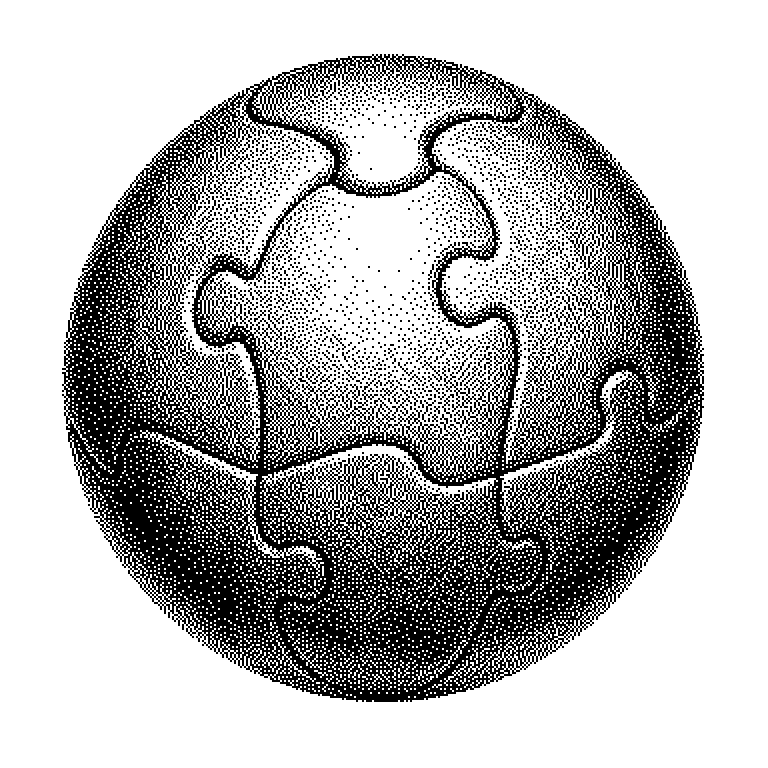
Poincaré Conjecture
The Poincaré conjecture is a famous mathematical claim about the shape of three-dimensional spaces: any space that, in a certain sense, has no holes and no boundary is essentially a sphere's surface. It was proposed in 1904 and was only proven in 2002/2003 by Grigori Perelman.
The Poincaré conjecture is one of the most well-known statements in mathematics. It deals with the question of how one can recognize the shape of a space without seeing it from the outside. The French mathematician Henri Poincaré proposed it in 1904. Roughly speaking, it claims: a closed three-dimensional space without holes and without boundary can always be deformed into a sphere’s surface. “Deformed” here means stretching and compressing, but not cutting and not gluing. For almost a hundred years, no one could prove that this claim was true.
A century-old problem with prize money
In the year 2000, the Clay Mathematics Institute in the USA put seven problems on a list of the most important open problems in mathematics. A million US dollars was offered for each of them. The Poincaré conjecture was on this list. To this day, it is the only one that has been solved.
The significance lies not in the prize money, but in the question behind it. Mathematicians want to know what shapes three-dimensional spaces can even take. For surfaces, this was already clarified in the 19th century: there is the sphere, the ring with one hole, the one with two holes, and so on. In three dimensions, the hole-free case was the most difficult building block of such an overview. The Poincaré conjecture was thus not an isolated question, but a missing piece in a larger picture.
A side effect: cosmology is also interested in such statements. No one can observe the universe from the outside. If one wants to determine its shape, one needs criteria that can be checked from within. This is exactly what this branch of mathematics, called topology, is about.
The rubber-band test and Perelman’s proof
The core of the conjecture is a simple test. One places a closed loop, say a rubber band, into the space. Then one tries to pull it together to a single point without leaving the space. On a sphere’s surface, this always works. On a car tire, it doesn’t: a band placed through the hole gets stuck. Poincaré conjectured that this test suffices in three dimensions to recognize the shape of a sphere.
The proof came from the Russian mathematician Grigori Perelman. He published it in 2002 and 2003 in three short papers on the internet, without a journal. His tool was the Ricci flow, an idea by Richard Hamilton. The space is treated like a dented surface that smooths itself out. Mathematically, the curvature at every point is gradually evened out, similar to how heat spreads through a piece of metal.
The problem: during the smoothing process, spots can arise where the space becomes infinitely thin and the calculation breaks down. Perelman showed how to operate at such spots, continue the calculation, and maintain control. In the end, only the spherical shape remains. Several working groups checked the proof for years and found no errors.
Perelman’s refusal and the role in the media
The case became well-known above all because of Perelman’s behavior. In 2006 he received the Fields Medal, the highest honor in mathematics, and declined it. In 2010 he also turned down the million dollars from the Clay Institute. Among his reasons, he stated that Hamilton’s contribution was not being adequately acknowledged. Since then he has been living in seclusion in Saint Petersburg.
In news reports and debates, the Poincaré conjecture today often serves as an example. It shows that some problems take decades and are not solved by more computing power. When discussions turn to AI systems that are supposed to prove mathematics, it comes up as a benchmark: such proofs consist of new concepts, not of long calculations. No program today could find Perelman’s line of reasoning on its own.
A common misconception is that the conjecture is only interesting for three dimensions. In fact, the three-dimensional case was the last one left open. For five and more dimensions, the proof had already existed since the 1960s, and the four-dimensional case was settled in 1982. Of all things, the dimension in which we live turned out to be the hardest.