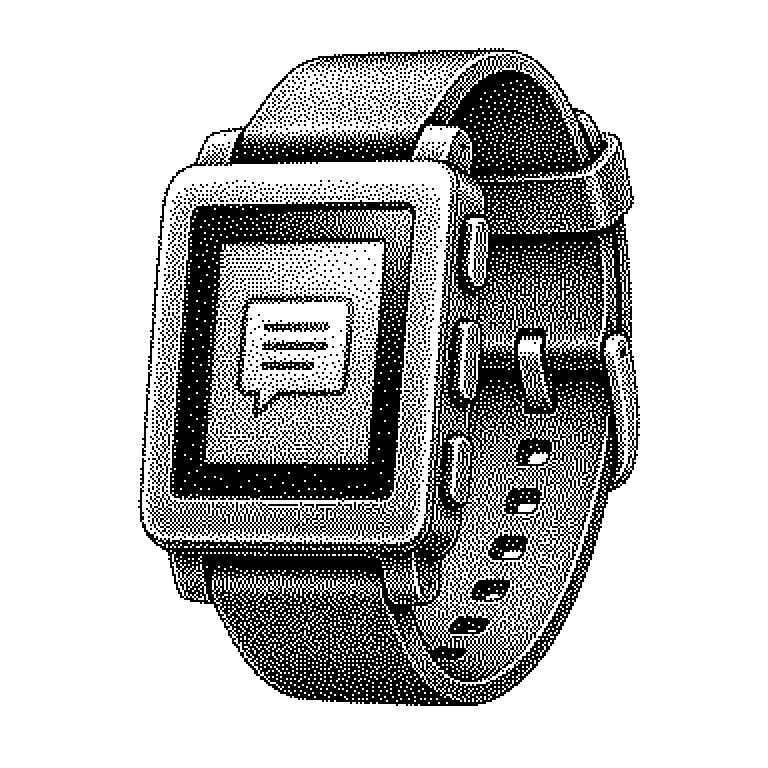
Pebble
Pebble was one of the first successful computer watches: a wristwatch with a small screen that displayed messages from a phone. It was funded in 2012 via an online crowdfunding platform, where it broke all records, and was sold in 2016.
Pebble was a wristwatch with a small screen that connected wirelessly to a phone. It showed who was calling, which message had arrived, and how far you had walked that day. Such watches are called smartwatches, literally “clever watches”. Behind Pebble stood a small company from the USA, founded by the Canadian Eric Migicovsky. The money for the first production run was raised in 2012 directly from future customers on the internet. Instead of the hoped-for 100,000 dollars, over 10 million came together. For years, this made Pebble the most well-known example that a product can be created without a big corporation behind it.
The record that made crowdfunding famous
Crowdfunding means: many people pay small amounts in advance so that a product can be built at all. Pebble used the platform Kickstarter for this. Before that, it was rather a niche for music albums and art projects. After Pebble, it was considered a serious way to finance real hardware.
The numbers explain this impression. 68,929 people ordered a watch that didn’t even exist yet. For the successor, Pebble Time, over 20 million dollars came together in 2015. To this day, both campaigns remain among the platform’s largest.
Pebble was also important as early proof that there was a market for watches on the wrist. Apple only introduced its Apple Watch in 2015, three years after the first Pebble. Anyone who reads today that a start-up recognized a product category “before the big corporations” will find in Pebble the textbook case. The second part of the lesson is more uncomfortable: the head start alone was not enough.
Why the watch lasted for weeks
Pebble deliberately did without a colorful, glowing screen. Instead, it used a display made of electronic ink, similar to e-book readers. Such displays only consume power when the image changes. A static watch face therefore costs practically no energy.
The result was a battery life of five to seven days per charge. Competing watches, both then and now, usually had to be plugged in every night. However, the image was gray, low-resolution, and without videos or photos. Pebble thus traded image quality for endurance.
The actual computing work remained on the phone. The watch was primarily a second screen, connected via Bluetooth, a wireless connection over a few meters. Nevertheless, outsiders were able to write their own small programs for Pebble. Tens of thousands of watch faces and apps emerged, many of them built for free by fans.
From the sale to Fitbit to the return in 2025
Despite all the enthusiasm, Pebble ran out of money in 2016. The company sold its technology and employees to the fitness band maker Fitbit. The watches themselves were discontinued, and the servers were later shut down. Fitbit, in turn, has belonged to Google since 2021.
After that, volunteers kept the system alive. With Rebble, they built a replacement for the discontinued services. In 2025, Google released the source code of the watch software, and founder Migicovsky announced new models. In tech news, Pebble therefore regularly appears as an example of a brand that has outlived its company.
For everyday life, Pebble today is more history than product. The name mainly comes up in two contexts: crowdfunding records and the question of why smartwatches have such short battery lives. A common misconception is that Pebble failed due to poor technology. It failed due to competition with Apple, Samsung, and Google, which had entire phone ecosystems behind them.