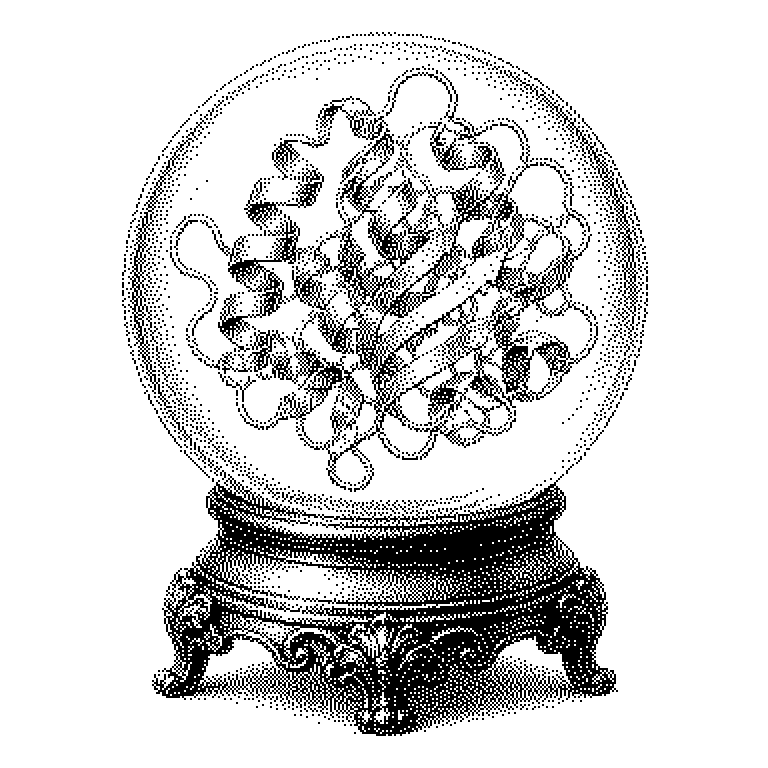
Protein Structure Prediction
Protein structure prediction means calculating the spatial shape of a protein molecule from its known building instructions. Since 2020, AI programs like AlphaFold solve this task so accurately that they replace laboratory experiments in many cases.
Proteins are the working molecules in every living cell. They transport oxygen in the blood, digest food, and fight off pathogens. Every protein starts out as just a long chain of smaller building blocks, the amino acids. However, this chain does not stay straight but folds itself spontaneously into a complicated three-dimensional tangle. Which task a protein can perform depends almost entirely on this shape. Protein structure prediction means: one knows only the sequence of building blocks and wants to calculate on a computer what the finished tangle looks like in space.
A 50-year-old riddle in biology
Determining the sequence of amino acids in a protein is routine today and costs only a few euros. Measuring the spatial shape, on the other hand, was laborious for decades. Researchers had to grow the protein into a crystal and shine X-rays through it. A single protein could consume several years of work and hundreds of thousands of euros. That is why, in 2020, out of roughly 200 million known proteins, only about 170,000 structures were known.
For medicine, shape is decisive. Drugs usually work by having an active ingredient fit precisely into a pocket on the protein’s surface, much like a key fits into a lock. Anyone who does not know the lock can only find the key by trial and error. If the structure is known, one can pre-select on screen which molecules stand any chance at all.
The breakthrough came in 2020 at the CASP competition, where research groups compete against unsolved structures every two years. The program AlphaFold, developed by Google subsidiary DeepMind, achieved an accuracy there that came close to experimental measurements. In 2024, part of the Nobel Prize in Chemistry was awarded to its developers for this.
What the AI reads out of evolution and neighborhood
Folding a protein through pure physics simulation is practically impossible. The chain could take on astronomically many shapes, and calculating through all of them would take longer than the age of the universe. Modern methods therefore do not simulate but predict. They learn from the tens of thousands of structures that have already been determined in the lab.
A key trick is comparing related proteins from different organisms. If an amino acid changes over the course of evolution and a second, distant site almost always changes along with it, these two sites are presumably close together in the folded state. From thousands of such clues, a map of contacts emerges. The model translates this map into concrete coordinates for every atom.
It is important to note: the result is an estimate, not a measurement. The programs therefore provide a confidence value for each section. It is high for rigid core regions and often low for flexible loops. The common misconception that AlphaFold shows the folding process is also not true. It only delivers the final result, not the path to get there.
From database to biotech startup
DeepMind has made the predicted structures of over 200 million proteins freely available online. Anyone, including school classes, can access the AlphaFold database. There are also competing systems such as ESMFold from Meta or the open RoseTTAFold from the University of Washington. In research, checking these databases is now as routine as a literature search.
Economically, the next step is especially interesting: protein design. Instead of predicting an existing structure, programs design new proteins that never existed in nature. Companies like Isomorphic Labs or Generate Biomedicines are raising billions of dollars for this. That is why the term regularly appears in news about pharma partnerships.
Nevertheless, expectations should be kept realistic. A known structure is only the beginning of a drug, not the result. Clinical trials still take many years. Prediction primarily shortens the early search phase in the lab.