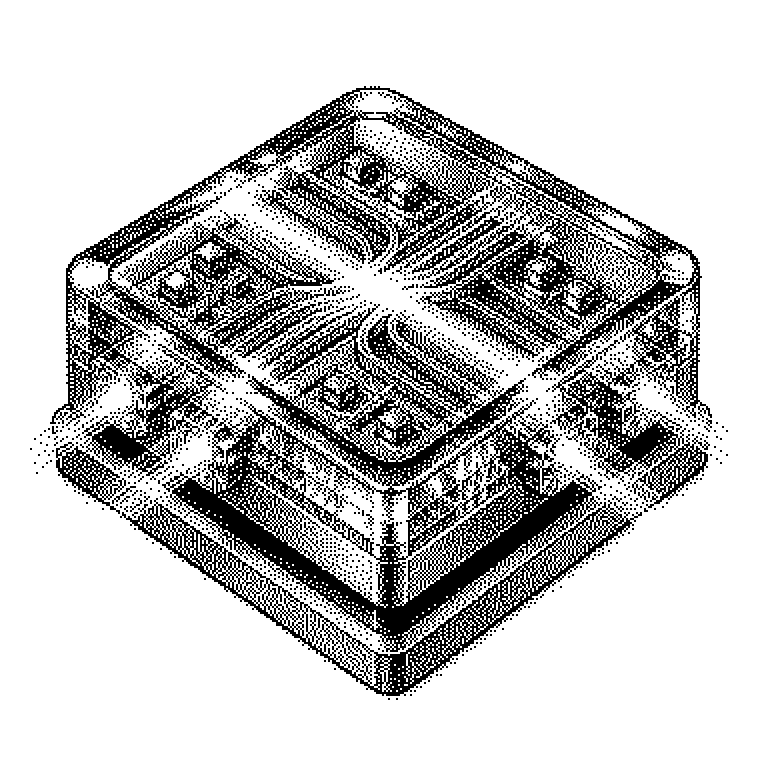
PIC (Photonic Integrated Circuit)
A PIC is a chip that processes and transmits information using light instead of electricity. Such chips are found today mainly in the networking infrastructure of large data centers, where they carry vast amounts of data between servers.
A PIC is a chip on which light does the work instead of electric current. The abbreviation stands for Photonic Integrated Circuit, in German roughly: photonisch integrierter Schaltkreis. An ordinary computer chip sends electrons through tiny metal pathways. A PIC instead sends beams of light through tiny channels made of glass or silicon, called waveguides. A single chip only a few millimeters across can hold hundreds of optical components: light sources, splitters, switches, and receivers. The idea behind it is the same as with the classic microchip sixty years ago — packing many individual components onto a piece of semiconductor instead of wiring them up separately.
Why data centers are switching to light
Modern AI models aren’t trained on a single computer, but on tens of thousands of graphics cards simultaneously. These cards constantly need to exchange intermediate results. The connection between them is often the bottleneck, not the computing power itself. Copper cables hit a physical limit here: the higher the data rate, the more the signal blurs, and the shorter the cable is allowed to be. At today’s typical speeds, that often means just one to two meters.
Light in a fiber-optic cable doesn’t suffer from this problem to the same degree. It can travel kilometers without significantly weakening or blurring. In addition, multiple data streams can be sent through the same fiber simultaneously by using different colors. This technique is called wavelength-division multiplexing, and it’s roughly like several conversations happening at once in the same room because each person speaks in a different pitch.
Then there’s power consumption. A large data center spends a considerable share of its energy not on computing, but on moving data around. Optical connections require significantly less energy per transmitted bit than electrical ones over the same distance. That’s exactly why PICs have been showing up regularly in quarterly reports and investor presentations across the chip industry in recent years.
Waveguides, modulators, and the detour through silicon
The basic building block of a PIC is the waveguide: an extremely thin strip of material in which light stays trapped and follows the path of the strip. You can think of it as a water slide for photons. These strips are manufactured using the same lithography machines used to pattern ordinary chips. That’s precisely the economic trick: photonics can piggyback on existing chip fabs instead of building an entirely new manufacturing process from scratch.
For light to become a signal, a modulator is needed. It switches the light beam brighter and darker extremely quickly, encoding zeros and ones in the process. At the other end, a photodiode converts the incoming light back into electric current. Both components operate billions of times per second.
The approach does have one weakness: silicon essentially doesn’t emit light on its own. The laser that actually generates the light therefore usually has to be made of a different material and attached to the chip afterward. This joining process is complex and expensive. Incidentally, a common misconception is that PICs “compute with light.” The vast majority of PICs sold today don’t compute at all — they merely transport data. Optical processors that actually perform computations with light remain, for now, a subject of research.
From fiber-optic connections to Nvidia keynotes
The most direct encounter most people have with this technology is in their home fiber-optic connection. The small box on the wall contains optical technology that translates light into electrical signals. Photonic chips are also used in medical sensors and in the distance-measuring systems of self-driving cars.
In business news, the term usually appears in connection with the keyword co-packaged optics. In this setup, the photonics chip sits directly next to the compute chip within the same housing, rather than at the edge of the device. Nvidia, Broadcom, Intel, and the Dutch-Belgian research consortium imec are all working on such solutions. This is of interest to investors because it represents the emergence of a new supplier market around the AI boom.
Anyone reading news on this topic should watch for two things. First: is it about data transmission or about computing with light? The former is a multi-billion-dollar market, the latter is still a promise. Second: is the report talking about lab results or about mass production? In this industry, there are often several years between a working prototype and millions of reliably functioning chips.