Protease
A protease is a protein molecule that cuts other proteins at specific points. Such enzymes control digestion, blood clotting and the multiplication of viruses – and are therefore an important target for medications.
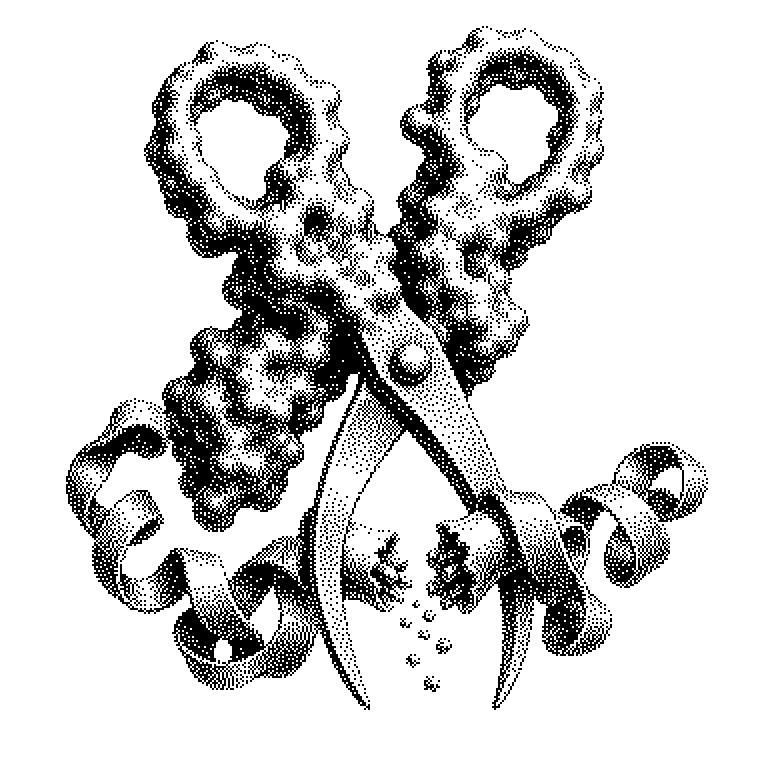
Proteins are long chains made of small building blocks. The body uses them to build muscles, hormones and almost all of its tools. A protease is one such tool with a very specific job: it cuts other protein chains at particular points. You can picture it as a molecular pair of scissors that doesn’t cut just anywhere, but only where a matching sequence of building blocks is present. Proteases therefore belong to the enzymes, meaning the molecules that speed up chemical reactions in the body. Without them, we could neither digest food nor close wounds.
Why scissors are vital to the body
The body doesn’t just build things up, it also has to constantly break them down. Old or damaged proteins are broken down by proteases so that their building blocks can be reused. Roughly every second protein in a cell is replaced within a few days. Without this breakdown, waste would accumulate inside the cells.
Many proteases, however, are not garbage disposal but switches. Some proteins are deliberately produced in an inactive form. Only a targeted cut makes them active. Blood clotting works exactly this way: a chain of proteases activates the next one in sequence, until finally a clot seals the wound. The advantage is speed and control – the process only starts when it’s actually needed.
This is precisely why a malfunctioning protease is dangerous. If it cuts too much, it destroys healthy tissue. In pancreatitis, for example, digestive enzymes become active before they reach the intestine and end up digesting the organ itself. This is why the body always keeps counterparts on hand, so-called protease inhibitors, which block the scissors.
Lock, key, and the targeted cut
A protease has a groove on its surface, the active site. Only a protein chain with the matching shape slides into it. Once it sits correctly, the protease breaks the bond between two building blocks with the help of a water molecule. The cut-off piece then falls away, and the enzyme is immediately ready again. A single protease can carry out thousands of cuts per minute this way.
Experts classify proteases according to which component in the active site does the actual work. Among others, there are serine, cysteine, aspartate and metalloproteases. This classification sounds academic, but it’s practical: if you know which family an enzyme belongs to, you can search more specifically for an inhibitor.
A common misconception is that proteases simply dissolve proteins. That’s only true for the crude digestive enzymes in the stomach and intestine. Most proteases in the body make a single, precisely placed cut. The difference is that between a shredder and a surgeon.
From laundry detergent to antiviral medication
In everyday life, you encounter proteases more often than you might think. In heavy-duty laundry detergents, they make sure blood or egg stains disappear. In cheesemaking, a protease splits milk proteins so that the milk curdles. Pineapple and papaya also contain such enzymes – which is why meat becomes more tender with pineapple juice.
The best known in medicine are protease inhibitors. Viruses such as HIV or the coronavirus initially produce their components as one long protein. Only a virus-specific protease cuts it into functional parts. If you block this pair of scissors, only useless viral fragments result. This principle underlies HIV therapy and the corona medication Paxlovid.
In business and technology news today, the term mostly comes up in connection with artificial intelligence. Programs like AlphaFold predict the three-dimensional shape of proteins. Once you know the shape of a protease’s active site, you can search for suitable inhibitors on a computer before anything is even mixed in the lab. This shortens the search for active substances from years to months and is one of the reasons why pharmaceutical companies are investing heavily in AI firms.