MuJoCo
MuJoCo is a physics simulation environment in which AI systems can train to control robots and joints without needing real hardware. It was originally developed for research and has been freely available since 2022, after Google acquired it.
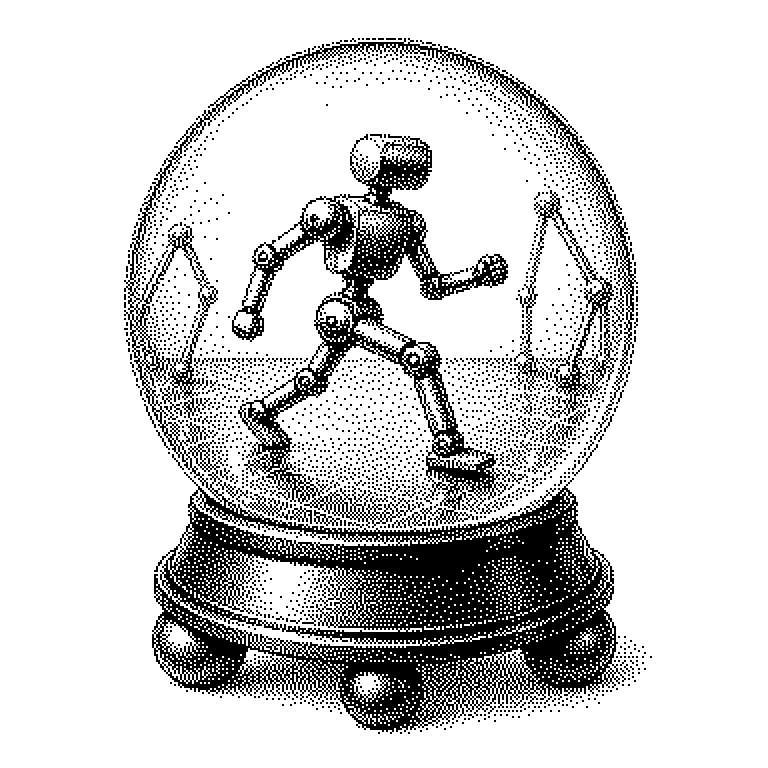
MuJoCo stands for “Multi-Joint dynamics with Contact.” It is a piece of software that calculates physical processes in a virtual world with great precision: How does a robotic arm tip over when it lifts a weight? How does a figure lose its balance when running too fast? These calculations run faster than in reality, allowing an AI to carry out millions of trials in a short amount of time. MuJoCo is therefore one of the most widely used tools for training robots before they are ever deployed in the real world.
MuJoCo’s role in AI training
Training a real robot is expensive, slow, and risky. A robot learning to walk falls over hundreds of times — in reality, this means wear and tear, repairs, and waiting time. In the simulator, the same learning phase can run in just a few hours on a normal computer, because time can be accelerated and no metal gets damaged.
This principle is called “sim-to-real transfer”: the AI is trained in simulation, and the learned behavior is then transferred to real hardware. MuJoCo is particularly popular here because its physics calculations are precise enough that training in simulation actually works later in the real world. A model that runs well in the simulator stumbles less in practice than one trained with an imprecise simulation.
Another reason for its widespread use: MuJoCo has been free since 2022. Previously, a license cost several thousand dollars per year, which excluded small research teams. When Google DeepMind acquired the software and made it freely accessible, it spread rapidly throughout the research community.
Physics under the hood
At its core, MuJoCo solves a system of physical equations at every time step — that is, several hundred times per simulated second. It calculates how forces act on joints, what happens when two bodies touch, and how friction and inertia influence motion behavior. Other simulators simplify these calculations heavily; MuJoCo prioritizes accuracy.
Joints are at the center of this. A human leg has a hip, knee, and ankle — each with its own degrees of freedom and limits. MuJoCo represents such chains of joints as mathematical structures, so-called kinematic chains. Anyone creating a model describes, in a simple text file, which body parts exist, how they are connected, and which motors act at which points.
The simulator then returns a measurement to the AI at every step: the angles of all joints, velocities, contact forces. Based on this, the AI decides which motors to drive and how strongly — and MuJoCo calculates the consequences. This feedback loop runs through millions of iterations during training.
MuJoCo in research and products
In research, MuJoCo is the standard environment for a class of AI tasks called “continuous control” — that is, controlling systems that move fluidly rather than taking only discrete steps. Classic test scenarios are called “HalfCheetah,” “Ant,” or “Humanoid”: virtual bodies that are meant to learn to run as fast as possible. These scenarios are so widespread in AI literature that researchers worldwide can directly compare their results.
Outside of basic research, companies like Boston Dynamics, Toyota Research, and various startups use MuJoCo or similar simulators to develop robotic hands, walking machines, and gripper arms. When a news report states that a robot was “pre-trained in simulation,” MuJoCo is often behind it. OpenAI used the simulator for years before the team disbanded its robotics division — the training environments published during that time remain widely used to this day.
Game development and film production also have physics simulators, but they optimize for visual appeal rather than accuracy. MuJoCo does the opposite: it looks less pretty than a game engine, but the numbers are correct — and that is crucial when a robot is ultimately meant to stand in the real world.