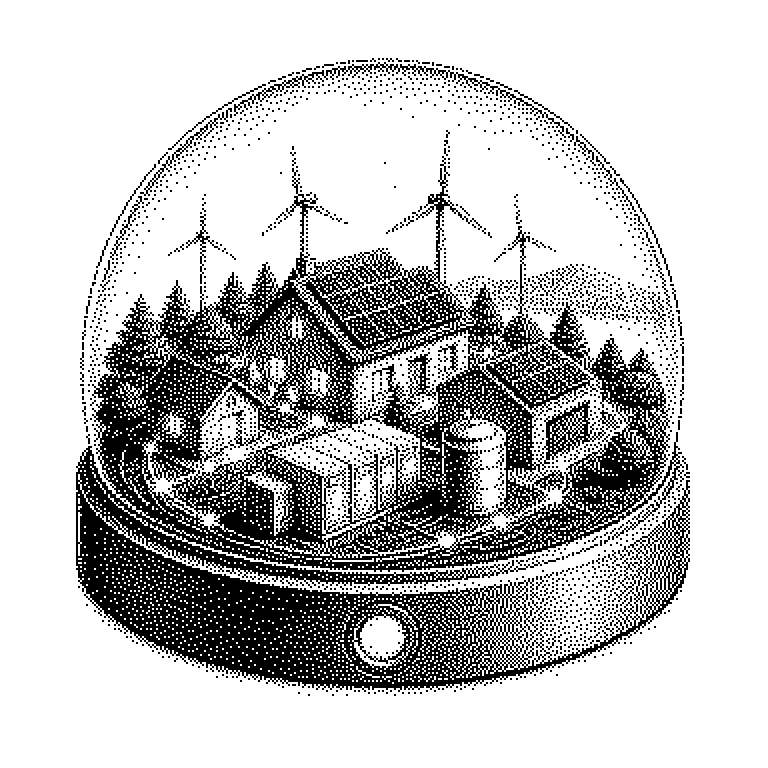
Microgrid
A microgrid is a small, local power grid that autonomously coordinates the generation, storage, and consumption of electricity within a limited area. It can be connected to the public power grid as well as operated entirely self-sufficiently.
The public power grid connects power plants to millions of households via thousands of kilometers of cables. A microgrid works on the same basic principle, but on a smaller scale: it supplies a school, a campsite, a hospital, or an entire village with electricity — generated from its own sources, such as solar panels or small wind turbines. One feature is crucial here: the microgrid can disconnect from the main grid and still continue to function. This mode of operation is called “island mode” or “islanding”. A control unit — a small computer — continuously monitors how much electricity is being generated, how much is being consumed, and how full the connected battery storage units are.
Why microgrids matter for the energy transition
The classic power grid was designed for centralized large-scale power plants. Electricity always flowed in one direction: from the power plant to the consumer. With the expansion of solar and wind energy, this is being reversed. Suddenly, houses and businesses are generating their own electricity — and the grid has to cope with that. Microgrids are better suited for this because they are built from the ground up for decentralized generation.
A second argument is security of supply. If a storm damages the main grid, areas with a microgrid remain supplied with electricity. For hospitals or data centers, this can be vital or economically decisive. According to a study by the U.S. Department of Energy, large-scale power outages in the US cause damages in the double-digit billions of dollars every year — microgrids can contain this risk locally.
Control, storage, and the interplay of components
A microgrid always consists of three elements: generators, storage units, and a control system. Generators are typically solar panels or a small combined heat and power plant — a facility that produces both heat and electricity simultaneously. Storage units are usually lithium-ion batteries, similar to those known on a larger scale from electric cars. The control system decides in real time where the electricity flows.
The real challenge lies in balance. When the sun is shining and consumption is simultaneously low, the surplus electricity must go into the battery or into the public grid. When it’s cloudy at night and consumption rises, the battery has to step in. This sounds simple, but it’s a constant regulatory process — similar to the balance on a bicycle, which never truly stands still. Modern microgrids use algorithms for this that draw on weather data and consumption patterns.
A common misconception: microgrid and island mode are not the same thing. Most microgrids are normally connected to the main grid and use it as a backstop. Island mode is only an option for emergencies or for locations that are simply too far from the nearest line.
Microgrids in products, projects, and headlines
In Germany, microgrids have so far been known mainly from research projects. The community of Feldheim in Brandenburg is considered one of the first villages in Europe to supply itself completely with electricity and heat — a real microgrid in operation. In the US, the state of California has started promoting microgrids for entire neighborhoods following repeated wildfire-related large-scale shutdowns.
In the tech industry, the term comes up because large data centers from Google, Microsoft, or Amazon require enormous amounts of electricity. Some of these companies are building their own microgrid structures around their data centers to become more independent from the public grid and to meet climate targets. Military bases have also relied on microgrids for years, because a grid failure there would be especially critical.
For private households, there are now products that move in this direction: Tesla's Powerwall combines solar panels and battery storage into a small home system. Complete microgrids for private individuals are still expensive, but battery storage prices are falling every year — bringing the technology within reach of more users.