Cortex
The cortex is the outer, folded layer of the human brain, where perception, language, and thought are processed. In the world of AI, it serves as a model and namesake: many technical terms and product names draw on its structure of uniform nerve cells organized in layers.
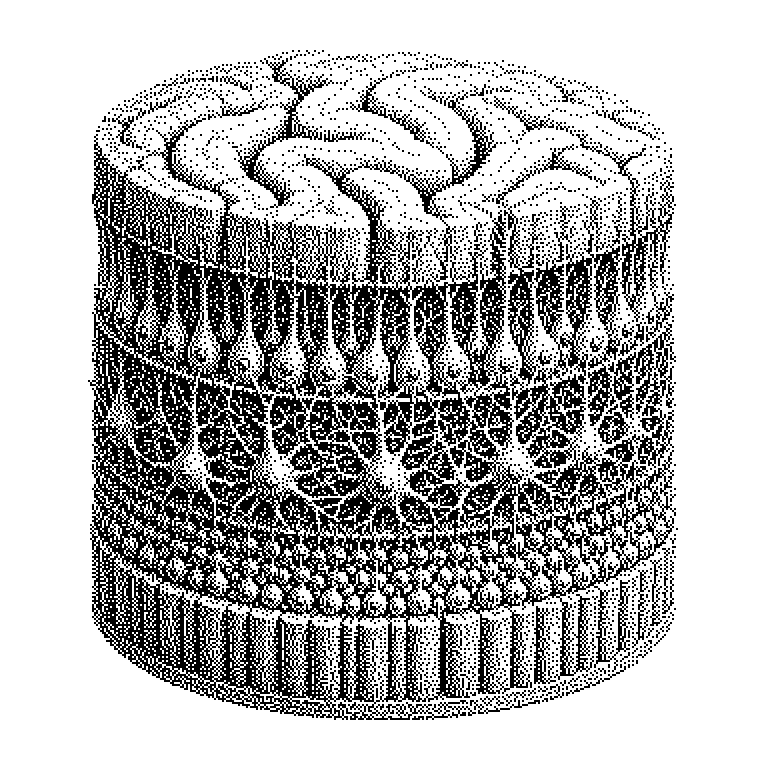
The cortex is the outer layer of the human brain. It is only a few millimeters thick, but strongly folded so that a large area fits inside the skull. In this layer sit the nerve cells that process sensory impressions, control movements, and understand language. The German name is “Großhirnrinde”, while in English it is usually called “cortex”. For computer science, the cortex is above all one thing: the best-known example that very simple, uniform components can together achieve something very complex. Exactly this idea underlies the concept of the artificial neural network, i.e. a computational model made up of many small, interconnected computing units.
The cortex as a model for neural networks
When researchers designed the first computational models for learning in the 1940s, they looked at the brain. They noticed that the cortex looks similar everywhere. The region that processes images is structured similarly to the region for sounds. From this arose a bold conjecture: perhaps there is only a single learning mechanism that learns something different depending on the input data.
This conjecture still shapes AI research today. Modern language models consist of dozens of nearly identical layers. No one programs in, piece by piece, how grammar works. Instead, one builds many similar building blocks and lets them learn from data. The fact that this approach seemed plausible at all goes back to the observation of the cortex.
An important distinction must be made here: an artificial neural network is not a model of the cortex. It is a simplification that has moved far away from its biological model. Real nerve cells send short electrical impulses and change their own connections. Artificial units only compute with numbers. Anyone who says a chatbot works like a brain is going too far.
Layers, columns, and feedback
The cortex is divided into roughly six layers stacked on top of one another. Signals from the sensory organs first arrive in a middle layer. From there they are passed upward and downward. Each layer has its own task in relaying the information.
Perpendicular to these layers, the cells form so-called columns. Such a column contains a few thousand nerve cells that respond to a very small section, for example to a line at a particular angle. You can imagine this like a grid of pixels, where each point has its own small area of specialization.
A crucial difference from many AI systems: in the cortex, information flows in both directions. There are very many connections that run from higher areas back to the simpler ones. Expectations therefore influence what one perceives. This is why a blurred word in a sentence is still recognized correctly. Replicating such feedback loops is considered an open problem in research.
Where the name shows up in the tech industry
In the news, one often comes across “Cortex” as a product name. The chip developer ARM calls its processor cores Cortex; they are found in almost every smartphone. Software from Nvidia, Palo Alto Networks, or Cloudflare also carries the name. It is meant to signal intelligence and performance and usually has nothing to do with biology.
The reference is meant seriously in a research direction called neuromorphic computing. Here, chips are built that work like nerve cells with short impulses instead of a steady computing clock. Such chips require very little power. So far they remain niche products, but are considered promising for AI in sensors and small devices.
If you come across a phrase like “works like the human cortex” in an article, some skepticism is warranted. Usually it just means that the system consists of many simple, similar units. That is a loose resemblance, not a replica. The real cortex is still not fully understood to this day.