CRM
CRM stands for Customer Relationship Management and refers to software in which a company collects everything about its customers and prospects. Every call, every email, and every offer is recorded there so the sales team keeps an overview.
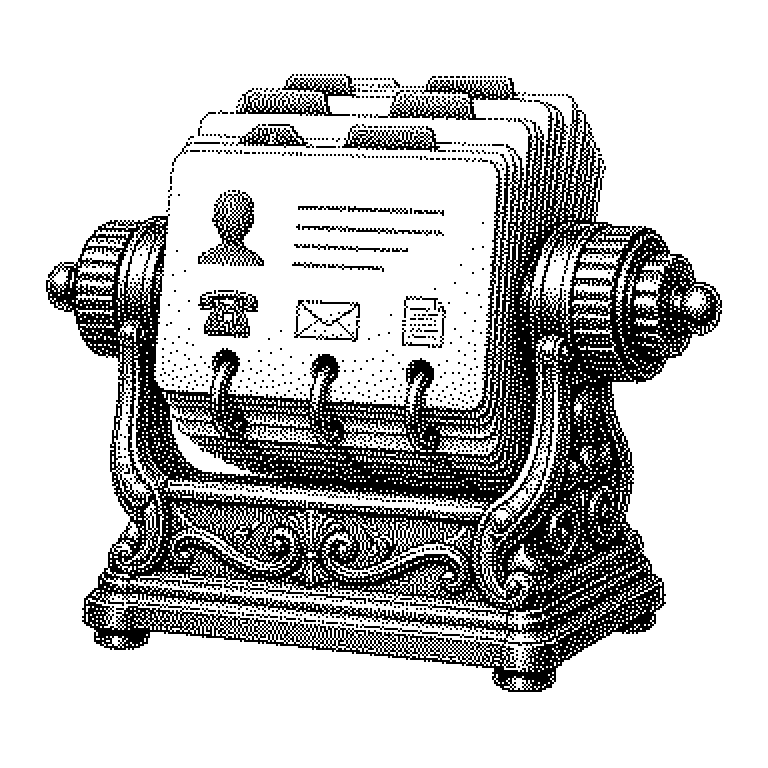
CRM is short for Customer Relationship Management. It usually refers to a computer program in which a company stores everything about its customers. It records who called, what was discussed, and which offer is currently pending. You can think of it as a shared notebook for all employees that never forgets anything. Without such a program, every salesperson would have their own notes, and no one would know what colleagues had already discussed with the same customer. Well-known providers of such programs are Salesforce, HubSpot, and Microsoft Dynamics.
Why companies consolidate their customer data in one place
For many companies, customer data is the most valuable asset of all. If a salesperson quits, their knowledge shouldn’t disappear with them. If everything is stored in the CRM, a colleague can pick up the conversation exactly where it left off the next day.
Then there’s the forward-looking view. A CRM shows how many offers are currently open and how much revenue is likely to result from them. This forecast is called a pipeline. Management uses it to plan staffing and budgets, and publicly traded companies base their forecasts for investors on it. Incorrect figures in the CRM can therefore quickly lead to false promises on the stock market.
The topic is also economically significant. CRM is one of the best-selling software segments in the world, with a market worth tens of billions annually. Salesforce, the largest provider, is one of the most valuable software companies in the world largely for this reason.
From contact to close: the structure of a CRM
At its core, a CRM is a large, highly organized database. The most important entries are contacts, meaning individual people, and companies, to which these people belong. Attached to these are so-called deals or opportunities: concrete sales opportunities with an estimated value. Every deal moves through fixed stages, for example initial contact, offer, negotiation, and close.
The system also automatically collects traces. It reads emails, logs calls, and remembers who visited which page on the company website. From these signals, many CRMs calculate a score known as lead scoring. It estimates how likely a prospect actually is to buy, so salespeople can focus on the most promising cases.
For a few years now, AI features have been making their way into these systems. Language models summarize long conversation histories in three sentences, suggest reply emails, or enter notes on their own. This is precisely why CRM providers appear so often in AI news: they already sit on the data that such models need. It’s important to distinguish this from an ERP system, which manages internal operations such as inventory, invoicing, and accounting. The CRM looks outward to the customer, while the ERP looks inward into the company.
CRM in the news, in job applications, and in your own inbox
A CRM becomes most visible in your own email inbox. When an online shop writes that you’ve left something in your cart, there’s an entry in such a system behind it. Customer service also works with it: the representative on the phone can see past orders without having to ask.
The term regularly appears in financial news when Salesforce or SAP release quarterly results. Analysts then pay attention to whether companies are renewing their software subscriptions and whether the new AI add-on features are actually being purchased. CRM is considered a good economic indicator, because companies tend to cut this kind of spending early.
A common misconception is that CRM is only for large corporations. A driving school, a trade business, or a sports club often uses a simple CRM too. Anyone who later works in sales, marketing, or customer service will almost certainly deal with it daily.