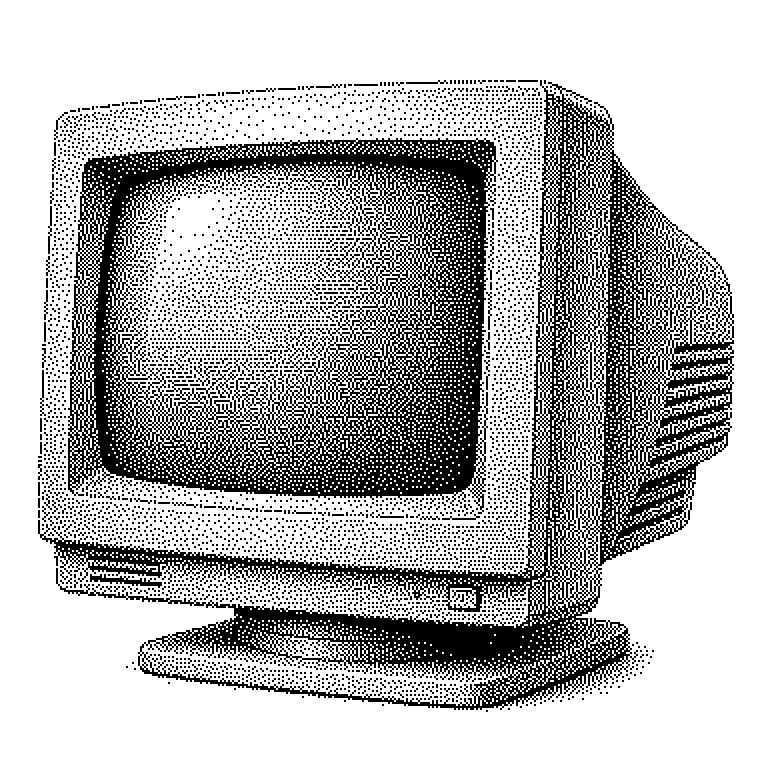
CRT Monitor
A CRT monitor is a display that generates its image using a large glass tube, inside which an electron beam excites a luminescent coating. This technology dominated televisions and computer screens until around 2005, when it was replaced by flat-panel displays.
A CRT monitor is a screen with a thick glass tube inside. Within this tube, a fine beam of tiny electrically charged particles is generated. The beam strikes the front of the glass from behind, which is coated with a layer that lights up when hit. This creates an image dot by dot. Because the tube requires a lot of space, such devices are deep and heavy: a screen with a 43-centimeter diagonal can easily weigh 20 kilograms. The abbreviation CRT stands for Cathode Ray Tube.
Why the tube dominated the market for decades
From the 1950s until the early 2000s, the tube was practically without alternative. Every television, every computer workstation, and every arcade machine worked with it. The technology was mature, cheap to mass-produce, and delivered vivid colors. A black on a CRT was truly black, because at that spot nothing lit up at all. Early flat-panel displays couldn’t manage that for a long time.
The switch to flat-panel displays starting around 2003 was one of the fastest technology transitions in consumer electronics. Within just a few years, tubes almost completely disappeared from stores. The reason wasn’t picture quality, but space, weight, and power consumption. A flat-panel display fits on the wall and can be shipped by mail, a tube cannot.
Nevertheless, the term has not disappeared to this day. Anyone who wants to play old video games authentically specifically seeks out CRT monitors. The games of that era were designed for these screens, and on modern displays they often look harsher and blockier than intended. Well-preserved units are therefore now traded, and sometimes sold at high prices.
The electron beam and the raster
At the rear end of the tube sits an electron gun. It fires a beam of electrons forward, that is, of the negatively charged particles that also make up electric current. Along the way, the beam is deflected by magnetic coils. These coils control exactly where it strikes the screen surface. The front is coated on the inside with phosphor, which briefly lights up upon impact.
The beam doesn’t wander around randomly, but works through the surface line by line. It moves from left to right, jumps back, drops down a line, and continues. The entire image is redrawn 60 to 100 times per second. This figure is called the refresh rate. If it was too low, a noticeable flicker was visible, which many people, after hours in front of the screen, felt as a headache.
For color, you need three guns instead of one, for red, green, and blue. Their dots lie so close together that the eye blends them into a mixed color. An important difference from today’s displays: a CRT has no fixed number of pixels. The same tube could be operated at different resolutions without the image becoming blurry. Modern displays, on the other hand, have a fixed number of built-in pixels and only really look good at that one resolution.
Where you still encounter the tube today
In everyday life, CRT monitors are found almost exclusively at flea markets, in basements, and among collectors. In museums and in art, they are deliberately used because their image looks different from any modern display. In films, too, they serve as a quick signal that a scene is set in the 1980s or 1990s.
In tech news, the term usually appears as a benchmark for comparison. When reporting on the response times of gaming monitors, it’s often said that a model finally comes close to the lag-free responsiveness of an old tube. Similarly, with displays using organic light-emitting diodes, or OLED for short, it’s often mentioned that they once again reach CRT-level black levels.
One more practical point matters: old tubes don’t belong in household trash. The glass contains lead, and after being switched off, the device still retains high voltages. Opening it is dangerous, and disposal should go through a recycling center. Handling these old devices still keeps recycling companies busy today, since millions of units are still in circulation worldwide.