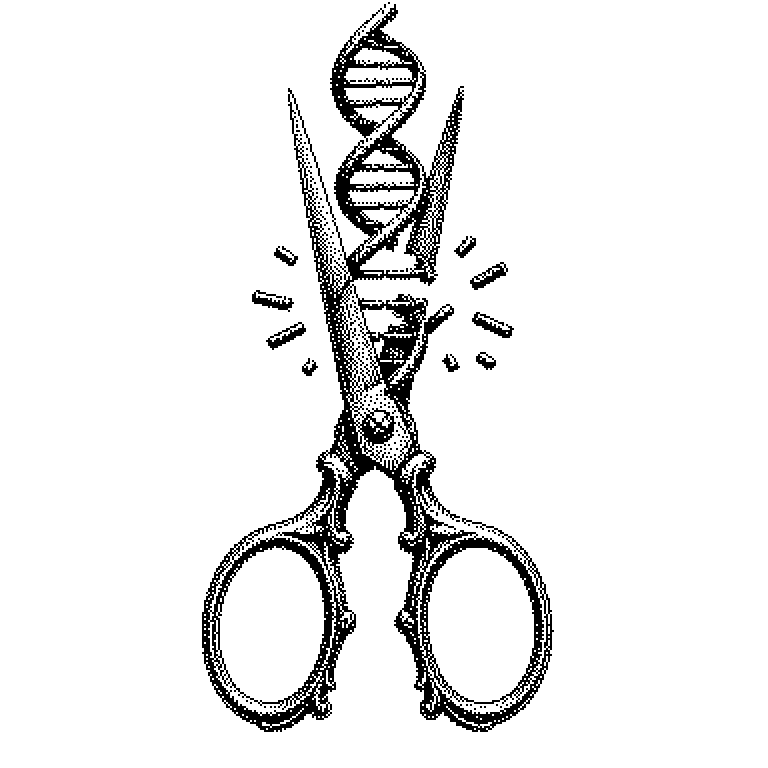
CRISPR
CRISPR is a method that allows scientists to precisely alter, remove, or replace individual sites in an organism's genetic material. It is considered the most precise and cost-effective technique for modifying DNA to date.
CRISPR is a method for altering the genetic material — that is, the DNA stored in every cell of a living organism, which determines how it is built — at a very specific location. Scientists can use it to cut out, alter, or replace individual sections with new ones. The technique works in plants, animals, and human cells. It became widely known starting in 2012 and has since fundamentally transformed biology and medicine. The name refers to a pattern researchers discovered in the genetic material of bacteria, which serves these bacteria as a kind of natural defense system against viruses.
CRISPR as a turning point in medicine
Genetic diseases arise when a particular section of DNA is faulty. Until now, there were hardly any ways to directly correct this error — symptoms could be treated, but not the cause. CRISPR fundamentally changes that.
In 2023, the first CRISPR-based drug was approved worldwide: it treats sickle cell disease, a severe hereditary blood disorder. Patients who previously suffered regular severe pain crises showed hardly any symptoms after treatment in studies. This is not incremental progress — it is a paradigm shift.
At the same time, CRISPR is significantly cheaper and faster to use than earlier methods of genetic modification. This makes the technology attractive not only to large pharmaceutical companies but also to smaller research labs worldwide. The low barrier to entry accelerates research, but it also raises questions about who controls what is done with it.
How the molecular scissors cut
CRISPR works with two main components. The first is a short piece of RNA — a molecule related to genetic material — which serves as a search function. It is built to match exactly the target site in the genetic material, like a key fits a lock. The second component is a protein called Cas9, which acts as the actual scissors: it cuts the DNA at the site the RNA points to.
After the cut, the cell repairs the damage itself. Scientists can specifically control this repair process: either the section is simply deactivated, or a new DNA segment that has been prepared in advance is inserted. The entire process is precise — but not perfect. Occasionally, the system also cuts at similar but incorrect sites. These so-called off-target effects are an active area of research.
Newer variants of the technique, such as base editing or prime editing, further refine this approach. They alter individual building blocks of DNA without cutting it completely. The basic idea remains the same, but the control becomes more precise.
CRISPR in the news, in labs, and in ethical debates
In agriculture, CRISPR-modified plants are being developed that are more resistant to drought or disease. In Japan, CRISPR tomatoes with increased levels of a blood-pressure-lowering compound are already on the market. In cancer research, patients' immune cells are being reprogrammed with CRISPR to attack tumor cells more precisely.
In 2018, Chinese researcher He Jiankui made headlines by claiming to have created the first CRISPR-modified babies — he faced sharp criticism worldwide and was convicted. The case shows where the line is drawn: modifications to human germ cells or embryos are passed on to future generations and are banned or strictly regulated in most countries.
Anyone who reads tech and science news regularly encounters CRISPR — in reports on new therapies, on biotech startups, on the 2020 Nobel Prize awarded to discoverers Emmanuelle Charpentier and Jennifer Doudna, or on the question of how far humans should be allowed to alter their own genetic material.