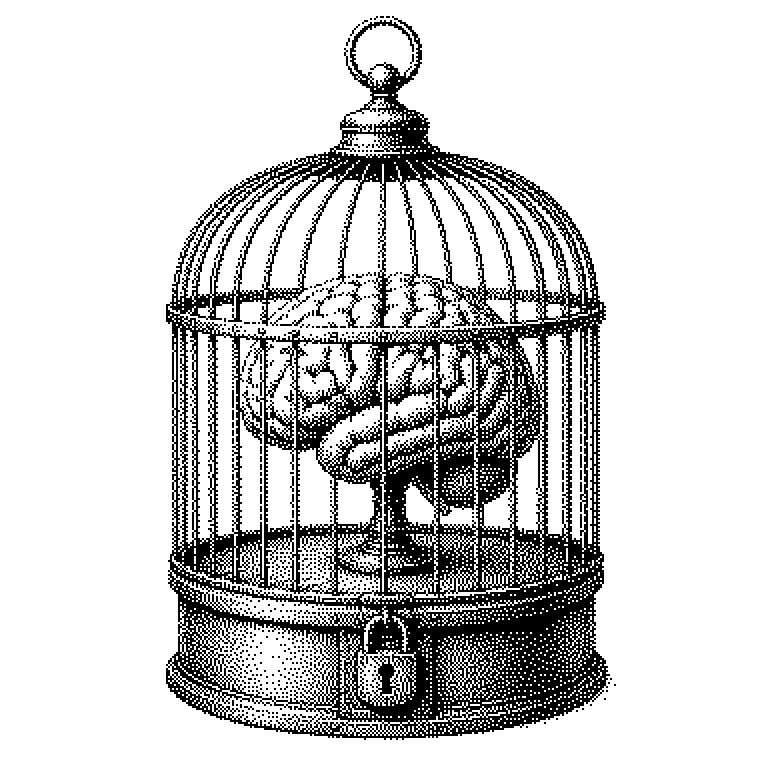
Cognitive Surrender
Cognitive Surrender describes people handing over their own thinking to computer programs and barely checking the answers anymore. The term is used above all where chat programs pre-formulate decisions in everyday life.
Cognitive Surrender means literally “cognitive capitulation,” that is, giving up one’s own thinking. What is meant is a habit: one lets a computer program answer a question and adopts the result without checking it. The program in this case is usually a text automaton that formulates sentences and makes suggestions on command. The human, at this moment, stops weighing things up, calculating, or looking things up themselves. The important distinction is from normal division of labor: A calculator takes over a task that one set for oneself. With Cognitive Surrender, one also hands over the judgment of whether the answer makes sense at all.
What happens when no one double-checks anymore
Text automatons formulate very convincingly and are nonetheless sometimes wrong. Experts call invented but fluently sounding claims “hallucinations.” Anyone who adopts such answers without checking passes the errors on. In a school assignment that is embarrassing; in a medical report or a credit contract it is dangerous.
For companies this is a liability issue. The human remains legally responsible, even if a program wrote the text. That is why many firms now explicitly require that an employee sign off on every result. Precisely this sign-off becomes worthless once it degenerates into mere rubber-stamping.
There is also a long-term effect: skills that are never used atrophy. Studies on learning show that one’s own effort improves retention. Anyone who immediately hands off every text task never learns the process behind it. However, there is also criticism of the term, since similar warnings already accompanied calculators and navigation devices.
How convenience turns into a reflex
The core is an error of trust. People unconsciously infer content from form: what sounds well formulated we tend to consider probably correct. Text automatons produce perfect form without any guarantee whatsoever for the content. This creates more trust than would be warranted.
On top of that comes the effort comparison. Thinking something through oneself costs minutes; nodding along to the result costs seconds. As long as nothing goes wrong, the nodding-along is rewarded. After a few weeks it is no longer a decision but a habit. Psychologists speak here of automation bias, that is, the tendency to prefer machine suggestions.
A comparison makes it tangible. A navigation device says “turn left,” and one turns left even though there is a construction site there. The view through the windshield would have been available, only no one looked. Countermeasures are simple but inconvenient: check a sample, ask for sources, seek a second source for important figures.
Cognitive Surrender in school, office, and stock market news
In school, the pattern shows up in homework copied from a chat window. It usually becomes noticeable only in the exam, when the same task appears without aids. It looks similar in programming: code is adopted, it works, and no one can later explain why.
In professional life the term appears in discussions about hiring procedures, insurance applications, and customer service. There, programs suggest decisions and a human clicks them through. Regulators demand genuine human oversight in such cases, often called “human in the loop.” Cognitive Surrender is the word for the case where this oversight exists only on paper.
In business news the term has a double role. Critics use it as a warning against blind faith in technology. Providers turn it around and use it to advertise tools that display sources or flag uncertainty. Anyone reading about AI stocks or regulation should therefore recognize the term as an argument, not as a neutral metric.