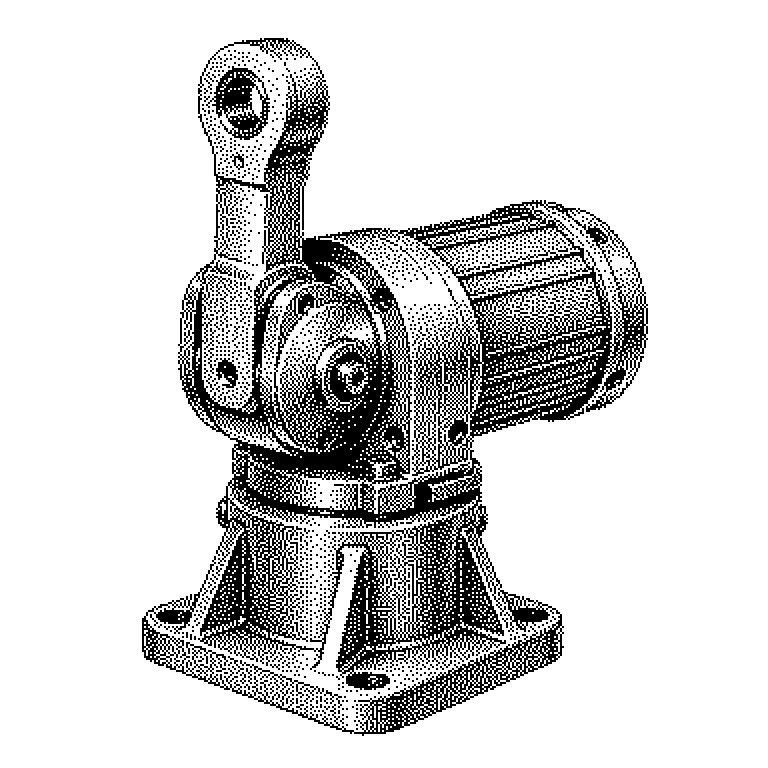
Actuator
An actuator is the component of a machine that converts a control signal into actual movement or force – for example, a motor that turns a robot arm joint. It is the counterpart to the sensor: one measures the world, the other changes it.
A machine can compute as well as it likes – at some point, something has to move. That’s exactly what actuators are for. An actuator is a component that converts an electrical signal into a physical effect: into movement, rotation, pressure, or force. The electric motor in a car’s window regulator is an actuator, as is the valve that lets hot water flow through a heating system. The counterpart is the sensor, a component that measures something and turns it into a signal. Sensors take in the world, actuators act back upon it. You’ll also find the shorter spelling “actor” (in German, “Aktor”); it means the same thing.
Without actuators, software remains disembodied
A language model can formulate a perfect plan for tidying up a kitchen. That doesn’t get the kitchen tidied, though. The leap from decision to action always happens via actuators. That’s why they represent the crucial boundary between software that merely produces text and systems that actually do something in the world – for better or worse.
For robotics, actuators are also often the most expensive and most fragile part. Computing power has become drastically cheaper in recent years, but precision motors and gearboxes have barely followed suit. Depending on the design, a humanoid robot needs 30 to 50 individually controlled joints. Each one costs money, adds weight, and can break. Many robotics projects fail not because of the software, but because of the mechanics.
The safety question also matters. A mistake in a chatbot produces a wrong sentence. A mistake in an actuator produces a wrong movement – and that can injure people. That’s exactly why standards for industrial robots require that drives can be hard-shut-down at any time, independent of the actual control software.
From control signal to movement
The typical process is a loop. Sensors report the current state, for instance the current position of a joint. A controller compares this value to the target state and calculates the deviation. This produces a control signal, usually a voltage or a digital value. The actuator converts this signal into movement, the sensors measure again, and the whole cycle starts over – often several hundred times per second.
Technically, there are mainly three families to distinguish. Electric actuators such as electric motors or servos are the most widespread, because they are precise and easy to control. Hydraulic actuators work with oil under high pressure and deliver enormous forces, for example in the arm of an excavator. Pneumatic actuators use compressed air, are fast and lightweight, but harder to dose precisely.
A common misconception: an actuator does not simply execute a command with perfect accuracy. Friction, inertia, and load distort the result. A motor told to “turn 90 degrees” might, without feedback, end up at 87 degrees. Only the constant measurement by sensors turns a crude drive into a precise tool. In modern robots, a model sometimes learns this control behavior itself, rather than having it hard-coded.
Actuators in cars, factories, and headlines
In everyday life, you encounter actuators constantly without them being called that. The vibration of a phone comes from a small motor. The door opener at the supermarket, the braking system in a car, the ejection of a sheet of paper from a printer – there’s a final control element behind all of it. A modern car contains a good hundred of them.
In the news, the term mainly comes up in connection with humanoid robots and factory automation. When companies like Tesla, Figure, or Unitree talk about their robots, it’s almost always about actuator costs, torque, and battery life. The term “embodied AI” also essentially means: an AI model that reads sensors and controls actuators.
This is relevant for investors because a whole supply chain hangs on it. Manufacturers of precision gearboxes, servo motors, and ball screw drives often benefit more directly from the robotics boom than the software companies do. Anyone reading news about robotics should therefore always keep in mind who actually supplies the components that ultimately do the moving.