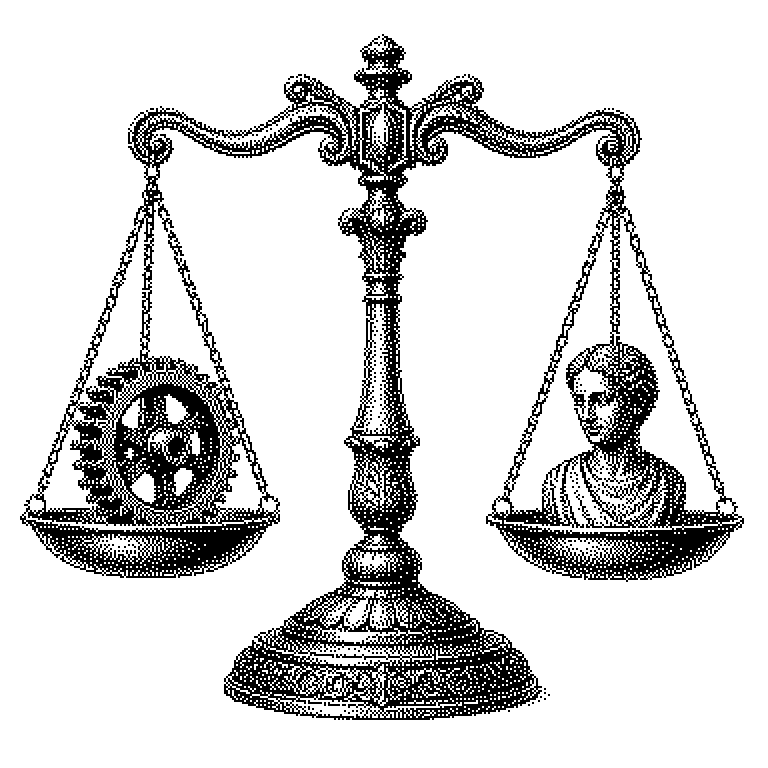
Automation Rights
Automation rights are contractually established permissions to have certain work steps or content performed by machines. They regulate who is allowed to replace a human service with software and what they must pay or guarantee in return.
Automation rights are agreements within a contract about which work a machine is permitted to take over. Anyone who books, say, a voice actress for an audiobook can additionally purchase the right to have her voice later recreated by a computer. Without this agreement, only what was explicitly agreed upon is permitted: that one recording. The term also appears in contexts that have nothing to do with voices but rather with entire workflows. In collective bargaining agreements, for example, it is regulated whether a company may hand over tasks to software without the consent of its employees. What all these cases have in common: automation here is not a purely technical issue, but a question of permission.
Why everyone is suddenly negotiating over this
Until a few years ago, the question was practically irrelevant. A machine simply could not replace an advertising text, a dubbing voice, or an illustration. Whoever wanted the service had to book the human. This technical limit was at the same time an economic protection, without any need for a contractual clause.
Since generative systems have become capable of producing texts, images, and voices, that protection is gone. That is why it is now being reinstated in writing. The 2023 strike by the actors' union SAG-AFTRA in Hollywood revolved, to a large extent, around exactly this issue. One result was that digital recreations of performers now require explicit consent and separate payment.
For companies, automation rights are conversely an asset. A publisher that owns the rights to its narrators' voices can produce thousands of audiobooks without renting a studio. It is precisely this distinction between a one-time recording and a permanent right of use that today determines a great deal of money.
What such a clause typically contains
A workable arrangement answers four questions. First, the scope: does the permission apply only to this one project or to everything in the future? Second, the duration: two years or indefinitely? Third, the compensation: a flat fee or a share per use? Fourth, revocation: can the permission be withdrawn if the result damages someone’s reputation?
An important point is the separation between training and output. A system may perhaps learn from my recordings but not publish new sentences in my voice. Or vice versa. If this is not separated, an inconspicuous phrase like “to further develop our services” suddenly covers a great deal.
For employees, the arrangement looks different because labor law applies there. In Germany, works councils have a co-determination right when technical systems are capable of monitoring employee behavior. Negotiations then are less often about money and more often about retraining, notice periods, and which decisions a human must review.
Where you encounter this topic
Most often in the terms of use of services you yourself use. Almost every platform grants itself the right to use uploaded content to train its own systems. This sentence is an automation right, even if it isn’t called that. With some providers it can be switched off in the settings, with others it cannot.
In business news, the term appears in negotiations between media companies and AI providers. When a publisher signs a licensing agreement with a tech company over its archive, that is exactly what it’s about. The same applies to music catalogs, stock photo archives, and dubbing studios. The sums involved in such deals now run into the hundreds of millions.
A common misconception is that automation rights are the same as copyright. Copyright arises automatically and protects a specific work. Automation rights, by contrast, must be negotiated, and they often concern things that are not a work at all: a timbre of voice, a face, a workflow. That is why contracts here fill a gap that the law has so far only partially closed.