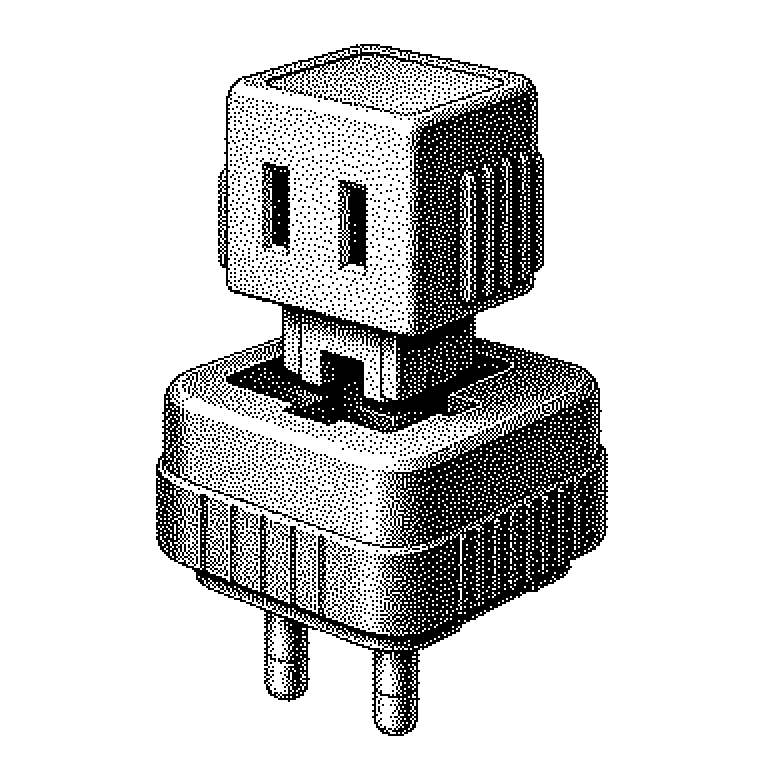
Adapter
An adapter is a small additional module that is plugged into an already trained AI model to specialize it for a new task without altering the original model. This saves enormous computing capacity and is what makes the use of large language models in specific fields economically viable in the first place.
A large language model — that is, an AI system that understands and generates text — is trained once on huge amounts of data. This training is expensive and takes weeks. Afterwards, one often wants to tailor the model to a particular task: medical reports, customer service, a specific language. This is what adapters are for. An adapter is a small, additional computational module that is inserted into the existing model. Only the adapter is trained on the new task area — the original model remains unchanged.
Why adapters replace training from scratch
A large language model can have billions of parameters — these are the internal numerical values that make up the model and store its knowledge. Retraining all of these parameters costs electricity, time, and money on a scale that only a few companies can afford. An adapter, by contrast, typically consists of just a few million parameters — a tiny fraction of the overall model.
This has an important practical effect: a hospital, a law firm, or an editorial team can build a specialized AI tool without training a model from scratch themselves. They load an existing base model, attach an adapter, and train only that adapter — with their own data, in a short amount of time, on standard hardware. This considerably democratizes access to powerful AI.
How an adapter intervenes in the model
A language model consists of many successive layers. Each layer processes the input and passes the result on to the next. Adapters are inserted between these existing layers — or connected in parallel to them. They receive the intermediate results, process them slightly, and pass them on in modified form. The base model itself keeps computing unchanged; the adapter merely nudges the output of each layer a small amount in the desired direction.
A particularly widespread variant is called LoRA, short for Low-Rank Adaptation. Instead of inserting new layers, LoRA augments each existing layer with two very slim matrices — that is, rectangular arrangements of numbers, like tables. Their multiplication produces the desired adjustment, but requires only a fraction of the storage space of a full layer. LoRA is now the standard in many open-source tools, because it delivers useful results even on a single graphics processor.
A common misconception is to confuse adapters with classic fine-tuning. In classic fine-tuning, all of the model’s parameters are actually further trained on new data — the model changes globally. An adapter, by contrast, leaves the model completely intact. This is not a minor difference: the same base model can be combined with dozens of different adapters, loading the appropriate one depending on the task, without ever having to store a second complete model.
Adapters in products and headlines
Anyone who reads terms like “LoRA model” or “custom fine-tune” in AI forums or product descriptions almost always means an adapter. On platforms like Hugging Face, a public directory for AI models, thousands of ready-made adapters can be downloaded — for specific drawing styles in image generators, for programming languages, for specialized medical vocabulary.
Image generators like Stable Diffusion have made the concept especially popular. There, users train small adapters on just a few dozen photos to specialize the model for a particular drawing style or a specific person. What used to be possible only through full model training can now be done on an ordinary gaming PC in under an hour.
Adapters are also playing a growing role in enterprise applications. Many cloud providers make it possible to equip a large base model with a company’s own adapter without the training data ever having to leave the company’s own data center. This is not only more cost-effective but also addresses data privacy concerns that would arise from full retraining.
