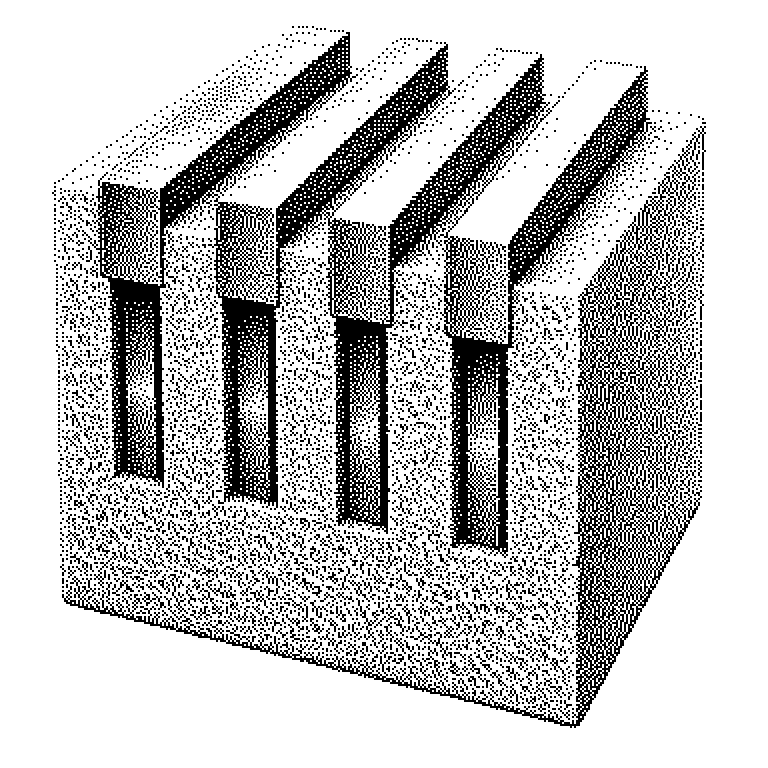
Low-k Dielectric
A low-k dielectric is an insulating material in modern computer chips that prevents adjacent conductive traces from electrically interfering with each other. The lower the material's so-called k-value, the faster and more energy-efficient a chip can operate.
In a modern computer chip, millions of tiny wires, so-called interconnects, run side by side in an extremely confined space. To keep them from influencing one another, they are surrounded by an insulating material. This material is called a dielectric. The k-value — also known as the dielectric constant — describes how strongly such a material stores and transmits electric fields. A low-k dielectric is an insulating material with a particularly low k-value. That sounds technical, but it has a direct consequence: the lower the k-value, the less energy is wasted as unwanted interaction between the interconnects — and the faster the chip can clock.
Why the k-value determines chip speed
When two interconnects lie close together, they attract each other electrically — similar to two parallel plates of a capacitor. This effect is called parasitic capacitance. It slows down signals because part of the electrical energy doesn’t continue on as signal but instead gets trapped in the insulating material.
The former standard was silicon dioxide with a k-value of about 3.9. Modern low-k materials achieve values between 2.0 and 3.0, with so-called ultra-low-k variants going even lower. This difference sounds small, but in practice it accounts for a considerable share of the energy savings and speed gains of modern chips. Anyone buying a smartphone today that lasts longer on a single charge than its predecessor benefits, among other things, from better dielectrics.
The k-value is not an isolated design feature — it is directly tied to manufacturing scale. The narrower the interconnects become, the closer together they move, and the stronger the parasitic capacitance becomes. Without better insulating materials, narrower structures would not automatically become faster, only more prone to interference.
Porosity as the key to a low k-value
Air has a k-value of 1.0 — the theoretical minimum. No solid material can match that, but researchers have found a clever workaround: they build tiny cavities into the insulating material. A porous material consists partly of air and partly of solid, and its effective k-value falls somewhere in between. The more pores, the lower the k-value.
In practice, carbon-containing silicon-based compounds are often used for this, such as SiCOH. These materials can be deliberately engineered with pores in the nanometer range. The catch: more pores also mean less mechanical stability. The material becomes more brittle. In chip manufacturing, chemists and engineers must therefore jointly find the compromise between a low k-value and sufficient strength, so the material can withstand subsequent production steps.
Another approach involves so-called air gaps — deliberately created cavities between the interconnects that contain no solid material at all. IBM and Intel have demonstrated this technique across various chip generations. It is complex to manufacture, but it pushes the effective k-value even lower than any solid material can.
Low-k dielectrics in current chips and news
Low-k materials are found in nearly every modern high-performance chip — from Apple's M-series processors to Nvidia graphics chips to the server processors in data centers. Whenever a chipmaker announces a new manufacturing node, such as TSMC's N2 process, improving the dielectric is one of the levers engineers negotiate over internally.
In tech news, the term often comes up in connection with so-called BEOL manufacturing — which stands for Back End of Line and refers to the part of chip production where the interconnects and their insulation are built up. When analysts report on progress or setbacks in chip manufacturing, the integration of new low-k materials is frequently a central point, because it is technically demanding and costly.
A common misconception: low-k dielectrics are sometimes confused with the transistor itself. Transistors switch the actual signal, while low-k materials merely ensure that signals arrive with as little loss as possible on their way between transistors. Both are indispensable — but they are two fundamentally different areas of chip development.