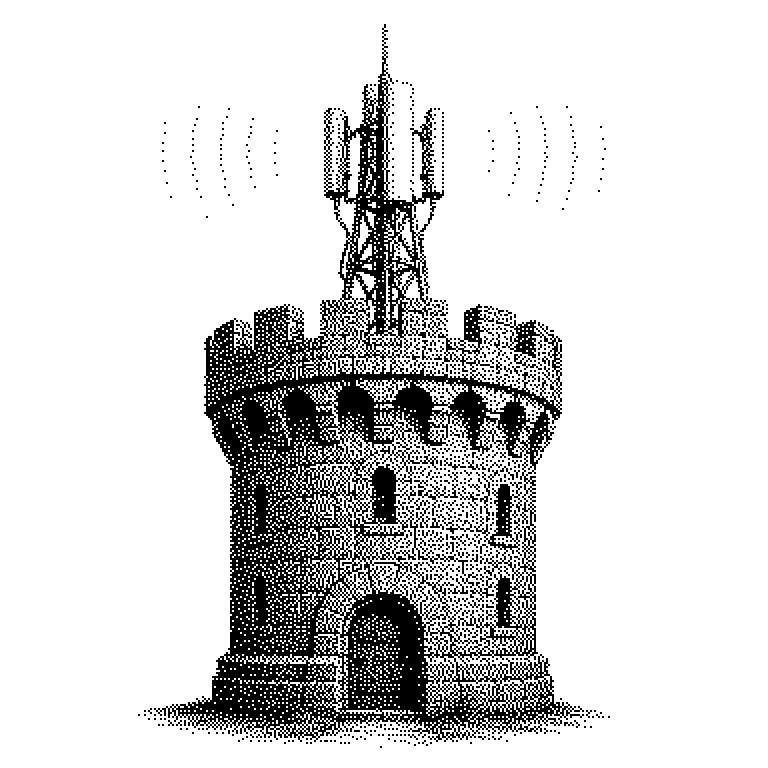
Low-Band Spectrum
Low-band spectrum refers to radio frequencies below roughly one gigahertz that mobile carriers use for networks such as 4G and 5G. These frequencies travel very far and penetrate walls well, but transmit less data per second than higher frequencies.
Mobile phones exchange their data with cell towers via radio waves. Radio waves differ in how fast they oscillate. This number of oscillations is called frequency and is measured in hertz. One gigahertz means one billion oscillations per second. The mobile industry groups all radio waves below about one gigahertz together as low-band spectrum. In Germany, this mainly includes the ranges around 700, 800, and 900 megahertz.
Why slow waves travel far
The lower the frequency, the longer a single wave is. Long waves lose less energy on their way and are stopped less by obstacles. That’s why they pass through house walls, windows, and trees. A single cell tower in the low band can cover areas with a radius of several kilometers.
This is economically decisive. Anyone wanting to serve an entire country needs far fewer towers in the low band than in higher bands. For sparsely populated regions, this is often the only affordable approach. So when a carrier proudly announces that it covers 98 percent of the population with 5G, low-band technology is usually behind it.
That is precisely why these frequencies are scarce and expensive. They are auctioned off by the state, and the usage rights expire after a number of years. When business news reports billions of euros being spent at a frequency auction, it is often about low-band licenses.
The price of long range
Range and data volume stand in conflict with each other. The data rate depends on how wide the allocated frequency segment is. You can imagine it like a road: a wide segment has many lanes, a narrow one only one. Below one gigahertz, the overall space is very limited, because broadcasting, government radio, and other services are also located there.
A carrier typically gets only 10 to 20 megahertz of bandwidth in the low band. In high bands around 3.6 gigahertz, it is often 100 megahertz. The result: 5G in the low band might deliver 100 megabits per second, while in high bands it can easily be ten times as much. The technology is the same, only the space is missing.
On top of that, all users of a radio cell share this space. A tower with a five-kilometer range serves many people at the same time. In a full stadium or train, things therefore quickly slow down, even though the display shows full bars.
Low band in everyday life and in financial reports
You cannot see the low band directly on your phone, but you notice it. If a connection still holds in the basement, in an elevator, or in the countryside, it is almost always running on low frequencies. Phone calls and emergency calls also preferentially rely on these bands, because reliability is more important there than speed.
A common misconception: many automatically assume 5G means fast. A 5G symbol in the low band can feel slower than good 4G in a mid band. Some carriers therefore specially mark higher bands, for example as 5G+ or 5G Ultra. Experts refer to the ranges around 1 to 6 gigahertz as the mid band, and to frequencies above 24 gigahertz as the high band or mmWave.
In corporate announcements, the low band mainly comes up in two contexts: auctions and so-called coverage obligations, meaning government requirements for network coverage. It also plays a major role in the rollout of radio connections for machines, such as electricity meters or sensors in agriculture. Such devices send little data but must be reachable everywhere.