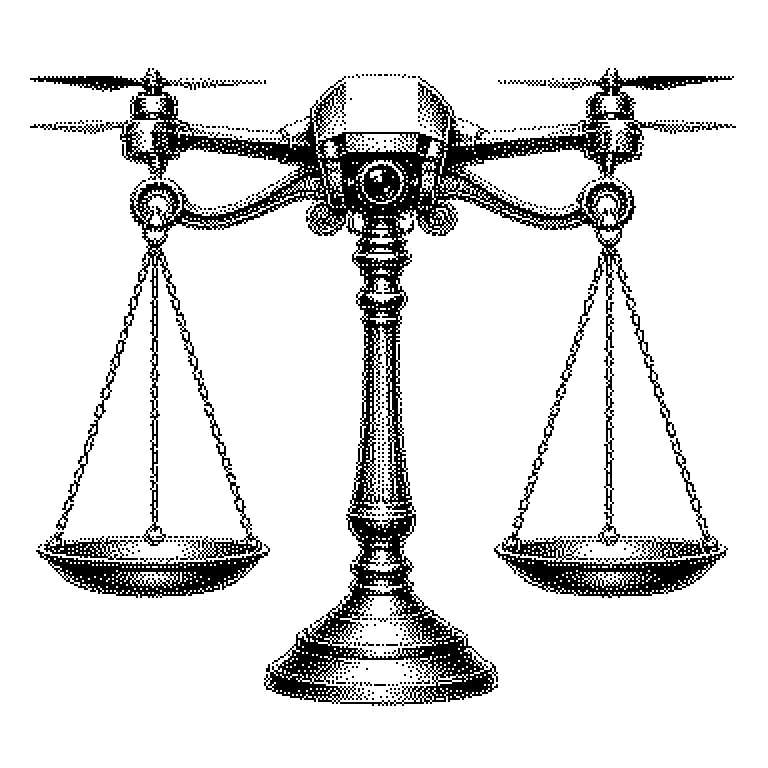
LAWS
LAWS – Lethal Autonomous Weapon Systems – are weapon systems that can independently select and attack targets without a human decision in the individual case. Whether and how such systems should be permitted is one of the most pressing ethical and legal debates in modern arms policy.
LAWS stands for “Lethal Autonomous Weapon Systems.” What is meant are weapons that decide for themselves when and whom to attack – without a human approving or intervening at the decisive moment. What’s special about this is not the technology alone, but the question of who bears responsibility when such a weapon kills. Until now, every use of a weapon involved a human who pulled the trigger or gave an order. With LAWS, this moment disappears. The systems can use cameras and sensors to capture their surroundings, classify objects or people as targets, and act independently – all within seconds.
The Question of Responsibility
The core problem of LAWS is not technical but moral. In the international law of war – the international rules meant to limit warfare – the principle of distinction applies: soldiers must distinguish between combatants and civilians. Humans can grasp context, hesitate, correct mistakes. A machine only does this as well as its algorithm allows.
If an autonomous system mistakenly attacks civilians, it is unclear who should be held accountable. The manufacturer? The commanding general? The programmer? Critics call this gap in the chain of responsibility the “accountability gap.” It is the main reason why more than 70 states are calling for an international ban on LAWS.
Proponents, on the other hand, argue that autonomous systems could act more precisely and coolly than a soldier under stress, exhaustion, or fear. They could thus cause fewer civilian casualties in certain scenarios. This debate is not settled – but it is actively shaping international negotiations right now.
Degrees of Autonomy
Not every automated weapon system is immediately a LAWS. Experts distinguish according to the degree of human control. “Human in the loop” means: a human approves every single shot. “Human on the loop” means: the system acts on its own, but a human can intervene and stop it. “Human out of the loop” means: the machine decides entirely on its own. Only this last level counts as a true LAWS.
Today’s systems, such as Israel’s Iron Dome missile defense or automatic naval guns on warships, already act faster than a human can react. However, they are usually still considered “human on the loop,” because an operator activates the system and can theoretically deactivate it. The boundary is fluid and is the subject of intense discussion in research.
What is decisive for the classification is not speed, but the question of target selection: does a human determine what constitutes a valid target – or does the AI do so itself? A drone strike in which a pilot fires by remote control via joystick is not a LAWS. A drone that independently recognizes a face and fires as a result is.
LAWS in the Current Debate
The term regularly appears in news about armament, AI regulation, and international law. Since 2014, a group of experts at the United Nations in Geneva has been discussing whether a ban treaty is possible – so far without result, because major powers such as the USA, Russia, and China are blocking a binding agreement. In the war in Ukraine and in the Middle East, largely autonomous drones have been deployed for the first time, reigniting the debate.
The topic also plays a role in the tech industry. Google employees successfully protested in 2018 against Project Maven, which involved developing AI image recognition software for the US military. Since then, several major AI labs have published ethical guidelines that partially exclude military applications.
Anyone reading news about AI regulation, drone warfare, or arms exports usually encounters the term LAWS when the question is raised: may a machine decide over life and death? This question is technically solvable – but politically and ethically still completely open.