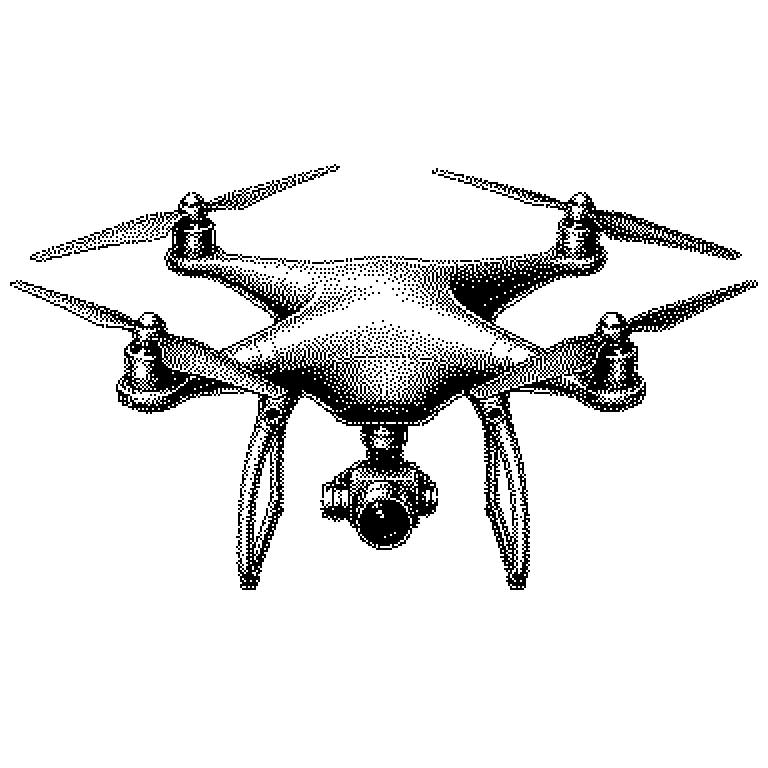
UAV
A UAV is an aircraft with no humans on board, controlled by radio from the ground or by an onboard computer. In everyday language, such devices are usually simply called drones.
UAV stands for “Unmanned Aerial Vehicle,” meaning an aircraft with no humans on board. The pilot either sits on the ground and steers via radio, or an onboard computer flies it itself. In everyday language, most people simply call it a drone. Sizes range from a toy with four rotors to military hardware with the wingspan of an airliner. Technically, people often speak of the larger overall system: the aircraft, ground station, and radio link together form a UAS, an unmanned aircraft system. The one decisive feature is always the same: no one sits inside the device itself.
Why unmanned flight has changed so much
As soon as no human is on board, a whole range of constraints disappear. There’s no need for a cabin, oxygen, or an ejector seat. The device can be built smaller, lighter, and cheaper. And it’s allowed to crash without anyone dying. This is precisely why missions become possible that one would never ask a manned aircraft to perform.
The second point is price. A good camera quadcopter costs a few hundred euros. An hour of helicopter flight for the same aerial images costs many times that. This gives even small businesses access to the bird’s-eye view: roofers, farmers, surveyors, film crews.
Militarily, it has become clear since around 2020 just how much cheap drones change the equation. A device costing a few thousand euros can knock out a tank worth several million. This cost gap is the reason why UAVs have become a constant topic in defense debates and on the stock market.
From remote control to autonomous flight
Technically, a UAV consists of a few basic components. Motors and rotors or wings generate lift. A battery or a small combustion engine supplies energy. Sensors measure attitude, acceleration, altitude, and position via satellite signals. An onboard computer, the flight controller, evaluates these values hundreds of times per second and adjusts the motors accordingly.
Control can be thought of as a ladder of stages. On the lowest rung, a human dictates every movement by radio. One rung higher, the device holds its position on its own and flies previously set waypoints. At the very top stands autonomy: the UAV decides on its own along the way, because the radio link is missing or would be too slow.
This is where AI comes in. Image-processing models run directly on the aircraft and recognize roads, vehicles, or people in the camera feed. Other methods calculate the device’s own position from the camera image when the satellite signal is disrupted. A common misconception is that every drone has such capabilities. Most consumer models simply follow a list of coordinates and, at best, avoid obstacles.
UAVs between construction sites, headlines, and regulation
In civilian everyday life, UAVs have long been a tool. They inspect wind turbines and high-voltage pylons without anyone having to climb. They survey construction sites and fields and deliver images from which software creates maps and volume calculations. In agriculture, they detect from leaf color where fertilizer is needed. Nearly every modern aerial film shot today also comes from a drone.
In Germany and the EU, clear rules apply. Anyone flying more than 250 grams must register and usually complete an online certification. Airports, residential areas, and crowds are off-limits or strictly restricted. Visual line of sight to the device is the norm; anything else requires a permit.
In the news, UAVs currently appear mainly in two contexts: in war reporting and in disruptions to air traffic caused by unidentified flying objects. Economically interesting is the opposite direction: entire companies now build defense systems that detect, jam, or intercept drones. Anyone reading reports on the topic should therefore always check which size class is being discussed. Worlds lie between a 300-gram quadcopter and a reconnaissance drone weighing several tons.